Overview
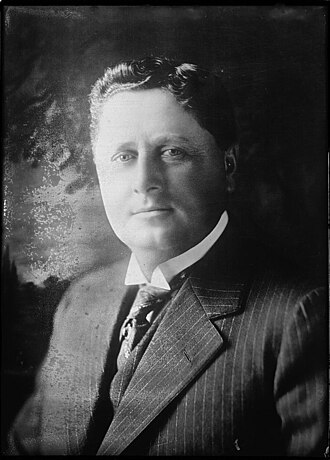
William Wrigley Jr. did not invent chewing gum, and for the first years of his Chicago business he was not even selling it. He was a soap salesman, then a baking-powder salesman, who happened to notice that the little throwaway he tossed in to sweeten a deal was more wanted than the thing he was paid to move [1][3]. When he gave two packages of gum away with each can of baking powder and watched the gum outpull the powder, he had stumbled onto the insight that would organize the rest of his life: the giveaway can be the business [3][4]. In 1892 he began jobbing chewing gum under his own name in Chicago, and by 1893 he had the two brands that would outlive him, Juicy Fruit and Wrigley's Spearmint [1][2].
What made Wrigley was not the gum, which was much like everyone else's, but a near-religious faith in advertising and repetition. His maxim, "tell 'em quick and tell 'em often", was less a slogan than an operating doctrine, and he backed it with money that frightened his own board [1][4]. In the panic year of 1907, with the economy contracting and rivals slashing their budgets, Wrigley did the opposite: he borrowed heavily and poured roughly $250,000 into advertising Spearmint, buying space cheaply in a frightened market [4][5]. Sales climbed steeply over the following two years, and by 1910 Wrigley's Spearmint was the best-selling gum in the United States [1][2].
He then did something no manufacturer had quite dared. In 1915 he had four sticks of gum mailed, unsolicited, to roughly 1.5 million Americans, everyone he could find in the nation's telephone directories, and repeated the stunt in 1919 to a list that had swelled to some 7 million names [1][6]. It was direct-mail sampling on a national scale, decades before the phrase existed, and it printed the green Spearmint arrow and the grinning "Spearmen" into the country's visual memory [6]. Wrigley advertised in barns, on streetcar cards, on billboards, eventually in dozens of languages overseas, on the theory that "there is no such thing as getting a business so established that it does not need to advertise" [1][4].
The five-cent stick built an empire that ranged far beyond gum. Wrigley folded the rival Zeno Manufacturing operation into a single firm, incorporating the Wm. Wrigley Jr. Company and pushing into Canada, Australia, and Britain [1][2]. With the cash flowing in, he bought a controlling interest in the Chicago Cubs, buying out the advertising man Albert Lasker and others to take full command by the mid-1920s; the ballpark was renamed Wrigley Field in his honor in 1926 [1][2]. In 1919 he paid roughly $3 million for a controlling interest in Santa Catalina Island off the California coast and set about turning it into a resort, complete with a casino ballroom and the Cubs' spring-training camp [1][7]. The Wrigley Building, his gleaming white terra-cotta tower on the Chicago River, rose in the early 1920s as the headquarters of the gum business and a permanent advertisement for it [1][2].
By the time he handed the presidency to his son Philip in 1925 and took the chairmanship, Wrigley sat atop one of the most profitable consumer-goods companies in America, with company profits running into the millions and an estimated lifetime advertising outlay north of $100 million [2][5]. He had taken a product worth a penny or two and, through relentless branding, made it worth a fortune. When he died in 1932 his estate was valued at more than $20 million, and the gum still moved on the strength of habits he had spent forty years teaching the public [2][6].
Early Life & Path
William Wrigley Jr. was born September 30, 1861, in Philadelphia, the son of William Wrigley Sr., a soap manufacturer of English Quaker descent, and Mary Ann Ladley Wrigley [1][3]. He was a restless, rule-breaking boy by every account, expelled from school more than once, and at about eleven he ran off to New York, where he hawked newspapers and slept rough for a stretch before drifting home [1][3]. Discipline finally came in the family soap factory, where his father set him to stirring vats and, at thirteen, sent him out on the road as a traveling salesman peddling Wrigley's Scouring Soap through New England and beyond [1][3]. The selling stuck where the schooling never had; he turned out to have an instinct for the trade and a tireless appetite for the road.
In 1891, at twenty-nine, Wrigley arrived in Chicago to set up as a manufacturer's representative, famously with about $32 in his pocket and a $5,000 stake borrowed from an uncle [1][3]. He sold soap, then realized that the premium he was offering to move it, first baking powder, was the thing storekeepers actually wanted, so he switched to selling baking powder and offered gum as the new lure [3][4]. When the gum, in turn, outsold the powder, Wrigley followed the demand one more step and became a gum man. It was a pattern of listening to what customers reached for rather than what he had set out to sell, and it became the foundation of everything he built [3][4].
The gum itself he did not make at first; he contracted with the Zeno Manufacturing Company to produce it while he concentrated on what he did best, branding, distribution, and advertising [1][2]. From the beginning he grasped that in a commodity business where every stick tasted roughly alike, the brand was the product, and the man who shouted longest and loudest would win the shelf [4][5].
Career Timeline
- 1861Born September 30 in Philadelphia, son of soap manufacturer William Wrigley Sr. [1][3].
- 1874At about thirteen, begins working as a traveling salesman for his father's Scouring Soap [1][3].
- 1891Moves to Chicago to sell soap, arriving with roughly $32 and a $5,000 loan from an uncle [1][3].
- 1892Begins selling chewing gum under his own name after the giveaway gum outsells his baking powder [3][4].
- 1893Introduces Juicy Fruit and Wrigley's Spearmint, the brands that will define the company [1][2].
- 1907Borrows heavily and spends some $250,000 advertising Spearmint during the financial panic, buying cheap space as rivals retreat [4][5].
- 1910Wrigley's Spearmint becomes the best-selling chewing gum in the United States [1][2].
- 1911Consolidates the Zeno operation and incorporates the Wm. Wrigley Jr. Company [1][2].
- 1915Mails free sticks of gum to roughly 1.5 million Americans listed in telephone directories [1][6].
- 1919Buys a controlling interest in Santa Catalina Island for about $3 million; repeats the mass gum mailing, now to some 7 million names [1][6][7].
- 1921Gains controlling interest in the Chicago Cubs [1][2].
- 1924Completes the Wrigley Building on the Chicago River as company headquarters [1][2].
- 1925Hands the company presidency to his son Philip K. Wrigley and becomes chairman [2].
- 1926The Cubs' ballpark is renamed Wrigley Field in his honor [1][2].
- 1932Dies January 26 in Phoenix, Arizona; estate valued at more than $20 million [2][6].
Key Ventures & Innovations
Wrigley's Spearmint and Juicy Fruit (1893)
Launched in 1893, these two five-cent brands became the heart of the business. Spearmint in particular was a flavor rivals had failed to make profitable; Wrigley fixed on it, branded it with the green arrow and the "Spearmen," and rode it to the top of the American market by 1910 [1][2].
The 1907 advertising gamble
In the panic of 1907, when competitors cut spending, Wrigley borrowed and poured roughly $250,000 into Spearmint advertising, exploiting the cheap rates of a frightened market. Sales surged over the next two years, a textbook case of counter-cyclical brand building [4][5].
National free-sample mailings (1915, 1919)
Wrigley mailed sticks of gum, unsolicited, to roughly 1.5 million people in 1915 and to some 7 million in 1919, working straight from the nation's telephone books. It was direct-mail sampling at unprecedented scale and seeded demand nationwide [1][6].
The Chicago Cubs and Wrigley Field
Wrigley moved from minority investor to controlling owner of the Cubs by 1921, buying out partners including ad man Albert Lasker. The park was renamed Wrigley Field in 1926; the team also trained on his Catalina Island [1][2].
Santa Catalina Island
In 1919 Wrigley paid about $3 million for a controlling interest in the island off Southern California, then spent lavishly to make it a resort, gardens, a steamship line, and the landmark Catalina Casino ballroom, and a personal kingdom [1][7].
“Tell 'em quick and tell 'em often.”
From the Record
“When two men always agree, one of them is unnecessary.”
“His moral and physical courage, his steady perseverance and unfailing good humor and optimism, his love of hard work and good old-fashioned American grit and gumption, his faith in his fellow man, all these qualities are strong in William Wrigley, Jr. Because of them he succeeded, where countless failed.”
“You must have a good product in the first place and something people want. Explain to folks plainly and sincerely what you have to sell, do it in as few words as possible, and keep everlastingly coming at them.”
What Operators Can Learn
- 01
Sell what the customer actually reaches for
Wrigley set out to sell soap, then baking powder, but each time he watched buyers prize the giveaway over the goods, and each time he followed the demand. The willingness to abandon his plan for the customer's preference is how he ended up in gum at all.
- 02
The brand is the product when the products are alike
Gum was a commodity; one stick tasted much like another. Wrigley won not on formula but on relentless, repetitive advertising that made his name the default, proof that in a parity market, mindshare is the moat.
- 03
Spend hardest when everyone else retreats
His 1907 gamble, borrowing to advertise heavily into a depression while rivals went quiet, bought cheap attention and lasting share. Downturns can be the cheapest time to buy a customer's habit.
- 04
Habit compounds; keep coming at them
"Keep everlastingly coming at them," he said, and he meant it literally, barns, streetcars, billboards, and millions of free samples. He treated demand not as a thing you capture once but as a habit you must keep watering forever.
Legacy
Wrigley's lasting contribution was less to confectionery than to marketing. He showed that a near-worthless commodity could be transformed into a national fortune by branding and saturation advertising alone, and he pioneered techniques, counter-cyclical ad spending, mass free sampling, the cultivated impulse buy at the cash register, that became staples of consumer-goods strategy [4][5][6]. The company he built remained the world's largest chewing-gum maker for generations and stayed in family hands until it was sold to Mars in 2008, long after his death [1][2].
His name outlived the gum in brick and turf. The Wrigley Building still anchors the north bank of the Chicago River, and Wrigley Field, named for him in 1926, is one of the most beloved ballparks in America [1][2]. On Catalina Island, the resort he willed into being survives as a tourist destination, and he himself was first entombed there in the tower of the Wrigley Memorial above Avalon [7]. Historians of business now treat him as a key figure in the rise of modern branding, a man who, as the scholar Daniel Robinson argued, "made meanings" as much as he made gum, attaching to a five-cent stick a whole apparatus of imagery and habit [4]. The contradictions of mass advertising he helped invent are still with us; so is the product, still sold on the strength of appetites he spent a lifetime manufacturing [4][6].
Further Reading
Famous Leaders of Industry (Second Series), Edwin Wildman (1921)
A contemporary profile of Wrigley written near the height of his career, full of his own maxims and the period's idiom, a primary window onto the self-made-man myth he embodied.
Biographical Dictionary of American Business Leaders, John N. Ingham (1983)
A reliable, densely sourced scholarly entry tracing Wrigley from the soap trade through the gum empire, the Cubs, and Catalina.
Marketing Gum, Making Meanings: Wrigley in North America, 1890–1930 (Enterprise & Society), Daniel Robinson (2004)
The best modern academic treatment, reading Wrigley's advertising and the Spearmen as a case study in the making of consumer meaning.
The Fortune Builders, Edwin Darby (1986)
A popular history of Chicago's great business families, including the Wrigleys, with color on the fortune and the dynasty.
Business Builders in Sweets and Treats, Nathan Aaseng (2005)
An accessible narrative history of confectionery entrepreneurs that places Wrigley's marketing innovations in context alongside his peers.
Sources
- 1.Nathan Aaseng, Business Builders in Sweets and Treats, The Oliver Press, 2005, book
- 2.Edwin Wildman, Famous Leaders of Industry (Second Series): The Life Stories of Boys Who Have Succeeded, The Page Company, 1921, book
- 3.John N. Ingham, Biographical Dictionary of American Business Leaders, Greenwood Press, 1983, book
- 4.Daniel Robinson, Marketing Gum, Making Meanings: Wrigley in North America, 1890–1930, Enterprise & Society, Vol. 5, No. 1 (Cambridge University Press), 2004, pp. 4–44, journal
- 5.Neil M. Clark, “"Spunk Never Cost a Man a Job Worth Having" (interview with William Wrigley Jr.)”, The American Magazine, Vol. 111, No. 3, March 1931, p. 63, archive
- 6.“Business: Death of Wrigley”, Time, February 8, 1932, newspaper
- 7.“Wrigley Memorial & Botanic Garden / Santa Catalina Island history”, Catalina Island Conservancy, n.d., archive
- 8.Edwin Darby, The Fortune Builders, Doubleday, 1986, book
- 9.“William Wrigley, Jr. (Chewing Gum, Businessman, Entrepreneur)”, Britannica Money, 2024
Researched and written with Claude + live web search.