Overview
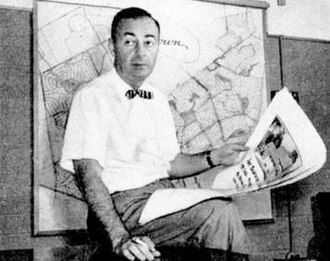
William Levitt did not invent the suburb, the tract house, or prefabrication, and he was not even the most original builder of his era [1]. What he did was rarer: he took the American single-family home, the most expensive thing most families would ever buy, and reorganized its production so ruthlessly that a returning veteran could move into a new house on Long Island for $7,990, with nothing down and a monthly payment lower than rent [1][2][6]. Time and Fortune would name him one of the most consequential businessmen of the twentieth century, and the press reached, again and again, for the same comparison: he was the Henry Ford of housing [1][2].
Levitt & Sons had been founded in 1929 by his father, Abraham, a Brooklyn real-estate lawyer, with William as the salesman-president at twenty-two and his younger brother Alfred as the in-house designer [3][7]. Before the war they built handsome, conventional houses for the Long Island middle class [3]. The transformation came from a wartime emergency contract to throw up defense housing near Norfolk, Virginia, where Levitt learned to strip homebuilding down to a sequence of repeatable motions [3][7]. When the GIs came home to a national shortage of millions of dwellings, he was ready [4][6].
On the potato fields of Hempstead, Long Island, beginning July 1, 1947, his crews broke construction into roughly twenty-six discrete operations, each performed by a specialized team that moved house to house while the houses stood still, the assembly line turned inside out [1][2][5]. He poured slabs instead of digging basements, pre-cut lumber and pre-assembled plumbing at a central yard, bought his own forest and built his own nail factory to dodge shortages, and shut out the building unions [2][3][5]. At peak the operation finished a house roughly every fifteen or sixteen minutes and turned out more than 17,000 of them in under five years [2][5][6]. "We are not builders," Levitt said. "We are manufacturers" [1][5].
He sold the houses as fast as he built them, and sold an ideology with them. "No man who owns his own house and lot can be a Communist," he liked to say. "He has too much to do" [4][8]. But the dream he mass-produced came with a clause printed in the lease: the house was "not to be used or occupied by any person other than members of the Caucasian race" [9][10]. Levitt, himself Jewish, and stung by the genteel antisemitism that had once barred Jews from the very Gold Coast he built on, refused to sell to Black families and defended the policy in plain commercial terms: "We can solve a housing problem, or we can solve a racial problem," he told the Saturday Evening Post in 1954, "but we cannot combine the two" [1][8][9].
The second act was a long fall. In July 1967 Levitt sold the company to the conglomerate ITT for about $92 million, most of it in ITT stock, accepting a non-compete that kept him out of U.S. homebuilding for years [1][3]. The stock collapsed, the deals abroad, Iran, Nigeria, Venezuela, Florida, failed one after another, and by the late 1980s the man who had housed a generation was looting his own family foundation to stay afloat [1][3]. New York's attorney general forced an $11 million settlement; Levitt died in 1994, in a hospital wing his own foundation gifts had helped build, his fortune gone [1][8].
Historians now hold the two halves together: Levitt democratized homeownership for millions of white families and, in the same stroke, helped engineer the racial wealth gap and the segregated metropolis that still define America [1][9]. His houses were a triumph of method. His covenants were a deliberate design feature, not an accident, and among the most enduring parts of the legacy [1][9].
Early Life & Path
William Jaird Levitt was born February 11, 1907, in Brooklyn, the elder son of Abraham Levitt, a self-made real-estate attorney whose own father was a Russian-born rabbi, and Pauline Biederman [3][7]. The household prized education and salesmanship in equal measure, and William inherited the second more than the first. He entered New York University around 1924 to study English but left in his junior year, restless and convinced, correctly, as it turned out, that he could make money faster than he could finish a degree [3][7].
The family business began in 1929, when Abraham, William, and the younger, more bookish Alfred formed Levitt & Sons [3][7]. The division of labor that would define the firm was set early: Abraham presided and handled the landscaping he loved, Alfred taught himself architecture and drew the houses, and William, president before he was twenty-three, ran sales, advertising, and financing, the public face and the closer [3][7]. Through the Depression they built upscale Tudor and colonial homes on Long Island's North Shore, including the Strathmore development in Manhasset, where houses sold for well over $10,000 [3][7].
The pivot to mass production came in uniform and under deadline. In 1941 the firm took a government contract to build some 2,350 units of war-worker housing near Norfolk, Virginia; the job was punishing and the margins thin, but it forced Levitt to learn how to build cheap and fast at scale [3][7]. Then William himself joined the Navy's Seabees, serving as a lieutenant in the construction battalions in the Pacific, where he absorbed more about logistics and the standardization of building [1][3][7]. He came out of the war with a method, a hunch about the coming GI housing famine, and the nerve to bet the company on both [4][6].
Career Timeline
- 1907Born February 11 in Brooklyn, New York, elder son of Abraham and Pauline Levitt [3][7].
- 1929Levitt & Sons founded; William becomes president at twenty-two, with brother Alfred as designer and father Abraham presiding [3][7].
- 1934–1941Builds upscale Long Island homes, including the Strathmore development in Manhasset [3][7].
- 1941Takes a wartime contract to build ~2,350 defense-housing units near Norfolk, Virginia, learning to mass-produce houses [3][7].
- 1944–1945Serves as a lieutenant in the U.S. Navy Seabees in the Pacific, absorbing large-scale construction logistics [1][3][7].
- 1947Breaks ground July 1 on the first Levittown, on former potato fields in Hempstead, Long Island [1][6].
- 1948–1951Crews complete a house roughly every 15–16 minutes at peak, building more than 17,000 homes in under five years [2][5][6].
- 1949Switches from rentals to sales; thousands of veterans line up, reportedly 1,400 houses sold in a single day [5][6].
- 1950Featured on the cover of Time, July 3, as the symbol of postwar suburban housing [1][2].
- 1952Begins the second Levittown in Bucks County, Pennsylvania; later builds Willingboro, New Jersey, and Bowie, Maryland [3][7].
- 1954Defends excluding Black buyers in the Saturday Evening Post: "we can solve a housing problem, or we can solve a racial problem, but we cannot combine the two" [1][8][9].
- 1960Levitt & Sons goes public on the New York Stock Exchange [3][7].
- 1967Sells the company to ITT in July for about $92 million, mostly in ITT stock, with a non-compete clause [1][3].
- 1990–1992New York Attorney General Robert Abrams accuses Levitt of looting the family foundation; he agrees to an ~$11 million settlement [1][8].
- 1994Dies January 28 of kidney failure at North Shore University Hospital, Manhasset, age 86, his fortune largely gone [1][8].
Key Ventures & Innovations
Strathmore and the pre-war Long Island houses
Through the 1930s Levitt & Sons built conventional upscale homes on Long Island's North Shore, including the Strathmore development in Manhasset, where the firm learned the development business and Abraham's landscaping became a signature [3][7].
Norfolk defense housing (1941)
A grueling wartime contract for some 2,350 war-worker units near Norfolk, Virginia, forced Levitt to strip homebuilding into repeatable steps and build cheaply at scale, the rehearsal for everything that followed [3][7].
Levittown, Long Island (1947)
On former potato fields, Levitt broke construction into roughly twenty-six specialized operations, poured slabs instead of basements, vertically integrated supply (his own lumber mill, cement, and nail factory), and shut out unions, finishing a house about every fifteen minutes and building 17,000-plus in under five years, priced at $7,990 with nothing down for veterans [1][2][5][6].
The whites-only covenant
Levitt's leases barred occupancy by anyone "other than members of the Caucasian race," and he refused to sell to Black families across his developments, a deliberate policy he defended commercially and fought to keep even as courts and the NAACP challenged it [1][9][10].
The later Levittowns and going public
Levitt replicated the model in Bucks County, Pennsylvania (1952), Willingboro, New Jersey, and Bowie, Maryland, took the company public in 1960, and turned it into a national homebuilding brand [3][7].
The ITT sale (1967) and the overseas ventures
Levitt sold the company to ITT for roughly $92 million, mostly in ITT stock, and accepted a non-compete; the stock cratered and his later projects in Iran, Nigeria, Venezuela, and Florida failed, unwinding his fortune [1][3].
“No man who owns his own house and lot can be a Communist. He has too much to do.”
From the Record
“No man who owns his own house and lot can be a Communist. He has too much to do.”
“We can solve a housing problem, or we can solve a racial problem. But we cannot combine the two.”
“not to be used or occupied by any person other than members of the Caucasian race”
“When cement was unavailable in this country we chartered a boat and brought it in from Europe. When lumber was in short supply, we bought a forest in California and built a mill. When nails were hard to come by, we set up a factory in our backyard and made them ourselves.”
What Operators Can Learn
- 01
Reorganize the process, not just the product
Levitt's breakthrough was not a better house but a better way to make it: break the work into specialized, repeatable steps and let crews flow through the houses. The same logic that cut auto costs could cut housing costs, if someone was willing to rethink the whole sequence.
- 02
Control your supply chain when the market is short
By buying his own forest, milling his own lumber, and making his own nails, Levitt turned postwar scarcity into an advantage. Owning the inputs let him keep building and keep prices low while rivals waited on deliveries.
- 03
A business decision can be a moral catastrophe
Levitt framed exclusion as neutral commerce, solve housing or solve race, not both. But the whites-only covenant was a choice with generational consequences, helping build the racial wealth gap. Efficiency is not a defense for the ends it serves.
- 04
The skill that builds the empire may not transfer
Levitt's genius was a specific method matched to a specific moment, a domestic housing famine, GI Bill financing, cheap suburban land. Cut loose from that context, in foreign markets and conglomerate finance, the magic failed and the fortune evaporated.
Legacy
Levitt's method outlasted his company. The idea that a house could be a manufactured good, standardized, financed, and sold at volume to ordinary wage-earners, became the template for postwar American development, and the suburb he scaled rewired where and how the country lived [1][2]. For millions of white families, a Levittown house was the on-ramp to the middle class: an appreciating asset, a school district, an inheritance [1][6].
That same achievement carries an inseparable shadow. Levitt's whites-only covenants and his refusal to sell to Black buyers were not incidental to the model but built into it, and historians now credit him with helping engineer the segregated metropolis and the durable wealth gap between white and Black families [1][9]. The best recent scholarship insists on naming both at once: a democratizer of homeownership and an architect of exclusion [1][9].
The man himself ended as a cautionary tale. Having sold his life's work to ITT for stock that collapsed, then failing abroad and at home, William Levitt died in 1994 with his fortune gone, having drained the very foundation that bore his name, a fall as instructive, in its way, as the rise [1][8].
Further Reading
Perfect Communities: Levitt, Levittown, and the Dream of White Suburbia, Edward Berenson (2025)
The definitive modern biography, meticulous on both Levitt's production genius and the racial exclusion built into his model.
Levittown: Two Families, One Tycoon, and the Fight for Civil Rights in America's Legendary Suburb, David Kushner (2009)
A gripping narrative of the integration of Levittown, Pennsylvania, anchored in the covenant fight and the families who broke it.
The Levittowners: Ways of Life and Politics in a New Suburban Community, Herbert J. Gans (1967)
A landmark sociological study by a scholar who actually lived in Levittown, New Jersey, a sympathetic counterweight to the suburb's critics.
Crabgrass Frontier: The Suburbanization of the United States, Kenneth T. Jackson (1985)
The standard history of American suburbanization, essential for placing Levitt within federal policy, the GI Bill, and FHA redlining.
Triumph of the City, Edward Glaeser (2011)
An economist's appraisal of Levitt's mass-production housing and its lasting effect on affordability and urban form.
Sources
- 1.Edward Berenson, Perfect Communities: Levitt, Levittown, and the Dream of White Suburbia, Yale University Press, 2025, book
- 2.Edward Berenson, William Levitt, the Henry Ford of Housing, Yale University Press (essay), 2025, journal
- 3.“William Jaird Levitt (biography)”, Encyclopedia.com, 2004
- 4.Edward Glaeser, Triumph of the City: How Our Greatest Invention Makes Us Richer, Smarter, Greener, Healthier, and Happier, Penguin Press, 2011, book
- 5.Brian Potter, Why Levittown Didn't Revolutionize Homebuilding, Construction Physics, 2021, journal
- 6.American Heritage, The Buy of the Century, American Heritage, Vol. 44, Issue 4, 1993, journal
- 7.Associated Press, “Suburb Pioneer William Levitt Dies (obituary)”, Roanoke Times, January 29, 1994, newspaper
- 8.Richard Lacayo, Suburban Legend: William Levitt, Time (Time 100: Builders & Titans), 1998, journal
- 9.David Kushner, Levittown: Two Families, One Tycoon, and the Fight for Civil Rights in America's Legendary Suburb, Walker & Company / Bloomsbury, 2009, book
- 10.“Restrictive racial covenant in Levitt & Sons leases ("members of the Caucasian race")”, Quoted in Long Island History Journal review of Kushner, Levittown, 1947, archive
Researched and written with Claude + live web search.