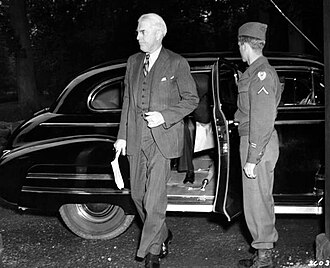
Overview
William Lockhart Clayton built no factory and patented no machine, yet he assembled one of the most formidable commercial organizations of the early twentieth century: Anderson, Clayton and Company, the largest cotton-trading enterprise on earth [1][2]. The partnership was struck in Oklahoma City on August 1, 1904, among three brothers-in-law and brothers, Frank E. Anderson and Monroe D. Anderson on one side, Clayton and, soon, his younger brother Benjamin on the other, to buy and sell raw cotton on the world's markets [1][6]. Clayton brought the trading brain; Monroe Anderson the banker's ledger; Ben Clayton the knowledge of rails and steamships [1]. Within a generation the firm would handle, in a poor year, two million bales of American cotton and own gins, presses, oil mills, and warehouses on four continents [4][3].
Clayton's instrument was not the machine but the market. A cotton merchant, unlike a speculator, hedged: he bought real cotton and simultaneously sold futures contracts short, so that a fall in price cost him nothing on his inventory while his insurance held [6]. Around that discipline Clayton built a system. In the 1920s he led the fight that forced the New York futures exchanges to accept "Southern delivery", letting traders settle contracts at Gulf ports rather than only New York, a change that broke a long northern monopoly on the cotton trade and pulled the center of gravity toward Houston [6]. The firm relocated its headquarters there in 1916 to sit beside the new deep-water Ship Channel [1][6].
What made Anderson, Clayton extraordinary was its reach backward and forward along the cotton chain. By 1940 the company could meet an American grower at every stage, financing the crop, ginning it, compressing and warehousing it, crushing the seed into salad oil and shortening and cattle feed, and shipping the lint to mills in Liverpool, Osaka, or Shanghai [1][6]. By 1945 Fortune called it the largest buyer, seller, storer, and shipper of raw cotton in the world, operating 223 gins, 33 cottonseed-oil plants, and 123 warehouses [3]. The firm even pioneered politically charged commerce, negotiating cotton sales to the Soviet textile trust in 1923, years before Washington recognized Moscow [2].
Clayton was, at heart, an apostle of free trade, and he stated the creed with a merchant's bluntness: the only honest regulator of a great world commodity, he held, was "the corrective influences of competitive price levels established in the free markets of the world, a harsh method, perhaps, but the only one that works" [4]. That conviction first set him against Franklin Roosevelt's New Deal crop controls, then drew him into government when he saw the administration turn toward reciprocal trade [2][8].
In 1940 Clayton left Houston for Washington and never fully returned to commerce [1][7]. Through a string of wartime posts and then as the first Assistant, later Under, Secretary of State for Economic Affairs, he became one of the principal architects of the postwar economic order: the reciprocal-tariff program, the institutions that became the GATT, and, above all, the European Recovery Program [7][2]. After a 1947 tour of a starving, dollar-short Europe, Clayton wrote the memorandum that helped move George Marshall to act [5][7]. The cotton man's faith, that open trade and prosperity were the surest barriers against war and revolution, had become American foreign policy [7][5].
He was a self-effacing figure who, his admiring biographer-daughter noted, never wrote his memoirs or cultivated a chronicler, and he is far less remembered than the policy he helped father [8][7]. But the arc is rare in American business: a man who left school at thirteen, learned shorthand by lamplight, cornered a global commodity, and then spent the authority that fortune bought him on the reconstruction of a continent [8][1][7].
Early Life & Path
He was born February 7, 1880, on a hardscrabble farm near Tupelo, Mississippi, the son of James Munroe Clayton and Martha Fletcher Burdine Clayton; the family moved when he was a boy to Jackson, Tennessee [1]. Formal schooling ended early. Clayton completed only seven grades and quit at thirteen, but he was relentless and quick: he taught himself shorthand at night and turned the skill into a livelihood, working as a deputy clerk and public stenographer [1][8].
The shorthand was his ladder. In 1895, at fifteen, he became secretary to Jerome Hill of the cotton-compress business in St. Louis, and the following year he followed Hill to New York as an employee of the American Cotton Company [1][8]. There the farm boy with a steno pad climbed fast in the rough trade of raw cotton, rising by 1904 to assistant general manager of the firm's New York office [1]. He had married Susan Vaughan of Clinton, Kentucky, in 1902, a partnership that would endure through decades of his absence on cotton's business and the nation's [1].
In 1904 Clayton gambled on himself. He left the security of the American Cotton Company to join with Monroe and Frank Anderson, Frank had married Clayton's sister, in a new partnership of their own, capitalized on little more than nerve, expertise, and credit, and operating first out of Oklahoma City [1][6]. He was twenty-four. The name on the door, Anderson, Clayton and Company, would within his lifetime become a byword for cotton across the trading capitals of the world [1][3].
Career Timeline
- 1880Born February 7 on a farm near Tupelo, Mississippi; family later moves to Jackson, Tennessee [1].
- 1893Leaves school after the seventh grade at age thirteen; studies shorthand at night to work as a stenographer [1][8].
- 1895At fifteen, becomes secretary to Jerome Hill in the St. Louis cotton-compress trade [1][8].
- 1896Follows Hill to New York with the American Cotton Company, rising to assistant general manager by 1904 [1].
- 1902Marries Susan Vaughan of Clinton, Kentucky, on August 14 [1].
- 1904Founds Anderson, Clayton and Company in Oklahoma City on August 1 with Frank E. and Monroe D. Anderson [1][6].
- 1905His brother Benjamin Clayton, an expert in rail and steamship transport, joins the firm [1].
- 1916Moves the headquarters to Houston to be near the deep-water Houston Ship Channel [1][6].
- 1920sWins the fight to make the New York futures exchanges accept "Southern delivery" at Gulf ports, breaking a northern monopoly [6].
- 1923Negotiates cotton sales to the Soviet textile trust, years before U.S. recognition of the USSR [2].
- 1936TIME profiles the firm as a cotton colossus; by now it routinely handles around two million bales a year [4].
- 1940Leaves Houston for Washington as deputy to the coordinator of inter-American affairs, beginning his government career [1][7].
- 1944Named the first Assistant Secretary of State for Economic Affairs in December [7][2].
- 1947Writes the "European Crisis" memorandum after touring a destitute Europe, a key spur to the Marshall Plan; resigns in October [5][7].
- 1966Dies February 8 in Houston, one day after his eighty-sixth birthday; buried in Glenwood Cemetery [1].
Key Ventures & Innovations
Anderson, Clayton and Company (1904)
A cotton-buying partnership begun in Oklahoma City with the Anderson brothers and, soon, Ben Clayton. Clayton supplied the trading instinct, Monroe Anderson the finance, and Ben the transport know-how; the firm grew into the largest cotton-trading house in the world [1][6][3].
Disciplined hedging
The merchant's edge: own physical cotton and sell futures short, rolling contracts forward (July into October) to keep the price insurance in force. Hedging, not speculation, let the firm trade at vast scale without being broken by price swings [6].
The fight for "Southern delivery"
In the 1920s Clayton forced the New York futures exchanges to accept delivery of cotton at Gulf ports rather than only New York, ending a long-standing northern advantage and helping make Houston a center of the world cotton trade [6].
Vertical integration of the cotton chain
By 1940 the firm financed growers, ginned and compressed their cotton, warehoused it, crushed the seed into oils and feed, and shipped the lint worldwide. By 1945 it ran 223 gins, 33 oil plants, and 123 warehouses [1][6][3].
Global and political reach
Trading offices spread to Europe, Egypt, India, and China by the mid-1920s, with later subsidiaries in South America. The firm even sold cotton to the Soviet textile trust in 1923, anticipating commerce that politics had not yet sanctioned [1][2].
“There is only one means of preserving a correct balance between supply and demand in a great world commodity like cotton, and that is through the corrective influences of competitive price levels established in the free markets of the world, a harsh method, perhaps, but the only one that works.”
From the Record
“There is only one means of preserving a correct balance between supply and demand in a great world commodity like cotton, and that is through the corrective influences of competitive price levels established in the free markets of the world, a harsh method, perhaps, but the only one that works.”
“The reins of world leadership are fast slipping from Britain's competent, but now very weak hands. These reins will be picked up either by the United States or by Russia. If by Russia, there will almost certainly be a war in the next decade or so, with the odds against us. If by the United States, war can almost certainly be prevented.”
“It is now obvious that we have grossly underestimated the destruction of the European economy by the war.”
What Operators Can Learn
- 01
Insure your position before you scale it
Clayton's empire rested on hedging, not betting. By owning physical cotton while selling futures short, he could trade two million bales a year without a price swing destroying him. Scale was safe only because the downside was covered.
- 02
Own the chain, not just the trade
Anyone could buy and sell a bale. Clayton's durable advantage came from financing, ginning, warehousing, crushing, and shipping, controlling cotton from the grower's field to the foreign mill so that margin lived at every link.
- 03
A skill learned at the bottom can carry you to the top
A seventh-grade dropout taught himself shorthand by lamplight; that stenographer's notebook put him at the elbow of cotton men and launched a global career. Master the unglamorous skill that gets you into the room.
- 04
Convictions outlast the business that formed them
The free-trade faith Clayton learned hedging world cotton became, decades later, the intellectual spine of the Marshall Plan. The principles you forge running a business can end up shaping far larger things.
Legacy
Clayton's commercial monument, Anderson, Clayton and Company, long outlived its founder, diversifying into branded foods and insurance before being absorbed by Quaker Oats in the 1980s, but its deeper legacy was institutional: it showed that a trading firm, by integrating finance, processing, storage, and shipping, could organize a sprawling global commodity with a precision once thought impossible [1][3]. The fortune the cotton trade generated also seeded one of America's great philanthropies, for it was Clayton's partner Monroe D. Anderson whose estate created the foundation behind the University of Texas MD Anderson Cancer Center in Houston [2][1].
Clayton's larger claim on history lies in Washington. The merchant's belief that open markets and shared prosperity were the surest defenses against war and revolution made him, more than almost any other figure, the economic conscience of America's postwar order, a principal architect of reciprocal trade, of the institutions that grew into the GATT, and of the European Recovery Program itself [7][2][5]. His 1947 warnings helped convince George Marshall and Harry Truman that Europe could not be left to collapse [5][7].
Yet he remains curiously obscure, a self-effacing man who declined the limelight and never wrote his memoirs; his own daughter penned the first biography precisely because no one else had [8][7]. Memorials carry his name in international economics at Johns Hopkins, the Fletcher School, and Rice's Baker Institute, fitting tributes to a cotton trader who came to believe that commerce, rightly freed, could keep the peace [7][8].
Further Reading
Will Clayton: A Short Biography, Ellen Clayton Garwood (1958)
The first life, written by Clayton's daughter, intimate on his early cotton years and indispensable for the family record, if necessarily admiring.
Our Finest Hour: Will Clayton, the Marshall Plan, and the Triumph of Democracy, Gregory A. Fossedal (1993)
The fullest modern biography, framing Clayton as the underappreciated economic architect of the postwar order.
Selected Papers of Will Clayton, Frederick J. Dobney (ed.) (1971)
Clayton in his own words, memoranda, letters, and speeches, including his free-trade and Marshall Plan writings.
King Cotton in Modern America: A Cultural, Political, and Economic History since 1945, D. Clayton Brown (2011)
Context for the cotton economy in which Anderson, Clayton operated and the forces that reshaped it after Clayton's era.
Sources
- 1.Texas State Historical Association, “Clayton, William Lockhart (Handbook of Texas) and Anderson, Clayton and Company (Handbook of Texas)”, Texas State Historical Association, Handbook of Texas Online, accessed 2026, archive
- 2.“William L. Clayton”, Wikipedia, accessed 2026
- 3.Anderson, Clayton & Co. characterized as the largest buyer, seller, storer, and shipper of raw cotton in the world (223 gins, 33 cottonseed-oil plants, 123 warehouses), Fortune, 1945, journal
- 4.“"Business: Cotton & King", profile of Anderson, Clayton & Co.”, TIME, August 17, 1936, newspaper
- 5.“Will L. Clayton Papers (incl. the 1947 "European Crisis" memorandum and related postwar economic policy papers)”, Harry S. Truman Presidential Library & Museum, 1947, archive
- 6.Texas State Historical Association, “Anderson, Clayton and Company, history, hedging methods, and the "Southern delivery" futures fight (Handbook of Texas)”, Texas State Historical Association, Handbook of Texas Online, accessed 2026, archive
- 7.Gregory A. Fossedal, Our Finest Hour: Will Clayton, the Marshall Plan, and the Triumph of Democracy, Hoover Institution Press, 1993, book
- 8.Ellen Clayton Garwood, Will Clayton: A Short Biography, University of Texas Press, 1958, book
- 9.Frederick J. Dobney (ed.), Selected Papers of Will Clayton, Johns Hopkins University Press, 1971, book
Researched and written with Claude + live web search.