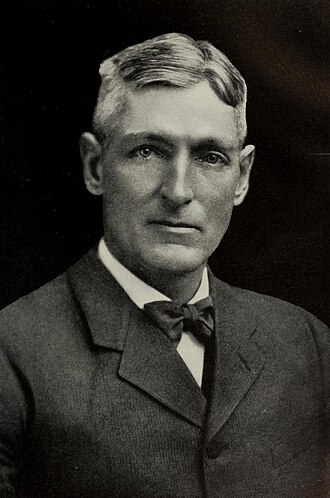
Overview
William Cooper Procter inherited a soap company and a famous name, and might easily have spent his life as a comfortable Cincinnati gentleman collecting dividends from Ivory [5][6]. Instead, the grandson of one of the firm's two founders turned Procter & Gamble into a laboratory for a radical proposition: that the surest path to industrial peace and rising output was to make the worker a partner, first in the profits, then in the stock, and finally in the security of his own job [5][6][7]. Over a career that ran from the factory floor in 1883 to the chairmanship he held until his death in 1934, he carried the company from a regional soap maker into one of the great consumer-products corporations of America, with sales rising from roughly $20 million when he became president in 1907 to more than $200 million by the time he stepped down as chief executive in 1930 [5][6].
The idea that defined him arrived early and was greeted as folly. Troubled by recurring strikes, the young Procter pushed the firm in the mid-1880s to shorten hours, and in 1887 he persuaded the partners to do something stranger still, to hand every employee a semi-annual "dividend" pegged to the company's profits and to the worker's own wages [2][7]. When he first proposed it, by one contemporary account, "the family thought he had lost his senses" [7]. He made the twice-yearly distribution an institution, gathering the workforce to hand out the checks and to deliver a plain-spoken sermon on where profit came from [5].
Profit-sharing alone, Procter found, did not bind men to the company, because the cash was too easily spent and felt like found money [7]. So he kept revising. In 1903 he tied the profit-share to ownership of actual Procter & Gamble stock, with the company adding to what a worker set aside, until employees held a meaningful slice of the firm they worked for; by 1915 roughly 61 percent of the workforce was taking part [1][7]. The logic was nakedly practical as well as paternal: a man who owned shares, Procter reasoned, would not walk out on his own dividend [1][6].
From there the innovations came in a steady file, each aimed at binding the worker to the work, a Saturday half-holiday at full pay, the eight-hour day, sickness and life insurance, a disability pension, and in 1918 a Conference Plan that put elected worker representatives in dialogue with management, with employee representation eventually reaching the board [5][6]. The capstone came on August 1, 1923, when Procter announced Guaranteed Employment: any worker with six months' service who participated in profit-sharing was promised at least forty-eight weeks of work a year [1][6]. To make the pledge affordable he attacked the root cause of seasonal layoffs, pushing P&G to sell directly to retailers and smooth its own production. "Five years ago," he later observed, "the sales curve showed a series of mountains and gorges. Today the manufacturing and employment curves are straight horizontal lines" [1].
Procter was no firebrand reformer; he was a hard-headed manufacturer who happened to believe that fairness paid. He prized cost reduction over sentiment and ran a tightly held, family-dominated firm whose progressivism was designed in part to make a union unnecessary [6][7]. "The first job we have," he told his workers on a dividend day, "is to turn out quality merchandise that consumers will buy and keep on buying" [3]. The dividend, in his logic, was the reward for doing exactly that. In 1911 the company launched Crisco, the first all-vegetable shortening, and backed it with the kind of national advertising that would make P&G the most relentless brand-builder in America [5][6].
Beyond Ivorydale he was a civic monument in his own right, an Episcopal warden, a colonel of the Ohio National Guard who relished being called "the Colonel," head of Cincinnati's Red Cross chapter for two decades, and a philanthropist who poured the soap fortune into Princeton's Graduate College and Cincinnati's Children's Hospital [5][6][8][9]. When he died in 1934, the country had absorbed his methods as a model of welfare capitalism, a private, paternalist answer to the labor question that the New Deal would soon begin to nationalize [5][6].
Early Life & Path
William Cooper Procter was born on August 25, 1862, in Glendale, a leafy railroad suburb north of Cincinnati, the only son among the children of William Alexander Procter and Charlotte Jackson Procter, and a grandson of William Procter, the English-born candlemaker who in 1837 had joined his brother-in-law James Gamble to found the firm [5][6]. He grew up in Glendale, attended the local elementary school, commuted into the city to Hughes High School, and went east to Princeton, from which he graduated in 1883 [5][8].
What distinguished him was that he refused to enter the company through the executive door his name entitled him to. On returning to Cincinnati he started at the bottom of the Ivorydale works as an ordinary laborer, hauling, packing, learning the trades of soap-boiling, the shipping room, and the sales force before he ever sat in an office [5][6]. The years on the floor gave him an unsentimental sympathy for the men beside him and a conviction, unusual among owners of his class, that the chronic strikes plaguing the company in the 1880s were a problem of design, not of agitators [5][7]. The construction of the great new Ivorydale plant, begun in 1886, gave him both the scale and the occasion for experiment.
When the company incorporated in 1890 his father became its first president and William Cooper, at twenty-eight, was made general manager, the post from which he actually ran the enterprise [5][6]. He married Jane Eliza Johnston on January 1, 1889; the couple had no children, and across his life the company's workforce and Cincinnati's civic causes would, in a sense, stand in for the family he did not raise [5].
Career Timeline
- 1862Born August 25 in Glendale, Ohio, the only son and grandson of P&G co-founder William Procter [5][6].
- 1883Graduates from Princeton and joins Procter & Gamble as a manual laborer at the Ivorydale works [5][6].
- 1887Persuades the family partnership to begin semi-annual profit-sharing dividends and a Saturday half-holiday [2][7].
- 1890Named general manager as P&G incorporates; his father becomes the firm's first president [5][6].
- 1903Reworks profit-sharing by tying it to employee stock ownership, with the company adding to workers' contributions [1][7].
- 1907Becomes president of The Procter & Gamble Company [5][6].
- 1909–1910Offers Princeton $500,000 for the Graduate College, igniting the Wilson–West site fight; he withdraws and then renews the gift [8].
- 1911P&G introduces Crisco, the first all-vegetable shortening, backed by mass national advertising [5][6].
- 1915Roughly 61 percent of P&G employees are participating in the stock-and-profit-sharing plan [1].
- 1918Establishes the Conference Plan, giving elected worker representatives a formal voice with management [5][6].
- 1923Announces Guaranteed Employment on August 1: at least 48 weeks of work a year for profit-sharing employees [1][6].
- 1930Steps down as president, the last family member to lead P&G, and stays on as chairman of the board [5][6].
- 1921–1934Serves as president of Cincinnati's Children's Hospital and endows its research foundation [9].
- 1934Dies May 2 in Cincinnati at age 71 [5][6].
Key Ventures & Innovations
Profit-sharing dividends (1887)
Over the partners' protests, Procter instituted semi-annual cash dividends to employees pegged to company profits and personal wages, widely cited among the first such plans in America. He turned the twice-yearly distribution into a ritual at which he preached that profit began with quality goods that consumers would 'buy and keep on buying' [2][3][7].
Employee stock ownership (1903)
Finding that cash bonuses were spent and forgotten, Procter rebuilt the plan around ownership: workers who set aside part of their pay had it supplemented by the company in Procter & Gamble shares. A man who owned stock, he reasoned, had a reason of his own not to strike the factory. By 1915 about 61 percent of employees took part [1][7].
Direct-to-retailer selling and demand smoothing (c. 1920)
Blaming the violent boom-and-bust in soap orders on jobbers who speculated on prices, Procter pushed P&G to bypass the wholesale middleman and sell straight to retailers. The steadier flow of orders was the precondition for his employment guarantee [1][6].
Guaranteed Employment (1923)
Using the smoother demand that direct selling made possible, Procter announced on August 1, 1923 that eligible workers would be guaranteed at least 48 weeks of work a year, a near-revolutionary commitment in an era of routine seasonal layoffs, and one of the earliest such schemes in American manufacturing [1][6].
Crisco and welfare capitalism
Under Procter, P&G launched Crisco (1911) and built a national advertising machine that helped lift sales from about $20 million to more than $200 million, while he layered on the eight-hour day, insurance, pensions, and the Conference Plan, a comprehensive system of company welfare [5][6].
“The first job we have is to turn out quality merchandise that consumers will buy and keep on buying.”
From the Record
“When William Cooper Procter suggested that it would benefit employer and employee alike to permit the employee to share in the company's profits, the family thought he had lost his senses.”
“Five years ago the sales curve showed a series of mountains and gorges. Today the manufacturing and employment curves are straight horizontal lines.”
“The first job we have is to turn out quality merchandise that consumers will buy and keep on buying.”
What Operators Can Learn
- 01
Make the worker an owner, not a recipient
Procter learned that a cash bonus was spent and forgotten, but a share of stock changed how a man saw the company. He kept redesigning his profit-sharing until ownership, not charity, was the mechanism, aligning the worker's interest with the firm's.
- 02
Fix the system, not the symptom
Faced with ruinous seasonal layoffs, he did not simply promise jobs; he first re-engineered distribution to kill the demand swings that caused the layoffs. Guaranteed employment was only possible because he had attacked its root cause first.
- 03
Generosity can be hard-headed
Procter's welfare measures were never sentimental. He pursued them because steady, loyal, invested workers produced more and struck less, proof that treating labor well and lowering costs need not be opposites.
- 04
Learn the work from the floor
The heir who chose to start as a laborer understood grievances and bottlenecks an executive entering from the top would never see. His reforms grew from intimacy with the plant, not theory about it.
Legacy
Procter's experiments at Ivorydale became a touchstone for the whole movement of early-twentieth-century welfare capitalism. Profit-sharing pegged to employee stock ownership, guaranteed annual employment, the eight-hour day, and worker representation on the board were studied and imitated, and they helped fix Procter & Gamble's reputation as a model employer, a reputation the company has traded on for a century [1][5][6]. That he achieved relative labor peace without surrendering family control made him, to admirers, proof that enlightened management could substitute for the union; to critics, the most sophisticated practitioner of a paternalism designed precisely to keep unions out [6][7].
His fortune also reshaped institutions far from soap. He gave Princeton the funds for Procter Hall and the Graduate College, a gift whose terms ignited the famous 1909–1910 battle between President Woodrow Wilson and Dean Andrew Fleming West and helped push Wilson out of academia toward national politics [8]. In Cincinnati he led the Red Cross chapter for two decades, served as president of Children's Hospital, and gave it more than $5 million, including the endowment of a research foundation whose later work touched polio and beyond [9]. As the last of the founding families to run P&G, he handed the company to professional managers, fittingly to Richard Deupree, who would write his memorial, leaving behind both a global consumer-goods giant and a distinctly American argument that capital could keep its workers whole [1][5][6].
Further Reading
Eyes on Tomorrow: The Evolution of Procter & Gamble, Oscar Schisgall (1981)
The authorized modern company history, with the fullest narrative of Procter's profit-sharing, stock, and guaranteed-employment reforms.
It Floats: The Story of Procter & Gamble, Alfred Lief (1958)
An earlier narrative history of the firm, rich in anecdote about Ivory, Ivorydale, and the founding families.
William Cooper Procter (1862–1934): Industrial Statesman, Richard R. Deupree (1951)
A short Newcomen Society memorial by Procter's hand-picked successor, the closest thing to an authorized life sketch.
The Letters of William Cooper Procter, Mary E. Johnston (ed.) (1957)
Privately printed correspondence offering Procter in his own words on the company, its people, and his philosophy.
Rising Tide: Lessons from 165 Years of Brand Building at Procter & Gamble, Davis Dyer, Frederick Dalzell, and Rowena Olegario (2004)
A Harvard Business School Press history placing Procter's reforms within P&G's long arc of marketing and management.
Sources
- 1.Richard R. Deupree, William Cooper Procter (1862–1934): Industrial Statesman, The Newcomen Society in North America, 1951, book
- 2.Contemporary notice of Procter & Gamble's profit-sharing announcement and Saturday half-holiday, Industrial Relations, April 1887, journal
- 3.William Cooper Procter (ed. Mary E. Johnston), The Letters of William Cooper Procter, Privately printed, 1957, book
- 4.Alfred Lief, It Floats: The Story of Procter & Gamble, Rinehart & Company, 1958, book
- 5.“William Cooper Procter”, Encyclopedia.com (drawing on American National Biography / business leaders)
- 6.Oscar Schisgall, Eyes on Tomorrow: The Evolution of Procter & Gamble, J.G. Ferguson Publishing (Doubleday), 1981, book
- 7.“Procter, William Cooper”, Reference for Business, Encyclopedia of Business
- 8.Alexander Leitch, “Graduate School (Procter's gift and the Wilson–West dispute), A Princeton Companion”, Princeton University Press / Princeton University Office of Communications, 1978, archive
- 9.“William Cooper Procter Legacy Society, Procter's gift to Cincinnati Children's Hospital”, Cincinnati Children's Hospital Medical Center, 2023, archive
Researched and written with Claude + live web search.