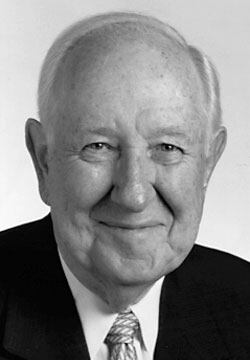
Overview
William B. Graham did not found Baxter, and he was not a physician. He was a University of Chicago chemist who had drifted into patent law, and when he took over what was then Baxter Laboratories in 1953 it was a small Midwestern maker of sterile intravenous solutions, packed in the vacuum glass bottles that had carried the company through the Depression [1][6]. Over the next twenty-seven years Graham did something rarer than invention: he built an organization whose entire purpose was to bring scientific risks, the artificial kidney, the plastic blood bag, the flexible IV container, out of the laboratory and into routine hospital use, and he made that mission pay [3][5]. By the time he stepped down as chief executive in 1980, sales had quadrupled to roughly $1 billion, and the company had posted earnings growth of about 21 percent a year for twenty-four consecutive years, one of the longest such records in American industry [4][6].
The defining decision came early. In the mid-1950s Dr. Willem Kolff, the Dutch émigré who had built the first working artificial kidney out of cellophane sausage casing and, famously, a Maytag washing machine tub, was looking for a manufacturer willing to mass-produce a cheap, disposable version of his twin-coil dialyzer [5][7]. Few wanted the risk; dialysis was exotic, the market unproven. Graham's Baxter took it on, and on October 30, 1956 the Travenol division in Morton Grove, Illinois, launched the first commercially built, disposable artificial kidney, its coil and bloodlines selling for fifty-nine dollars [5][7]. It was the moment a solution company became a device company, and it set the pattern for everything after [3][6].
Graham institutionalized that pattern. Where the founder, Ralph Falk, had built a research function, Graham poured money into it and organized the company to convert discoveries into products, Hyland Laboratories' blood plasma fractions (acquired 1952), the Fenwal plastic blood-collection systems that came with the 1959 purchase of Fenwal, the first concentrated clotting factor that transformed the lives of hemophiliacs, and in 1970 Viaflex, the first flexible plastic IV bag, which displaced the breakable glass bottle that had defined the industry for a generation [1][6]. Each was a 'first,' and each opened a market that competitors then had to chase [3].
He was also a builder of the modern corporation. In 1961 he took Baxter public on the New York Stock Exchange, and the steadily compounding earnings produced a long series of stock splits that made early shareholders wealthy [1][6]. In 1963 he made one of his boldest moves, ending the thirty-year arrangement under which American Hospital Supply Corporation had distributed Baxter's products, and building Baxter's own national sales force, a wrenching change that gave Graham direct control of how his products reached the hospital [1][6]. The company entered the Fortune 500 in 1971 [6].
Graham's Baxter was not flashy. He shunned personal publicity, left almost no quotable bravado behind, and ran the company as a disciplined compounding machine rather than a personality cult [2][6]. His genius lay in matching long-horizon scientific bets to the patient, methodical R&D and financial structure that could carry them, and in understanding that in medicine, being first with a genuinely needed product was the most durable competitive advantage of all [3][6]. The artificial kidney, the blood bag, and the flexible IV container are now so ordinary that no one thinks of them as inventions, which is precisely the measure of his success [3][5].
Early Life & Path
William Blair Graham was born in 1911 in Illinois, and his entire formation was bound up with one institution: the University of Chicago [3][6]. He entered as an undergraduate and graduated in 1932 with a B.S. in chemistry, finishing first in his class and winning election to Phi Beta Kappa and Sigma Xi [1][6]. He stayed on for two years of honors graduate work in chemistry, studying under the future Nobel laureate Harold Urey, the discoverer of deuterium, an apprenticeship in serious science that would shape how Graham later thought about industrial research [1][6].
Then he changed course. Rather than complete a doctorate in chemistry, Graham entered the University of Chicago Law School and took his J.D. cum laude, and he went into practice as a patent lawyer, a hybrid training in science and intellectual property that was almost ideally suited to a company whose business would be turning novel medical inventions into protected, marketable products [1][6]. He practiced patent law until 1945, when, at the age of thirty-three, he joined Baxter Laboratories as a vice president and manager [1][6].
Baxter itself was young and small. It had been founded in 1931 by Dr. Donald Baxter to manufacture sterile intravenous solutions, a real innovation at a time when hospital-mixed IV fluids were of dangerously variable quality, and Dr. Ralph Falk had bought out Baxter's interest in 1935 and established the company's research arm [1][6]. When Falk handed Graham the chief executive's role in 1953, he was entrusting the firm to a man with no medical degree and only eight years inside it, but with exactly the blend of scientific literacy and legal-commercial discipline the next phase would demand [1][6].
Career Timeline
- 1911Born in Illinois [3].
- 1932Graduates first in his class from the University of Chicago with a B.S. in chemistry; elected to Phi Beta Kappa and Sigma Xi [1][6].
- 1930sEarns a J.D. cum laude from the University of Chicago Law School after graduate study in chemistry under Harold Urey, then practices patent law [1][6].
- 1945Joins Baxter Laboratories as vice president and manager at age 33 [1][6].
- 1952Baxter acquires Hyland Laboratories, adding blood-plasma fractionation to its product line [1][6].
- 1953Succeeds founder Ralph Falk as president and chief executive officer [1][6].
- 1956On October 30 the Travenol division launches the first commercially built disposable artificial kidney, based on Willem Kolff's twin-coil dialyzer; the coil and bloodlines sell for $59 [5][7].
- 1959Acquires Flint, Eaton & Company and Fenwal Laboratories, bringing in the plastic blood-collection (Blood-Pack) systems [1][6].
- 1961Takes Baxter public on the New York Stock Exchange, beginning a long run of stock splits [1][6].
- 1963Ends the 30-year distribution partnership with American Hospital Supply Corporation and builds Baxter's own sales force [1][6].
- 1970Introduces Viaflex, the first flexible plastic IV container, displacing the breakable glass bottle [1][6].
- 1971Baxter enters the Fortune 500; sales reach $242 million [6]. Graham becomes chairman while remaining CEO [2][6].
- 1978Sales quadruple to about $1 billion, capping an earnings-growth record of roughly 21 percent a year over 24 consecutive years [4][6].
- 1980Steps down as CEO, succeeded by Vernon R. Loucks Jr.; remains chairman to 1985 and senior chairman until 1996 [1][2].
- 2006Dies of heart failure on January 24 in Kenilworth, Illinois, at age 94 [2][3].
Key Ventures & Innovations
The disposable artificial kidney (1956)
Graham backed Dr. Willem Kolff's effort to mass-produce a cheap, disposable version of his twin-coil dialyzer when other manufacturers balked at the risk. The Travenol division launched it on October 30, 1956 in Morton Grove, Illinois, the first commercially built artificial kidney, with coil and bloodlines priced at $59, turning a solutions house into a medical-device pioneer and opening the field of clinical dialysis [5][7].
Blood plasma and the plastic blood bag (1952, 1959)
The 1952 acquisition of Hyland Laboratories brought plasma fractionation, and the 1959 purchase of Fenwal Laboratories brought the unbreakable plastic Blood-Pack collection system, the first plastic blood-collection system, which transformed blood banking and seeded the later flexible-container line [1][6].
Clotting factor for hemophilia
Under Graham, Baxter developed the first commercial concentrated antihemophilic clotting factor, dramatically improving, and lengthening, the lives of people with hemophilia, and establishing the company as a leader in blood-derived therapeutics [3][6].
Viaflex flexible IV container (1970)
Building on Fenwal's plastic technology, Baxter introduced Viaflex in 1970, the first flexible plastic intravenous bag. It replaced the heavy, breakable vacuum glass bottle that had defined IV therapy since the company's founding and became a worldwide standard [1][6].
Going public and going direct (1961, 1963)
Graham listed Baxter on the NYSE in 1961, funding decades of growth, and in 1963 severed the 30-year distribution tie with American Hospital Supply Corporation to build Baxter's own sales force, taking direct command of how its products reached hospitals [1][6].
From the Record
“This was the first commercially sold, disposable dialyzer. It was launched on October 30, 1956, by the Travenol Division of Baxter Laboratories, Inc., in Morton Grove, IL. ... The machine was a result of the efforts of Dr. Willem Kolff and William B. Graham, CEO of Baxter.”
“Bill Graham has made an impact on healthcare throughout the world that will last far beyond his lifetime. His visionary leadership and never-ending pursuit of innovation for the good of the patient changed the course of modern healthcare and helped save, extend and improve the lives of hundreds of thousands of people all over the world.”
“By 1978, sales had quadrupled to $1 billion, and the company could boast an earnings growth rate of 21 percent for the preceding 24 continuous years.”
What Operators Can Learn
- 01
Be first with what is genuinely needed
Graham's durable advantage came from a string of medical 'firsts', the disposable kidney, the plastic blood bag, the flexible IV container. In medicine, being first to market a product patients truly needed created a lead competitors had to spend years chasing.
- 02
Take the risk no one else will take
When other manufacturers balked at mass-producing Kolff's artificial kidney, Graham's company took it on. The willingness to absorb scientific and commercial risk that frightened rivals was the seed of Baxter's transformation from solutions house to device leader.
- 03
Build the machine that turns research into product
Graham didn't just fund discovery; he organized the company, sales force, financing, manufacturing, to carry long-horizon scientific bets all the way to routine clinical use. Invention without that delivery system stays in the lab.
- 04
Compounding beats flash
Roughly 21 percent earnings growth for 24 straight years was achieved by a publicity-shy chemist running a disciplined compounding machine, not by spectacle. Steady, patient execution built one of the great growth records in American industry.
Legacy
The products William Graham brought to market are now so ordinary that their origins are invisible. The disposable artificial kidney made routine dialysis possible and helped lay the groundwork for the modern treatment of kidney failure [10]; the plastic blood bag remade blood banking; the flexible IV container became a global standard; and the first clotting factors changed what it meant to live with hemophilia [3][5][6]. Under Graham, Baxter grew from a small regional solutions maker into a Fortune 500 international healthcare company, and the growth model he established, long-term R&D bets converted into market-defining firsts, carried the company for decades after he left the chief executive's chair in 1980 [4][6].
Graham remained tied to the University of Chicago for life, serving as a trustee and lecturer, and in 1997 he and his wife Catherine gave the university $10 million; its continuing-studies division was renamed the William B. and Catherine V. Graham School of General Studies in their honor [1][3]. Harvard Business School named him among the great American business leaders of the twentieth century, and the Baxter International Foundation endowed the William B. Graham Prize for Health Services Research in his name [3][6]. When he died in 2006 at ninety-four, Baxter, by then a roughly $10-billion enterprise, credited him with having 'changed the course of modern healthcare' [2][3].
Further Reading
International Directory of Company Histories, Vol. 25, "Baxter International Inc.", Tina Grant (ed.) (1999)
The most reliable concise corporate history, with the dates, acquisitions, and the 21-percent / 24-year growth record that defined the Graham era.
New Ways of Treating Uraemia: The Artificial Kidney, Peritoneal Lavage, Intestinal Lavage, Willem J. Kolff (1947)
The inventor's own account of the artificial kidney that Graham's Baxter would later commercialize, essential primary background to the 1956 breakthrough.
Dropsy, Dialysis, Transplant: A Short History of Failing Kidneys, Steven J. Peitzman (2007)
A medical historian's account of dialysis, placing Kolff's twin-coil kidney and its commercialization in clinical and scientific context.
The Social Transformation of American Medicine, Paul Starr (1982)
Pulitzer-winning history of the postwar medical-industrial system in which Baxter rose, the market Graham was building products for.
Sources
- 1.“History of Baxter International Inc.”, FundingUniverse (company history)
- 2.“Baxter International, Inc. Mourns Passing of William B. Graham, Pioneer and Long-Time Leader in Healthcare (company statement, quoting CEO Robert L. Parkinson Jr.)”, Baxter International / BioSpace, January 25, 2006, archive
- 3.“William B. Graham, Great American Business Leaders of the 20th Century”, Harvard Business School, Leadership Initiative, archive
- 4.Shruti Date Singh, “Former Baxter CEO William Graham dies”, Crain's Chicago Business, January 25, 2006, newspaper
- 5.“Dialysis Machine Museum, the Kolff twin-coil disposable artificial kidney (Travenol/Baxter, 1956)”, Home Dialysis Central (Medical Education Institute / National Kidney Foundation), archive
- 6.Tina Grant (ed.), International Directory of Company Histories, "Baxter International Inc.", St. James Press, 1999, book
- 7.Dr. Willem J. Kolff: The Father of the Artificial Kidney (twin-coil dialyzer; 1956 Baxter Travenol commercialization), PMC / National Library of Medicine, 2024, journal
- 8.Jay P. Pederson (ed.), International Directory of Company Histories, Vol. 36, "Baxter International Inc." (reprinted online), St. James Press, 2001, book
- 10.Steven J. Peitzman, Dropsy, Dialysis, Transplant: A Short History of Failing Kidneys, Johns Hopkins University Press, 2007, book
- 9.“Travenol artificial kidney, ca. 1963 (artifact and history)”, Dittrick Medical History Center, Case Western Reserve University, archive
Researched and written with Claude + live web search.