Overview
Thomas H. McInnerney is the most consequential American businessman almost no one remembers. He built no famous brand under his own name, designed no machine, and courted no celebrity; what he did was take the most local, perishable, and fragmented business in the country, fresh milk and hand-cranked ice cream, sold city by city, and fuse it into a coast-to-coast colossus. The vehicle was National Dairy Products Corporation, incorporated in Delaware and organized in New York in December 1923, and within seven years it had passed the venerable Borden Company to become the largest dairy enterprise in the United States and the world [1][6].
McInnerney's insight was financial as much as operational. Milk could not be shipped far, so no single producer could dominate a national market the way Ford dominated cars; the industry was a patchwork of family creameries and route men. But Wall Street had just learned to fund consolidations through stock-for-stock mergers, and McInnerney saw that a holding company could buy up the strongest local dairies, leave their routes and labels in place, and harvest the economies of scale in purchasing, financing, laboratories, and advertising [1][6]. In 1923 he carried that idea to the Street and sold it to Waddill Catchings of Goldman, Sachs, joined by Lehman Brothers and Tobey & Kirk, who underwrote the new corporation; the founding merger married McInnerney's own Hydrox ice-cream company of Chicago to the Rieck-McJunkin Dairy of Pittsburgh, with McInnerney as president and Edward E. Rieck as chairman [3][7].
Then came the roll-up. Between 1923 and 1931 National Dairy absorbed more than fifty-five companies, at one stretch eighteen in a single year, paying mostly in its own shares so that cash never constrained the pace [1][6]. The trophies were household names: Sheffield Farms, whose wagons delivered roughly a million quarts of milk a day in New York City; Breyer Ice Cream of Philadelphia (1926); Breakstone Brothers (1928); and, in 1930, the Kraft-Phenix Cheese Corporation, which alone was selling some forty percent of all the cheese in America [1][2][6]. By the close of 1930 the company employed around 35,000 people and was the dominant force in fluid milk, ice cream, butter, and cheese at once [1].
Managing an empire assembled from strangers required a unifying promise of quality, and McInnerney's answer was the Sealtest name, a "seal of test" backed by centralized laboratories that checked milk for bacteria and adulteration. Rolled out as a national umbrella over the company's scattered regional brands, Sealtest let a customer in Atlanta and a customer in Boston trust the same mark while the local dairy kept its old identity, and it doubled as a licensing system that quieted the charge that National Dairy "controlled every cow" [4][2]. By the mid-1930s Time could report the company earning $9,338,000 on sales of roughly $290,000,000, and registering a $62,545,000 bond issue, the largest industrial registration since the Securities Act of 1933 [2].
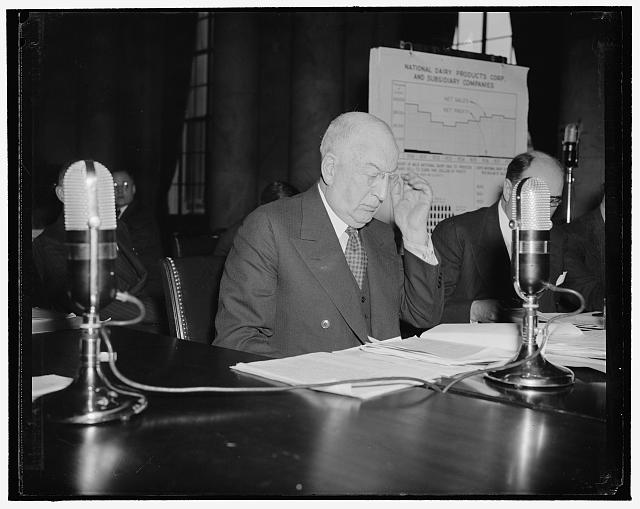
McInnerney ran National Dairy as president from 1923 to 1941 and then as chairman, presiding over the very scale that drew Washington's suspicion; hauled before a federal monopoly inquiry, he insisted flatly that no monopoly in milk distribution was even possible [5][1]. The deeper truth was that he had not built a monopoly but a new kind of organism, a decentralized federation of local businesses under one financial and scientific roof, and in doing so he wrote an early American chapter in the playbook every conglomerate-builder would later study [1][6].
The name National Dairy survived until 1969, when the firm renamed itself Kraftco after its most famous acquisition, and later simply Kraft; its corporate descendants run today through Kraft Heinz and Mondelez. The empire long outlived the man, but its architecture, and the audacity of consolidating the unconsolidatable, was McInnerney's [1][6].
Early Life & Path
He was born Thomas Henry McInnerney on May 8, 1867, in Dubuque, Iowa, a Mississippi River town then bound up with the steamboat and packet trade; his father moved in the orbit of the riverboat magnate Joseph "Diamond Jo" Reynolds [1]. The family was not rich, and the boy went to work young, hired as a cash boy by the H.B. Glover Company for twenty-five cents a day, eleven hours a day on weekdays and four more on Saturday [1]. It was an apprenticeship in the unglamorous arithmetic of retail that would mark everything he later did.
He found his first ladder in pharmacy, studying the subject at the University of Illinois in 1893 and borrowing $10,000 to open a drugstore at 35th Street and Indiana Avenue in Chicago during the year of the World's Columbian Exposition [1][2]. He ran it, sold it for $20,000, and carried his profit and his nerve east to Manhattan, becoming manager of the drug department at the great Siegel, Cooper & Company department store. Told the department was losing money, he challenged the owner, walked out, and was rehired on a share of the profits, earning $4,000 the first year and $16,000 the second, an early demonstration of his instinct for tying his fortune to results [1].
The pivot to dairy came almost by accident. By 1911 McInnerney was back in Chicago with a stake in a coal company that, in the manner of the day, also dealt in ice and ran a small ice-cream division. He traded his coal interest for control of the ice-cream business, built it up, and by 1920 was, in the phrase that follows him through every account, "doing a million-dollar-a-year ice cream business" in Chicago under the Hydrox name [1][2]. He was past fifty, prosperous, and restless, convinced, as Time later put it, that there might be more money in milk [2].
Career Timeline
- 1867Born May 8 in Dubuque, Iowa, a Mississippi River town tied to the steamboat trade [1].
- 1893Studies pharmacy at the University of Illinois; borrows $10,000 to open a Chicago drugstore at 35th and Indiana during the World's Columbian Exposition [1][2].
- c. 1900sSells the drugstore for $20,000 and becomes drug-department manager at Siegel, Cooper & Company in New York, winning a profit share [1].
- 1911Returns to Chicago, trades a coal-company stake for control of its ice-cream division [1].
- 1920Running Hydrox, a million-dollar-a-year Chicago ice-cream business, he resolves there is more money in milk [1][2].
- 1923Sells the milk-consolidation idea to Waddill Catchings of Goldman, Sachs, with Lehman Brothers and Tobey & Kirk underwriting the new corporation [3][7].
- 1923National Dairy Products Corporation is organized in New York and incorporated in Delaware in December, merging Hydrox with Rieck-McJunkin Dairy; McInnerney becomes president [1][6][7].
- 1925Acquires Sheffield Farms, whose wagons deliver roughly a million quarts of milk a day in New York City; buys eighteen businesses in the year [1][2].
- 1926Acquires Breyer Ice Cream of Philadelphia; the company now operates in some 1,600 cities [1][6].
- 1928Acquires Breakstone Brothers, adding cottage cheese and cream cheese to the portfolio [6].
- 1930Acquires Kraft-Phenix Cheese Corporation, then selling about 40% of all U.S. cheese; National Dairy passes Borden as the world's largest dairy company [1][2][6].
- c. 1935Unifies dozens of regional labels under the Sealtest name and laboratory-certification system [4][2].
- 1941Steps up from president to chairman of the board, having led National Dairy for eighteen years [1][5].
- 1952Named chairman emeritus on April 17; dies September 30 at his home in Greenwich, Connecticut, at age 85 [1].
Key Ventures & Innovations
Hydrox Corporation (ice cream)
The Chicago ice-cream company McInnerney built from a coal firm's side division into a million-dollar-a-year business by 1920. Hydrox was both his proving ground and the founding asset he folded into National Dairy in 1923 [1][2].
National Dairy Products Corporation (1923)
The holding company that executed the great dairy roll-up. Organized in New York and incorporated in Delaware in December 1923 on a Goldman, Sachs / Lehman Brothers underwriting, it merged Hydrox with Pittsburgh's Rieck-McJunkin and made McInnerney president [3][6][7].
The stock-for-stock roll-up (1923–1931)
More than fifty-five acquisitions in eight years, Sheffield Farms, Breyer, Breakstone, Kraft-Phenix and dozens more, bought largely with National Dairy shares so cash never throttled the pace. Local routes and labels were kept; scale was harvested behind the scenes [1][6].
The Kraft-Phenix acquisition (1930)
The capstone deal. Kraft-Phenix sold roughly 40% of America's cheese; National Dairy ($315M in sales) absorbed it ($85M) and ran the combined firm. Decades later the conglomerate would take the Kraft name itself [1][2][6].
The Sealtest brand and laboratory system
A national "seal of test" backed by centralized labs and, from the mid-1930s, a licensing program. It gave a federation of strangers one trusted promise of quality and blunted the charge that National Dairy was a milk monopoly [4][2].
“There never had been and did not exist any possibility of monopoly in milk distribution.”
From the Record
“In 1920 Thomas Henry McInnerney was doing a million-dollar-a-year ice cream business in Chicago. He thought there might be more money in milk.”
“Last year Mr. McInnerney's National Dairy Products Corp. made $9,338,000 on milk, cheese, butter & ice-cream sales of $290,000,000.”
“Called before the National Monopoly Investigating Committee, McInnerney assured them there never had been and did not exist any possibility of monopoly in milk distribution.”
What Operators Can Learn
- 01
A fragmented industry can be a feature, not a bug
Because milk could not travel, rivals assumed the business was un-consolidatable. McInnerney saw that the very thing keeping competitors small, locality, was what made a financial federation of locals so valuable. He competed on capital structure where others competed on routes.
- 02
Buy with paper, not cash, to keep the flywheel spinning
Paying for acquisitions mostly in National Dairy stock meant the pace of the roll-up was never limited by the bank balance. The deals funded themselves on the strength of the consolidated story Wall Street had bought into.
- 03
Don't kill the brands you buy, unify them with a promise
Rather than erase beloved local dairies, McInnerney kept their names and stitched them together under Sealtest, a single guarantee of tested quality. Decentralized operations, centralized trust.
- 04
Scale invites the regulators; have your answer ready
Becoming the largest dairy firm on earth meant Washington came calling. McInnerney's defense, that perishability made a true milk monopoly impossible, shows that the strategist who builds something dominant must also be prepared to argue why it isn't dangerous.
Legacy
McInnerney's monument is structural rather than sentimental. He took an industry everyone considered too local and too perishable to nationalize and proved that finance and laboratory science, not geography, set the limits of scale. National Dairy's decentralized-federation model, autonomous local operators, central capital, central quality control, a unifying consumer brand, anticipated the conglomerate logic that would sweep American business decades later, and it made the company, by 1930, the largest food enterprise in the world [1][6].
The corporate bloodline he founded is extraordinary. National Dairy renamed itself Kraftco in 1969 in tribute to its 1930 acquisition, then Kraft, Inc.; through later mergers and spin-offs its DNA runs into today's Kraft Heinz and Mondelez International [1]. Brands he assembled or built, Sealtest, Breyers, Breakstone's, Kraft cheese, outlived him by generations, even as his own name faded from the story [1][2].
That fading is itself instructive. McInnerney was the rare empire-builder who put no statue of himself at the center of his creation: no eponymous brand, no cult of personality, just a holding company and a seal of quality. Business historians who reconstruct the 1920s merger wave and the rise of the modern food giant keep rediscovering him as the quiet engineer behind one of the era's largest consolidations, the Iowa druggist who decided there was money in milk, and was right on a scale almost no one foresaw [1][6].
Further Reading
Land of Milk and Money: The Creation of the Southern Dairy Industry, Alan I. Marcus (2021)
A university-press history of the dairy boom of the 1920s, strong on Borden and the national consolidators that reshaped the milk business McInnerney came to dominate.
The Great Merger Movement in American Business, 1895–1904, Naomi R. Lamoreaux (1985)
The classic analysis of how stock-for-stock consolidations remade American industry, the financial logic McInnerney applied to milk two decades later.
The Visible Hand: The Managerial Revolution in American Business, Alfred D. Chandler Jr. (1977)
The foundational account of how managerial hierarchies and integration built the modern corporation; essential context for the National Dairy federation.
New and Improved: The Story of Mass Marketing in America, Richard Tedlow (1990)
On the rise of national brands and mass distribution in food and consumer goods, the world Sealtest and Kraft helped create.
Milk: The Surprising Story of Milk Through the Ages, Anne Mendelson (2008)
A cultural and commercial history of milk, useful for understanding the perishable, local trade McInnerney consolidated.
Sources
- 1.“McInnerney, Thomas Henry”, Encyclopedia Dubuque, 2020, archive
- 2.Business & Finance: Money in Milk, Time, c. 1936, journal
- 3.Alan I. Marcus, Land of Milk and Money: The Creation of the Southern Dairy Industry, Louisiana State University Press, 2021, book
- 4.“Sealtest Dairy Products (advertising and product collection)”, National Museum of American History, Smithsonian Institution, n.d., archive
- 5.“Kraft Foods Inc. (National Dairy Products Corporation)”, Wikipedia, 2024
- 6.Naomi R. Lamoreaux, The Great Merger Movement in American Business, 1895–1904, Cambridge University Press, 1985, book
- 7.“Lehman Brothers Collection, deal books and corporate records (National Dairy Products Corporation financing, 1923)”, Baker Library Special Collections, Harvard Business School, 1923, archive
- 8.Alfred D. Chandler Jr., The Visible Hand: The Managerial Revolution in American Business, Harvard University Press / Belknap, 1977, book
- 9.“T.H. McInnerney, founder and chairman emeritus of National Dairy Products, dies at 85”, Daily News (New York), October 1, 1952, newspaper
Researched and written with Claude + live web search.