Overview
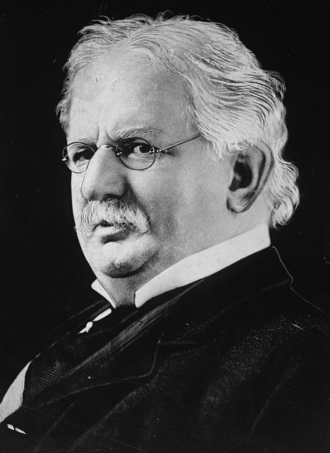
Theodore Newton Vail did not invent the telephone, found the Bell Company, or build the first long-distance line. What he did was decide what the American telephone would be: not a scatter of competing local exchanges, but one seamless, interconnected, government-blessed monopoly reaching "every one in every place" [4][6]. He ran the Bell System twice, first as its general manager from 1878 to 1887, then, after a twenty-year exile, as president of the American Telephone and Telegraph Company from 1907 to 1919, and it was the second act that fixed the shape of the industry for the next three-quarters of a century [2][6].
When J.P. Morgan's interests installed Vail at AT&T in 1907, the company was bleeding. The original Bell patents had lapsed in 1893 and 1894, and a swarm of independent companies had seized roughly half the nation's telephones, undercutting Bell in town after town [4][6]. Vail's response was the slogan he made corporate scripture, "One Policy, One System, Universal Service", and a strategy with three blades: build a long-distance network no rival could match, absorb or interconnect the independents, and, most heretically for a Gilded Age tycoon, openly invite government regulation [2][3][7]. In his very first annual report he wrote that there was no "serious objection" to public control "provided it is independent, intelligent, considerate, thorough and just" [4].
That acceptance of regulation was the master stroke. Vail bet that Americans would tolerate a private monopoly only if it behaved like a public utility, and that a regulated monopoly was far preferable, from Bell's chair, to either ruinous competition or outright nationalization, which several countries had already chosen [2][7]. The bet paid off in the 1913 Kingsbury Commitment, an out-of-court settlement with the Wilson administration in which AT&T agreed to sell its controlling stake in Western Union and to let independent companies connect to its long-distance lines, in exchange for being spared an antitrust dissolution [6][7]. Justice Department officials concluded the deal gave the government as much as it could have won in court; in practice it ratified Bell's dominance and carved the country into geographic monopolies [6][7].
The word Vail chose to justify all this, "universal service", did not yet mean what it means today. As the historian Milton Mueller and others have shown, Vail used it to argue against "dual service," the wasteful situation in which two unconnected systems served the same town and a subscriber needed two telephones to reach everyone [6][7]. In the 1910 annual report Vail put it with engineer's clarity: two exchanges offering the same list of subscribers were "as useless as a duplicate system of highways or streets" [3]. The cure for duplication was consolidation under one management, his management [3][6].
Underneath the politics ran a deep faith in engineering. Vail released the funds for the research push that conquered the long-distance "repeater" problem, the vacuum-tube amplifier that in January 1915 carried the first transcontinental call from New York to San Francisco, a marketing triumph staged to coincide with the Panama–Pacific Exposition, with Vail listening in from Jekyll Island and President Wilson from the White House [1][5]. The same instinct seeded what became Bell Telephone Laboratories, the most productive industrial research organization of the century [5][6].
Management theorist Peter Drucker later called Vail perhaps the most effective decision-maker in American business history, crediting him with four foundational choices: that the business of the Bell System was service; that the telephone was a natural monopoly best integrated nationally; that the company must generate its own science; and that it must embrace public regulation rather than fight it [2][6]. Vail's machine outlived him by decades, the regulated Bell monopoly stood until the court-ordered breakup of 1984 [6][7].
Early Life & Path
He was born on July 16, 1845, near Minerva in Carroll County, Ohio, into a family with engineering in its blood: he was a cousin of Alfred Vail, the partner of Samuel Morse who had helped build the first practical telegraph [1][2]. The family soon moved east to New Jersey, and the boy grew up restless on a farm he could not wait to leave. The line his biographer Albert Bigelow Paine preserved captures the temperament exactly, "I have had all of that dam' farm I want. I am going where I can make some money" [1]. He learned telegraphy, was drawn to "the fascination of the wires," and by his late teens was working a key for what would become Western Union in New York [1][2].
The making of him was not the telephone but the mail. Vail joined the Railway Mail Service and rose with startling speed, becoming general superintendent in 1876, the youngest in the service's history, by re-engineering how letters were sorted and routed across the rail network [1][2]. He championed the celebrated "Fast Mail" between New York and Chicago, ran week-long conferences to standardize the work of his divisional superintendents, and built an esprit de corps and a meritocratic, civil-service ethos he would later transplant whole into the Bell System [6]. Crucially, the Railway Mail Service taught him to think of a communications network as a single integrated system owned in the public interest, and to believe, as he wrote of the mails, that the government should hold "absolute power" over how the network was run [6].
It was in that work that Gardiner Greene Hubbard, telephone promoter, founder's father-in-law, and chairman of a federal commission on railway-mail pay, met Vail, was struck by his "energy, imagination, and capacity for abstract thought," and in 1878 lured him away from the government to become the Bell Telephone Company's first general manager [6]. Vail was thirty-three. He had found the wires that would make him famous [1][6].
Career Timeline
- 1845Born July 16 near Minerva, Carroll County, Ohio, a cousin of telegraph pioneer Alfred Vail [1][2].
- 1876Becomes general superintendent of the U.S. Railway Mail Service, its youngest, after overhauling mail sorting and routing [1][2].
- 1878Hired by Gardiner Greene Hubbard as the first general manager of the Bell Telephone Company [6].
- 1885Becomes the first president of the newly formed American Telephone and Telegraph Company, the long-distance subsidiary [2][4].
- 1887Resigns from Bell after clashing with Boston financiers who favored dividends over Vail's long-term network building [2][6].
- 1890sPursues ventures abroad and at home, including a Córdoba waterpower plant and a Buenos Aires street railway in Argentina [2].
- 1907Returns as president of AT&T as J.P. Morgan's interests take control of the financially pressed company [2][6].
- 1907First annual report endorses public regulation "provided it is independent, intelligent, considerate, thorough and just" [4].
- 1908Launches the institutional advertising campaign behind the motto "One Policy, One System, Universal Service" [7].
- 1910Annual report frames competing local systems as wasteful "duplication," arguing for one interconnected network [3].
- 1913The Kingsbury Commitment settles the federal antitrust threat: AT&T divests Western Union and interconnects independents [6][7].
- 1915AT&T completes the first transcontinental telephone call, New York to San Francisco, on January 25 [1][5].
- 1919Retires the AT&T presidency, remaining as chairman of the board [2].
- 1920Dies April 16 at Johns Hopkins Hospital, Baltimore; U.S. telephone service pauses for one minute during his funeral [2][8].
Key Ventures & Innovations
The Railway Mail Service (to 1878)
As general superintendent Vail turned mail-sorting into a national system run on the moving railroad car, with standardized procedures, periodic competence tests, and a public-service ethos he later imported wholesale into Bell [1][6].
Building the Bell System (1878–1887)
In his first tenure Vail defended the Bell patents against Western Union, pushed long-distance lines, and organized the licensing of operating companies, only to resign in 1887 when Boston backers preferred paying dividends to plowing earnings back into the network [2][6].
The regulated-monopoly bargain (1907–1913)
Returning under J.P. Morgan, Vail traded an antitrust fight for federal acceptance of Bell's dominance, culminating in the 1913 Kingsbury Commitment that divested Western Union and required interconnection with independents [6][7].
Universal service and interconnection
Vail's "One Policy, One System, Universal Service" was an argument against duplicate, unconnected exchanges. In 1910 he likened two rival systems serving the same town to "a duplicate system of highways or streets" [3][6].
Long distance and industrial research
Vail funded the engineering attack on the vacuum-tube repeater that made coast-to-coast telephony possible in 1915 and seeded the organization that became Bell Telephone Laboratories [1][5][6].
“The strength of the Bell system lies in this 'universality.' It affords facilities to the public beyond those possible on any other lines. It carries with it also the obligation to occupy and develop the whole field.”
From the Record
“It is not believed that there is any serious objection to such control, provided it is independent, intelligent, considerate, thorough and just, recognizing, as does the Interstate Commerce Commission in its report recently issued, that capital is entitled to its fair return, and good management or enterprise to its reward.”
“Two exchange systems in the same place offering identically the same list of subscribers, if such a thing can be imagined, are as useless as a duplicate system of highways or streets in a village.”
“I have had all of that dam' farm I want. I am going where I can make some money.”
What Operators Can Learn
- 01
Choose the regulator before the regulator chooses you
Vail's contrarian embrace of government oversight defused antitrust and nationalization at once. By defining the terms of regulation early, he made the rules a moat rather than a threat, the durable lesson of the Kingsbury Commitment.
- 02
A network's value is in its connections, not its nodes
Vail understood that an unconnected telephone was nearly worthless and that two rival systems were mere duplication. The strategic prize was interconnection, the property economists now call the network effect.
- 03
Fund the science your strategy will need before you need it
By bankrolling the repeater research that enabled transcontinental service, Vail turned R&D into competitive advantage and built the institution that became Bell Labs, engineering as moat.
- 04
Patience is a strategy; impatience can cost you the company
Vail quit in 1887 rather than starve the network to pay dividends. Vindicated twenty years later, his willingness to invest through the present for the system's future defined his second, decisive tenure.
Legacy
Vail's settlement endured almost unchanged for three generations. The regulated national monopoly he engineered, Ma Bell, with its operating companies, its Western Electric manufacturing arm, and its Bell Laboratories, became the template for how Americans thought a great utility should be run, and it stood until the antitrust breakup of 1984 finally undid it [6][7]. The phrase he popularized, "universal service," outlived his narrower meaning and became enshrined in federal communications policy as a public commitment to connect everyone, everywhere [6].
Historians remain divided on whether to admire or indict him, and the best scholarship insists on holding both views together. To management thinkers in the Drucker tradition, Vail is a model of strategic foresight and service-first leadership [2]. To critics such as Milton Mueller, the "universal service" rhetoric was partly a public-relations weapon that smothered the scrappy independents and locked in a monopoly the public might have done better without [6][7]. Richard R. John traces Vail's deepest convictions not to the market at all but to the civic, public-service ethos of the nineteenth-century Post Office and Railway Mail Service, the seedbed where Vail first learned to see a communications network as a single national trust [6].
What is beyond dispute is the scale of what he built. When Vail died in 1920, AT&T was among the largest private enterprises on earth; on the morning of his funeral, telephone service across the United States went silent for one minute in tribute, stilling millions of telephones at once [2][8].
Further Reading
In One Man's Life: Chapters from the Personal & Business Career of Theodore N. Vail, Albert Bigelow Paine (1921)
The authorized contemporary biography by Mark Twain's biographer, partial and admiring, but the richest source for Vail's voice and early years.
Telephone: The First Hundred Years, John Brooks (1976)
The most readable single-volume history of the Bell System, written for AT&T's centennial; strong on Vail's two tenures and the Kingsbury bargain.
Universal Service: Competition, Interconnection, and Monopoly in the Making of the American Telephone System, Milton L. Mueller Jr. (1997)
The sharpest revisionist account, arguing Vail's 'universal service' was about killing dual service and the independents, not about reaching everyone.
Theodore N. Vail and the Role of Innovation in the Modern Bell System (Business History Review, vol. 66), Louis Galambos (1992)
A leading business historian's careful study distinguishing Vail's first career at Bell from his transformative second one.
Creating the Corporate Soul: The Rise of Public Relations and Corporate Imagery in American Business, Roland Marchand (1998)
Places AT&T's universal-service campaign at the origin of modern institutional advertising and corporate image-making.
Sources
- 1.Albert Bigelow Paine, In One Man's Life: Being Chapters from the Personal & Business Career of Theodore N. Vail, Harper & Brothers, 1921, book
- 2.Peter F. Drucker, The Effective Executive, Harper & Row, 1967, book
- 3.Theodore N. Vail (president), “Annual Report of the Directors of American Telephone and Telegraph Company (1910)”, American Telephone and Telegraph Company, 1910, archive
- 4.Theodore N. Vail (president), “Annual Report of the Directors of American Telephone and Telegraph Company (1907)”, American Telephone and Telegraph Company, 1907, archive
- 5.Engineering and Technology History Wiki (ETHW), “Transcontinental Telephone Service / First Telephone Repeater”, IEEE / ETHW
- 6.Richard R. John, Theodore N. Vail and the Civic Origins of Universal Service, Business and Economic History, vol. 28, no. 2 (Business History Conference), 1999, pp. 71–82, journal
- 7.Milton L. Mueller Jr., Universal Service: Competition, Interconnection, and Monopoly in the Making of the American Telephone System, MIT Press / AEI Press, 1997, book
- 8.Obituary notice: Theodore Newton Vail, Nature, vol. 105, 1920, journal
- 9.John Brooks, Telephone: The First Hundred Years, Harper & Row, 1976, book
Researched and written with Claude + live web search.