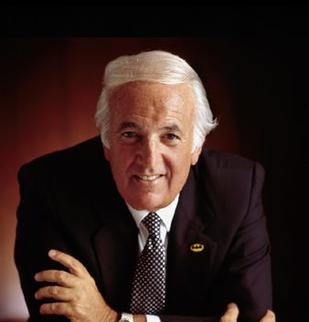
Overview
Steven J. Ross built nothing and invented nothing; what he possessed, in surplus, was a salesman's instinct for the angle no one else had bothered to see. He began with a literal one: the limousines at his father-in-law's Manhattan funeral home, The Riverside, stood unused every night, so the young Ross talked the family into renting them out after dark [4][1]. That observation, that idle assets are money lying down, became the engine of a forty-year career that turned a parking-and-funeral business into Warner Communications and finally into Time Warner, for a time the biggest entertainment and media conglomerate in the world [1][5].
The corporate vehicle was Kinney, the parking and cleaning company Ross merged his rental operation into and took public in 1962, when its revenues were on the order of $17 million [4]. Through the mid-1960s Kinney National Service swallowed businesses with cheerful indiscriminacy, the Ashley-Famous talent agency in 1967, the comics and Mad magazine of National Periodical Publications and the lens-maker Panavision in 1968, and then, in 1969, made the leap that defined him: a roughly $400 million stock bid for the ailing studio Warner Bros.-Seven Arts [1][4]. In 1972 Ross shed the parking lots and renamed the whole thing Warner Communications, with the movie studio as its crown jewel [1].
Ross ran Warner by a method that was the opposite of the Hollywood mogul's micromanagement. He hired operators he trusted, Ted Ashley, John Calley, and Frank Wells at the studio, handed them "extraordinary autonomy," and bound them to him with salaries that were merely respectable and bonuses that were astonishing, sometimes only loosely tethered to results [4][1]. The loyalty this purchased was real and lifelong; so was the indiscipline. The same hands-off largesse that produced A Clockwork Orange, Dirty Harry, and the Cosmos signing of Pelé also produced the catastrophe of Atari, the video-game maker Warner bought for about $28 million in 1976 and which by 1982 threw off half of Warner's roughly $4 billion in revenue, before collapsing in the 1983 industry crash and costing the company close to a billion dollars [4][6].
Ross's genius and his vulnerability were the same trait at different magnifications. His openhandedness with executives shaded into a tolerance for the questionable: in the early 1980s he and his deputies were dragged through a federal investigation into the mob-controlled Westchester Premier Theatre, an 800-page private inquiry the Warner board itself commissioned; Ross was never indicted, but two associates were convicted [4][2]. The Atari debacle left Warner exposed to Rupert Murdoch, whom Ross fended off in 1983–84 only by selling a large stake to Herbert Siegel's Chris-Craft, a white knight who promptly turned into a tormentor, attacking Ross's pay (then among the highest in America) and clipping his power [4].
His masterpiece was the 1989 combination of Warner with Time Inc. Ross insisted the transaction be structured as a stock merger rather than a sale, so that no one could say Time had bought Warner or that he was a caretaker [4][2]. When Paramount lunged with a hostile $175-a-share cash bid for Time, Time's board restructured the deal into a $14-billion-plus cash-and-stock acquisition of Warner and beat Paramount in the Delaware courts, a landmark decision that enshrined the right of a board to defend its "culture" and long-term plan [7][2]. Ross emerged as chairman of Time Warner with a ten-year contract whose stock-based value was reported at roughly $193 million, and within two years he had outmaneuvered and fired the Time-side heir apparent, Nicholas J. Nicholas Jr., installing his own ally Gerald Levin [4][6].
He did not live to see what he had made. Diagnosed with prostate cancer in 1991, Ross died on December 20, 1992, at sixty-five [5][1]. He remains the archetype of a distinctly American figure: the conglomerateur as impresario, who understood that in the entertainment business the product being financed and the talent being seduced were finally the same thing, and who could not always tell where charm ended and self-dealing began [1][4].
Early Life & Path
He was born Steven Jay Rechnitz on September 17, 1927, in the Flatbush section of Brooklyn [4]. The Depression wiped out his father's money, and around 1932 the family changed its name to Ross, a small act of American reinvention that his biographer Connie Bruck treats as a key to the man, who spent his life refashioning identities, his own most of all [1][4]. Tall, athletic, and magnetic, he won an athletic scholarship to the Columbia Grammar School, was elected student-council president, and learned early that he could charm a room [4].
After a brief Navy stint at the end of World War II and a two-year degree from Paul Smith's College in the Adirondacks, Ross drifted through the New York garment trade as a stockroom boy and salesman, including a spell selling children's bathing suits for an uncle [4]. The pivot of his life was his 1954 marriage to Carol Rosenthal, daughter of Edward Rosenthal, who owned The Riverside, the largest funeral business in the country [4][1]. Ross at first balked at joining the family firm, repelled by the undertaking trade, until he was offered an administrative rather than mortuary role [4].
It was inside that staid, profitable business that the dealmaker was born. Noticing the funeral fleet sat idle at night, he persuaded his father-in-law to let him rent the cars after hours; the side venture's profits let him found Abbey Rent-a-Car, which he soon married to the Kinney parking empire of Caesar Kimmel [4][1]. By 1962 he had taken the combined Kinney public. He was thirty-four, and he had discovered the only thing he ever truly did: turn an overlooked asset into a stock, and a stock into a bigger one [4][1].
Career Timeline
- 1927Born Steven Jay Rechnitz on September 17 in Flatbush, Brooklyn; the family adopts the name Ross around 1932 [4].
- 1954Marries Carol Rosenthal and joins her father's funeral business, The Riverside, in an administrative role [4].
- 1962Takes the combined Kinney parking, cleaning, and rental business public; revenues are around $17 million [4].
- 1967Kinney National Service acquires the Ashley-Famous talent agency, its first move toward show business [4][1].
- 1968Acquires National Periodical Publications (DC Comics, Mad) and the lens-maker Panavision [4].
- 1969Wins control of the ailing studio Warner Bros.-Seven Arts in a stock deal valued at roughly $400 million [1][4].
- 1972Sheds the parking and non-entertainment assets and renames the company Warner Communications Inc. [1].
- 1976Buys the video-game maker Atari for about $28 million after seeing its games at Disneyland [4][6].
- 1982–83Atari, briefly half of Warner's ~$4 billion revenue, collapses in the video-game crash, costing close to $1 billion [4][6].
- 1983–84Fends off Rupert Murdoch's stake-building by selling a large block to Herbert Siegel's Chris-Craft, who then challenges Ross's leadership and pay [4].
- 1989Agrees to merge Warner with Time Inc.; after Paramount's hostile bid, the deal is restructured into a cash-and-stock acquisition exceeding $14 billion [2][7].
- 1990The merger closes in January; Ross becomes co-chairman and CEO of Time Warner, then sole chairman by May [5][6].
- 1992Engineers the firing of Time-side heir apparent Nicholas J. Nicholas Jr. in February, elevating Gerald Levin [4][6].
- 1992Dies of prostate cancer on December 20 in Los Angeles at age 65 [5][1].
Key Ventures & Innovations
Kinney National Service (public 1962)
The roll-up of funeral limousines, car rental, parking, and building cleaning that Ross took public, giving him a stock with which to buy bigger companies. It was the financial machine on which everything later was built [4][1].
Warner Bros.-Seven Arts (1969)
Ross's roughly $400 million stock bid for a fading studio was his entry into entertainment. He installed Ted Ashley, John Calley, and Frank Wells to run it with wide autonomy, and the studio became the heart of Warner Communications, renamed in 1972 [1][4].
Atari (1976)
Bought for about $28 million, Atari at its 1982 peak generated roughly half of Warner's $4 billion in revenue, then cratered in the 1983 video-game crash. The losses, near a billion dollars, exposed Ross's decentralized model and left Warner open to takeover [4][6].
The New York Cosmos and the Warner culture
Transferred to Warner for a dollar and subsidized at over $5 million a year, the Cosmos, with Pelé and Beckenbauer, exemplified Ross's belief that glamour, loyalty, and lavish spending were themselves a business strategy in entertainment [6].
The Time Inc. merger (1989–90)
Ross's crowning deal, structured as a stock merger so no one could call it a sale of Warner. After Paramount's hostile run at Time, the courts blessed a cash-and-stock combination worth more than $14 billion, creating the world's largest media company and a chairmanship worth a reported $193 million to Ross [2][7][4].
“They threw in the sponge because they knew finally that I wasn't going to do anything but a stock deal.”
From the Record
“He was like an opera singer. He was larger than life; he knew how to make grand entrances; he knew he didn't have to yell at the top of his lungs to keep an audience's attention; he was always on a diet; and he knew how to share curtain calls.”
“They threw in the sponge because they knew finally that I wasn't going to do anything but a stock deal.”
“Steve Ross' clarity of vision, exceptional intellectual and personal magnetism were the driving force in creating Time Warner and in securing its leadership in global media and entertainment.”
What Operators Can Learn
- 01
The best deal is the asset everyone else ignores
Ross's whole career grew from a single perception, funeral cars sitting idle at night, applied at ever larger scale. He looked for value others had stopped seeing, then financed it into something bigger.
- 02
Loyalty can be bought, but so can indiscipline
Generous, lightly conditioned bonuses earned Ross fierce devotion and creative freedom that produced hits. The same hands-off largesse let Atari and other ventures run unchecked until they nearly sank the company.
- 03
Structure the deal so the story is yours to tell
By insisting the Time combination be a stock merger rather than a sale, Ross controlled not just the economics but the narrative, ensuring he emerged as a founder and chairman, not an acquiree or a caretaker.
- 04
Charm is a tool; it is not a control system
Ross's magnetism opened every door, but it also blurred the line between generosity and self-dealing, leaving him entangled in the Westchester Theatre scandal and dependent on personal loyalty where governance should have been.
Legacy
Ross is the founding figure of the modern entertainment conglomerate, the man who proved that a parking-lot operator with a stock and a salesman's nerve could assemble film, music, television, publishing, and cable under one roof and run it not by command but by cultivating talent. The Time Warner he built was, at his death, the largest media company in the world, and the management style he pioneered, decentralized divisions, outsized incentives, a chairman who was patron and impresario more than operator, became the template, for better and worse, of the industry that followed [1][5][6].
The inheritance is genuinely double-edged. The Delaware courts' decision in the Paramount-Time fight, which his deal-making provoked, reshaped American corporate law on takeover defenses and the rights of boards [7]. Yet the same conglomerate logic he perfected, grow by merging, bind people with money, trust the deal to justify itself, ran on after him into the disastrous AOL Time Warner combination of 2000, engineered by his protégé Gerald Levin, whom Ross had installed [3][6]. Steven Spielberg, who modeled aspects of Oskar Schindler on Ross and dedicated Schindler's List to him, called him the man who taught him most about a certain kind of generosity and seduction [1][4].
Connie Bruck's Master of the Game and Richard Clurman's To the End of Time fixed the verdict that history has largely kept: a brilliant, warm, openhanded builder of empires whose flaws were the precise underside of his gifts, and whose career is the best single case study in how the entertainment business actually finances its dreams [1][2].
Further Reading
Master of the Game: Steve Ross and the Creation of Time Warner, Connie Bruck (1994)
The definitive biography, built on some 250 interviews including Ross himself; balanced, scene-rich, and indispensable.
To the End of Time: The Seduction and Conquest of a Media Empire, Richard M. Clurman (1992)
An insider's account of the Time-Warner merger by a former Time editor, sharp on the boardroom intrigue and the Westchester inquiry.
Fools Rush In: Steve Case, Jerry Levin, and the Unmaking of AOL Time Warner, Nina Munk (2004)
Traces the later fate of the empire under Ross's chosen successor, Gerald Levin, essential for the long arc of his legacy.
The Predator's Ball: The Inside Story of Drexel Burnham and the Rise of the Junk Bond Raiders, Connie Bruck (1988)
Bruck's earlier classic; the financial world of leverage and raiders that formed the backdrop to Ross's 1980s takeover battles.
Sources
- 1.Connie Bruck, Master of the Game: Steve Ross and the Creation of Time Warner, Simon & Schuster, 1994, book
- 2.Richard M. Clurman, To the End of Time: The Seduction and Conquest of a Media Empire, Simon & Schuster, 1992, book
- 3.Nina Munk, Fools Rush In: Steve Case, Jerry Levin, and the Unmaking of AOL Time Warner, HarperBusiness, 2004, book
- 4.“Ross, Steven Jay (biographical entry)”, Encyclopedia.com
- 5.“Steven Ross, Time Warner Inc. Chairman (obituary)”, The Seattle Times, December 21, 1992, newspaper
- 6.The Inside Story of Time Warner, Fortune, 2012, journal
- 7.Supreme Court of Delaware, “Paramount Communications, Inc. v. Time Inc., 571 A.2d 1140”, Justia, Delaware Supreme Court Decisions, 1990, archive
- 8.Tim Wu, “Steve Ross, Time Warner, and Growth for Growth's Sake”, Slate, 2010
Researched and written with Claude + live web search.