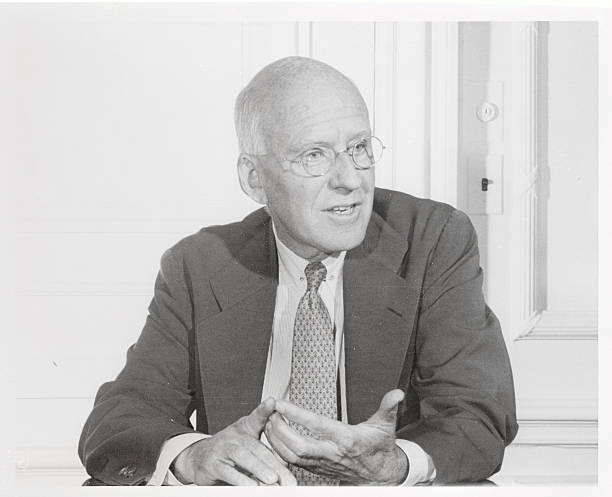
Overview
Royal Little did not set out to remake American capitalism. He set out, again and again, to win at textiles, and lost so often that he finally concluded the business itself was the problem [1][6]. Out of that disgust came the modern conglomerate: a corporation deliberately spread across unrelated industries so that no single market cycle could sink it. By the time he retired in 1960, his company, Textron, owned some forty businesses turning out everything from helicopters and radar antennas to chain saws, golf carts, watchbands, and silverware, and Wall Street had a new word for the species he had spawned [2][4][5].
He started small. In 1923 the twenty-seven-year-old Little borrowed about $10,000 and founded the Special Yarns Corporation in Boston to process synthetic yarn, a then-exotic material; first-year sales were $75,000 [3][6]. Over the next two decades he chased a dream of vertical integration in textiles, owning the whole chain from fiber to finished, branded garment, renaming the firm Atlantic Rayon, pivoting to parachute manufacturing in World War II, and in 1944 christening it Textron, a coinage welding "textiles" to the "-tron" of the new synthetics [1][4][5]. By 1947 sales topped $125 million and Little had, on paper, his integrated textile giant [6]. Then the postwar textile slump of 1948–49 gutted it, and the whole laboriously assembled empire of New England mills began bleeding [1][6].
The turn came from an accountant's insight, not a manufacturer's. In 1948 Little bought the Cleveland Pneumatic Tool Company for $6.8 million, Textron's first nontextile firm, and discovered how the losses of one division could shelter the profits of another from tax [4][5]. In late 1951 he reorganized around a doctrine he called "unrelated diversification": buy leaders in small industries, demand a hard return on equity from each, and let the portfolio ride out cycles that would have broken any single line [1][7]. In 1952 he won shareholder approval to amend the charter and operate nontextile businesses, and the buying spree began, Dalmo Victor, MB Manufacturing, Homelite, Camcar, plywood and aluminum and leather concerns, two dozen of them by 1958 [4][5].
The defining brawl was the American Woolen Company. In 1954 Little went after the world's largest woolen-fabric maker, not for its mills, which were losing roughly a million dollars a month, but for its cash hoard and a tax-loss carryover worth tens of millions that he could use to finance still more diversification [4][7]. The proxy and tender battle was so vicious that Fortune called it "the stormiest merger yet"; Textron won in 1955, and the experience finished off whatever affection Little still had for the textile trade [4][7]. Sales climbed from $99 million in 1952 to $383 million in 1960, and in 1960 he capped the transformation by acquiring Bell Aircraft, bringing the Bell helicopter line into the fold [2][4].
Little stepped down as chairman in 1960 and severed all ties with Textron by 1962, then refused to actually retire [2][3]. He founded Narragansett Capital, an early small-business investment company, and a consulting outfit to teach others the acquisition game, insisting that in venture finance the only thing that mattered was "people! people! people!" [1][6]. In 1979, at eighty-three, he published a gleefully self-deprecating memoir, "How to Lose $100,000,000 and Other Valuable Advice," cataloguing his costliest blunders, and remarking that he hadn't lost the money, the stockholders had [1][8].
He was, in the end, a financier wearing a manufacturer's overalls: less interested in any product than in the return on the capital tied up making it. That coldly numerical view of the corporation, the firm as a portfolio of cash flows to be optimized rather than a craft to be perfected, was his real invention, and it spread from Textron through Litton, LTV, Gulf and Western, and ITT to define an entire era of American business [2][6].
Early Life & Path
Royal Little was born March 1, 1896, in Wakefield, Massachusetts, into an unsettled family that drifted around the country as his stepfather chased printing work [2][6]. His connection to business came through his uncle, Arthur D. Little, the founder of the famous Cambridge consulting and chemical-research firm that bore his name. The uncle was childless, and around 1910 he invited the boy to come back to Boston, live in his household, and eventually enter the business world [2][6].
Little was educated at the Noble and Greenough School, graduating in 1915, and then at Harvard, where he studied and emerged with the class of 1919 despite, by his own cheerful admission, time on academic probation [2][6]. His schooling was interrupted by World War I, in which he served as an Army lieutenant [6]. The Harvard years left him with a lifelong network and a taste for the deal, but no romance about industry for its own sake.
After graduation he went to work learning the textile trade from the bottom, an apprenticeship at Cheney Brothers, the Connecticut silk house, jobs at a string of textile firms, and a stint at a Wall Street brokerage to learn finance, the combination that would later make him so dangerous [2][6]. In 1923, at twenty-seven, he scraped together roughly $10,000 in borrowed money and opened the Special Yarns Corporation in Boston, betting on the unproven synthetic fibers that more cautious men avoided, the first move in a fifty-year career [3][6].
Career Timeline
- 1896Born March 1 in Wakefield, Massachusetts [2][6].
- 1919Graduates from Harvard (class of 1919) after Army service in World War I [2][6].
- 1923Founds the Special Yarns Corporation in Boston with about $10,000 in borrowed money; first-year sales of $75,000 [3][6].
- 1928Acquires the Franklin Rayon Dyeing Company and consolidates operations in Providence, Rhode Island [5].
- 1944Renames the company Textron, fusing "textiles" with the "-tron" of synthetic fibers [1][4].
- 1947Sales top $125 million; Little has built his dreamed-of integrated textile giant [6].
- 1948Buys the Cleveland Pneumatic Tool Company for $6.8 million, Textron's first nontextile firm [4][5].
- 1948–1949The postwar textile slump inflicts heavy losses on Textron's New England mills [1][6].
- 1951Adopts the strategy of "unrelated diversification" in late 1951 after concluding textiles can never reliably reward capital [1][7].
- 1952Wins shareholder approval to amend the charter and operate nontextile businesses; sales of $99 million [4][5].
- 1954–1955Wages the bitter takeover of the American Woolen Company, "the stormiest merger yet," per Fortune, chiefly for its cash and tax-loss carryover [4][7].
- 1960Acquires Bell Aircraft, gaining the Bell helicopter line; sales reach $383 million; steps down as chairman [2][4].
- 1962Severs all remaining ties with Textron; later founds Narragansett Capital and a consulting firm [2][3].
- 1979Publishes the memoir "How to Lose $100,000,000 and Other Valuable Advice" [1][8].
- 1989Dies January 10 at his home in Nassau, the Bahamas, age 92; per his wishes there is no funeral [2][8].
Key Ventures & Innovations
Special Yarns / Textron (1923–1960)
Begun on roughly $10,000 to process synthetic yarn, the firm grew through the 1920s and 1930s, by 1930 selling about 4 percent of all rayon yarn in the United States, before Little reinvented it as the prototype conglomerate [3][5][6].
The vertically integrated textile dream (1943–1949)
Little tried to own the entire chain from fiber to branded finished goods, buying mills like Manville-Jenckes, Lonsdale, and Nashua. The 1948–49 slump exposed it as "a jumble of barely related textile firms," and its failure pushed him toward diversification [1][6].
Cleveland Pneumatic Tool (1948)
The $6.8 million purchase of an aircraft-landing-strut maker was Textron's first step outside textiles, and taught Little how a diversified portfolio could shelter profits from tax and smooth out cycles [4][5].
The American Woolen takeover (1954–1955)
A no-holds-barred proxy and tender fight for the world's largest woolen maker, pursued for its cash and a tax-loss carryover worth tens of millions, not its mills. Fortune dubbed it "the stormiest merger yet"; winning it killed Little's remaining taste for textiles [4][7].
Bell Aircraft (1960)
The capstone acquisition brought the Bell helicopter business into Textron, completing the journey from a yarn processor to a top-100 American industrial corporation in unrelated fields [2][4].
Narragansett Capital (1959 onward)
In semi-retirement Little ran one of the first small-business investment companies, betting on promising young firms and preaching that venture success came down to "people! people! people!" [1][6].
“I didn't lose it, the stockholders lost it.”
From the Record
“After having tried desperately in the past to make a success of (1) yarn processing, (2) parachute manufacturing, (3) the completely integrated Textron brand operation, and (4) low-cost southern mills, I decided that there must be some better medium than the textile business.”
“There is no question that the most important thing in venture capital financing is people! people! people!”
“Royal Little, the shrewd Rhode Island entrepreneur who is widely regarded as the inventor of the modern conglomerate, the highly diversified breed of corporation that became the rage on Wall Street in the late 1960's, died Thursday night at his home in Nassau in the Bahamas.”
What Operators Can Learn
- 01
Diversify what's unrelated, not what's adjacent
Little's heresy was that businesses should be combined precisely because they have nothing to do with one another, so their cycles cancel out. Owning more of the same volatile industry just doubles the exposure; owning unlike ones smooths the whole.
- 02
Manage the corporation as a portfolio of returns, not a craft
He cared less about any product than about the return on the capital tied up in it, demanding a hard hurdle rate from each division. The firm became a balance sheet to be optimized, the mindset that defined the conglomerate era.
- 03
The best asset can be the one nobody else wants
American Woolen was hemorrhaging cash, but its tax-loss carryover and reserves were worth more to Little than a healthy mill would have been. Value hides in the parts of a balance sheet that operators overlook.
- 04
Back people before ideas
No business, however promising, was worth buying unless its management was capable, and Little built incentives so that the founders he made rich kept working hard. In venture finance, he insisted, it was people, people, people.
- 05
Own your mistakes out loud
He titled his memoir after the fortune his blunders cost, calculated the real figure was higher, and joked he hadn't lost it, the stockholders had. The candor was both disarming and instructive.
Legacy
Royal Little's invention outlasted his company's textile roots and his own life. The conglomerate he pioneered at Textron, a diversified holding company knitting together unrelated businesses under tight financial control, became the dominant corporate fashion of the 1960s, copied by Tex Thornton at Litton, James Ling at LTV, Charles Bluhdorn at Gulf and Western, and Harold Geneen at ITT [2][6]. Robert Sobel's history of the movement opens its account of these "conglomerate kings" with Little, the man who started it all and, characteristically, walked away before the bubble burst [2].
Historians render a mixed verdict. Little was a genuine financial innovator who showed that a corporation could be engineered against the business cycle and that capital, not sentiment, should govern what a company makes [6][7]. He was also a buccaneer whose haphazard bargain-hunting earned him the nickname the "junk man" of the textile industry, and whose model, pushed to excess by imitators with more debt and less discipline, helped inflate a merger mania that collapsed in the early 1970s and gave "conglomerate" its later whiff of overreach [5][6].
Textron itself endured, shedding its last textile holdings by 1963 and surviving as a multibillion-dollar industrial company built on Little's blueprint [4][5]. In retirement he turned to philanthropy and venture capital, endowing trusts for the Rhode Island School of Design and the United Way and seeding small businesses through Narragansett Capital [3]. He had asked for no funeral, calling them "a barbaric institution" and hoping friends would simply think he had "taken a long trip" [8].
Further Reading
How to Lose $100,000,000 and Other Valuable Advice, Royal Little (1979)
The inventor of the conglomerate in his own candid, funny words, the essential primary source on his thinking and his mistakes.
The Rise and Fall of the Conglomerate Kings, Robert Sobel (1984)
The standard history of the conglomerate era, opening with Little and tracing the movement through Litton, LTV, Gulf and Western, and ITT.
The Entrepreneurs: Explorations Within the American Business Tradition, Robert Sobel (1974)
Sets Little among the great American business builders, with a chapter situating Textron in the wider entrepreneurial tradition.
The Making of a Conglomerate, Charles Gilbert (ed.) (1972)
An early scholarly examination of how diversified corporations like Textron were assembled and managed.
The Merger Game, Stan Sauerhaft (1971)
A contemporary insider's account of the acquisition and merger frenzy that Little's model helped unleash.
Sources
- 1.Royal Little, How to Lose $100,000,000 and Other Valuable Advice, Little, Brown and Company, 1979, book
- 2.Robert Sobel, The Rise and Fall of the Conglomerate Kings, Stein and Day, 1984, book
- 3.“Royal Little, Rhode Island Heritage Hall of Fame (induction biography)”, Rhode Island Heritage Hall of Fame, 2012, archive
- 4.Eric Pace, “"Royal Little, 92, Textron Founder And Developer of Conglomerate"”, The New York Times, January 12, 1989, newspaper
- 5.Textron Inc., “Company History”, Textron Inc. (corporate archive), n.d., archive
- 6.Robert Sobel, The Entrepreneurs: Explorations Within the American Business Tradition, Weybright and Talley, 1974, book
- 7.Textron Initiates the Trend Toward Conglomeration (Research Starter), EBSCO Research Starters: History, 2023, journal
- 8.David R. Francis, “"A conglomerate whiz, 84, sharing his know-how"”, The Christian Science Monitor, October 10, 1980, newspaper
Researched and written with Claude + live web search.