Overview
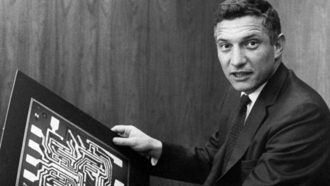
Robert Noyce did not invent the integrated circuit alone, and he was not the first to build one; Jack Kilby of Texas Instruments demonstrated a working hybrid circuit in 1958, months ahead [4][5]. What Noyce did at Fairchild Semiconductor was rarer and more consequential: working from Jean Hoerni's planar process, he conceived a way to fabricate an entire circuit, transistors, resistors, and the wiring between them, in one monolithic slab of silicon, with the interconnections laid down as evaporated metal lines on an oxide surface [4][5]. That was the form of the chip that could actually be mass-produced, and it became the template for the entire industry [1][4].
The company itself was born of a revolt. In 1956 Noyce had joined William Shockley's new transistor lab near Palo Alto, lured by the chance to work for the co-inventor of the transistor [1]. Shockley proved a brilliant scientist and an intolerable boss, paranoid, abusive, and erratic, and in 1957 eight of his young researchers, with Noyce as their reluctant leader, walked out together [1][2]. Shockley called them the "traitorous eight." Backed by the East Coast industrialist Sherman Fairchild after the financier Arthur Rock found them a sponsor, the eight signed dollar bills as their founding stock certificates and incorporated Fairchild Semiconductor on September 18, 1957, on a loan of about $1.38 million [2][6].
Fairchild grew with startling speed. Its first transistors went to IBM's Federal Systems Division, 100 units at $150 apiece for the B-70 bomber's computer, and in its first full year, 1958, the company booked over $500,000 in sales and finished in the black [6]. Hoerni's planar process, then Noyce's integrated circuit built on top of it, gave Fairchild reliable, cheap, manufacturable chips, and by the late 1960s the company employed tens of thousands [1][6]. But success bred defection: Fairchild's profits flowed to a distant parent corporation, stock options were thin, and one by one the founders and their best people peeled off to start rival firms, the "Fairchildren" who would seed the valley [1][2].
In the summer of 1968, Noyce, passed over to run the parent company and chafing at corporate control, did to Fairchild what he had once done to Shockley [1]. Gordon Moore came to talk while Noyce was mowing his lawn; they decided to leave together, Noyce phoned Arthur Rock for $2.5 million, and Intel was incorporated that July [1][3]. Noyce was Intel's first president and CEO, and the management style he had pioneered at Fairchild, no reserved parking, no executive dining rooms, first names, partitioned cubicles instead of corner offices, became the cultural signature of Silicon Valley itself [1][2][3].
Noyce was a study in productive contradiction: a Congregational minister's son who rejected organized religion; a multimillionaire who exuded "just folks" charm; a man who flew his own planes and skied helicopter slopes yet counseled employees to "go off and do something wonderful" [1]. Tom Wolfe, profiling him for Esquire in 1983, found the key to the man in the dissenting-Protestant Midwest that made him, the small-town ethic that when something breaks, you fix it yourself, and that hierarchy is something to be distrusted [1][2].
By the time he died of a heart attack in 1990 at sixty-two, Noyce held some sixteen patents, the National Medal of Science and the National Medal of Technology, and a nickname, "the Mayor of Silicon Valley", that captured a role no patent could [5][8]. His last act was public service: running Sematech, the government-industry consortium formed to claw back American chip manufacturing from Japan [5][8].
Early Life & Path
He was born December 12, 1927, in Burlington, Iowa, and grew up mostly in Grinnell, a town of about seven thousand on the prairie, the third of four sons of Ralph Brewster Noyce, a Congregational minister [1][8]. Both of his grandfathers had been Congregational ministers as well, and the dissenting-Protestant rectitude of small-town Iowa, self-reliant, suspicious of show, certain that a broken thing is a thing you fix yourself, stamped him for life [1]. As a boy he and his brother built a glider with an eighteen-foot wingspan and launched it from a barn roof; the tinkering never stopped [8].
At Grinnell College he majored in physics and mathematics and very nearly threw it all away. In a famous escapade he stole a twenty-five-pound pig from a local farm for a dormitory luau, a felony in agricultural Iowa, and was suspended for a semester rather than expelled, largely because his physics professor, Grant Gale, refused to lose him [8]. Gale was the decisive figure of his youth: a college classmate of the transistor's co-inventor John Bardeen, Gale obtained two of the first transistors ever made and, by the fall of 1948, was teaching what may have been the first solid-state electronics course anywhere, to the eighteen physics majors at Grinnell [1]. Noyce was among them, and he was hooked [1].
He earned his bachelor's degree in 1949, took a Ph.D. in physics from MIT in 1953, and went to work as a research engineer at Philco in Philadelphia [5]. In 1956 William Shockley recruited him to the new Shockley Semiconductor Laboratory in Mountain View, California, the move west that would, within two years and one mutiny, put him at the center of an industry that did not yet have a name [1][2].
Career Timeline
- 1927Born December 12 in Burlington, Iowa, son of a Congregational minister; raised in Grinnell [1][8].
- 1948At Grinnell College, studies the first transistors under professor Grant Gale, who knew transistor co-inventor John Bardeen [1].
- 1949Earns B.A. in physics and mathematics from Grinnell College [5].
- 1953Receives Ph.D. in physics from MIT; joins Philco in Philadelphia as a research engineer [5].
- 1956Recruited by William Shockley to the Shockley Semiconductor Laboratory near Palo Alto [1][2].
- 1957Leads the "traitorous eight" out of Shockley's lab; Fairchild Semiconductor is incorporated September 18 on a ~$1.38 million loan [2][6].
- 1958Fairchild sells its first transistors to IBM (100 units at $150 each) and ends its first full year in the black with over $500,000 in sales [6].
- 1959Building on Jean Hoerni's planar process, conceives the monolithic integrated circuit; files patent for a "Semiconductor Device-and-Lead Structure" on July 30 [4][5].
- 1961U.S. Patent 2,981,877 is granted on April 25, anchoring Fairchild's side of the long IC patent fight with Texas Instruments [4].
- 1968Leaves Fairchild with Gordon Moore; Intel is incorporated in July with $2.5 million raised through Arthur Rock; Noyce becomes first CEO [1][3].
- 1971Intel ships the 4004, the first commercial microprocessor, packing the logic of a computer onto a single chip [5].
- 1975Hands the Intel CEO role to Gordon Moore, becoming chairman [3][5].
- 1979Receives the National Medal of Science; had won the IEEE Medal of Honor in 1978 [5][8].
- 1988Becomes president and CEO of Sematech, the U.S. chip-manufacturing consortium, and moves to Austin, Texas [5][8].
- 1990Dies June 3 of a heart attack in Austin at age 62 [5][8].
Key Ventures & Innovations
Fairchild Semiconductor (1957)
Founded by the eight who quit Shockley, with Noyce as research head and de facto leader. Sherman Fairchild's backing came after Noyce's vision pitch; the founders signed dollar bills as stock and built the firm into a multi-thousand-employee giant on the strength of the planar transistor and the integrated circuit [1][2][6].
The monolithic integrated circuit (1959)
Where Kilby wired components together by hand, Noyce, using Hoerni's flat, oxide-protected planar surface, saw how to print the wiring directly onto the silicon, making the whole circuit a single manufacturable object. It was the chip the world could actually mass-produce [4][5].
Intel (1968)
Co-founded with Gordon Moore and funded by Arthur Rock, Intel turned the chip into the engine of computing, first memory, then in 1971 the 4004 microprocessor. Noyce, its first CEO, embedded the flat, perk-free, options-rich culture that defined the valley [1][3][5].
The egalitarian workplace
Noyce's deliberate war on corporate hierarchy, no reserved parking, no limousines, no executive dining rooms, cubicles for all, broad stock ownership, was as influential as any circuit. Tom Wolfe immortalized it as the social invention beneath the technical ones [1][2].
Sematech (1988)
In his final role, Noyce left semi-retirement to lead the government-industry consortium created to rescue U.S. chip manufacturing from Japanese competition, lending the effort his stature as elder statesman of the industry [5][8].
“Don't be encumbered by history. Go off and do something wonderful.”
From the Record
“So by the fall of 1948 Gale had obtained two of the first transistors ever made, and he presented the first academic instruction in solid-state electronics available anywhere in the world, for the benefit of the eighteen students majoring in physics at Grinnell College.”
“Not only would there be no limousines and chauffeurs, there would not even be any reserved parking places. Work began at eight A.M. for one and all.”
“Bob Noyce's father, Ralph Sr., was a Congregational minister. Not only that, both of his grandfathers were Congregational ministers.”
What Operators Can Learn
- 01
Being first matters less than being manufacturable
Kilby built an integrated circuit before Noyce did. Noyce won the industry by conceiving the version that could be produced cheaply and reliably at scale. The decisive innovation is often not the demonstration but the process that makes it ordinary.
- 02
Culture is a deliberate invention
Noyce engineered the flat, perk-free, options-rich workplace as carefully as he engineered circuits, precisely because he had suffered Shockley's tyranny. The social design proved as durable and as copied as the technical one.
- 03
Treat people as you wished Shockley had treated you
Having walked out on an abusive genius, Noyce led by trust and autonomy, "go off and do something wonderful", and it bred loyalty, initiative, and a self-replicating ecosystem of new companies.
- 04
Talent that leaves is still a legacy
The very openness that made Fairchild and Intel great also let people leave to found rivals. Noyce accepted that the "Fairchildren" diffusing his methods across the valley were not a loss but the point.
Legacy
Noyce's monolithic chip is the physical foundation of the digital age: every computer, phone, and networked machine descends from the idea of printing an entire circuit onto a single piece of silicon [4][5]. But his deeper legacy may be social. The company he could not hold together, Fairchild, scattered its talent across Santa Clara County and seeded dozens of firms; the flat, informal, equity-sharing culture he built first there and then at Intel became the operating system of Silicon Valley itself [1][2]. Tom Wolfe argued that the valley's whole ethos, anti-hierarchical, restless, indifferent to inherited status, was an export of the dissenting Midwest that produced Robert Noyce [1].
He was, in his last decades, the industry's elder statesman, "the Mayor of Silicon Valley", co-founding the Semiconductor Industry Association, lobbying Washington, and finally leading Sematech to defend American chipmaking [5][8]. He mentored a young Steve Jobs and was widely beloved in a business not known for warmth [1][5]. Honored with the National Medal of Science, the National Medal of Technology, and the IEEE Medal of Honor, he died in 1990 with the integrated circuit's paternity formally shared with Kilby, a settlement that suited a man who always insisted the work mattered more than the credit [4][5][8].
Further Reading
The Man Behind the Microchip: Robert Noyce and the Invention of Silicon Valley, Leslie Berlin (2005)
The definitive, archive-grounded biography; the indispensable single volume on Noyce and the birth of the valley.
The Intel Trinity: How Robert Noyce, Gordon Moore, and Andy Grove Built the World's Most Important Company, Michael S. Malone (2014)
A vivid company history centered on the three leaders, strong on Noyce's role and the founding of Intel.
Crystal Fire: The Birth of the Information Age, Michael Riordan and Lillian Hoddeson (1997)
The standard history of the transistor and early semiconductor industry that set the stage for Noyce's work.
"The Tinkerings of Robert Noyce" (Esquire, December 1983), Tom Wolfe (1983)
The most celebrated piece of journalism about Silicon Valley, locating Noyce's character in the dissenting Midwest.
The Chip: How Two Americans Invented the Microchip and Launched a Revolution, T. R. Reid (1985)
Accessible joint account of Noyce and Kilby and the parallel invention of the integrated circuit.
Sources
- 1.Leslie Berlin, The Man Behind the Microchip: Robert Noyce and the Invention of Silicon Valley, Oxford University Press, 2005, book
- 2.Michael S. Malone, The Intel Trinity: How Robert Noyce, Gordon Moore, and Andy Grove Built the World's Most Important Company, HarperBusiness, 2014, book
- 3.“Intel's Founding”, Computer History Museum (chiphistory.org), 1968, archive
- 4.Robert N. Noyce (inventor), “Milestones: Semiconductor Planar Process and Integrated Circuit, 1959; U.S. Patent 2,981,877, "Semiconductor Device-and-Lead Structure"”, Engineering and Technology History Wiki (ETHW) / U.S. Patent and Trademark Office, 1959-1961, archive
- 5.“Robert N. Noyce, Co-Inventor of Semiconductor Chip, Dies”, The Washington Post, June 4, 1990, newspaper
- 6.“1958: Silicon Mesa Transistors Enter Commercial Production”, Computer History Museum, The Silicon Engine, 1958, archive
- 7.Michael Riordan and Lillian Hoddeson, Crystal Fire: The Birth of the Information Age, W. W. Norton & Company, 1997, book
- 8.William B. Ashworth Jr., “Robert Noyce, American Physicist (Scientist of the Day)”, Linda Hall Library, 2020
Researched and written with Claude + live web search.