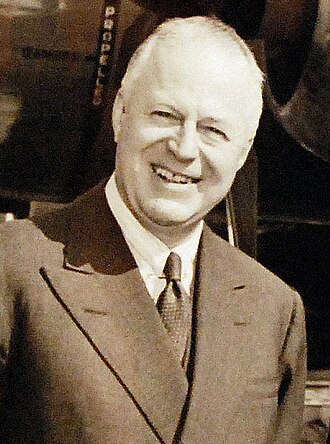
Overview
Robert Ellsworth Gross did not invent an airplane, draw a wing, or fly a mission. He was a Boston-bred investment banker who understood something most engineers did not: that an aircraft company is, before it is anything else, a perpetual financing problem, and that the firm which could keep raising money through the lean years and bet it boldly in the fat ones would inherit the sky. On the morning of June 21, 1932, at the bottom of the Great Depression, the thirty-five-year-old Gross stood in a U.S. district court in Los Angeles holding a single white envelope and bought the assets of the bankrupt Lockheed out of receivership for $40,000 [4][1]. The judge looked at him and said, "I hope, young man, you know what you're doing." Gross answered, "I do," and over the next twenty-eight years he was proved right [4].
The company he bought was a husk, a famous name attached to the wreckage of the Detroit Aircraft Corporation, maker of the wooden Vega and Orion that had carried Wiley Post and Amelia Earhart, but with no cash, few orders, and a market for civil aircraft that the Depression had simply erased [3][1]. Gross's first and most important act was not technical but human: he assembled and kept a team, Hall Hibbard as chief engineer, Carl Squier in sales, and a brilliant, headstrong twenty-three-year-old named Clarence "Kelly" Johnson, and turned them loose on a single audacious idea, a fast, all-metal twin-engine transport called the Model 10 Electra [1][9]. It was a young Johnson, sent back to the University of Michigan wind tunnel, who solved the airplane's stability problem with the twin tail that became a Lockheed signature, after seventy-odd tunnel runs [10]. The Electra flew in February 1934 and sold roughly forty in its first year, enough to put the reorganized Lockheed Aircraft Corporation, with Gross as its driving force, onto its feet [1][9].
Gross's gift was nerve disciplined by arithmetic. He bet repeatedly on aircraft his company had no business building. In 1937, when daring blueprints for a radical twin-boom fighter came across his desk, he backed them despite Lockheed's near-total lack of military experience; the result was the P-38 Lightning [8][4]. In 1938, when a British Purchasing Commission led by Sir Henry Self arrived in America shopping for warplanes, Lockheed had no bomber, so Gross's men built a full wooden mock-up of a bomber version of the Super Electra, rebuilt it overnight to the RAF's specifications, and signed on June 23, 1938, a contract for up to 250 Hudson bombers, the largest foreign aircraft order an American firm had ever taken [5][1]. "I was entirely convinced," Sir Arthur Harris later wrote, "that anyone who could produce a mock-up in twenty-four hours would indeed make good on all his promises, and this Lockheed most certainly did" [5].
The boldest gamble of all came in 1939, in secret. Howard Hughes, who had just bought control of TWA, summoned Gross, Hibbard, and Johnson to a Beverly Hills meeting and demanded a pressurized airliner that could cross the country nonstop. Gross committed Lockheed to it on Hughes's terms, exclusivity, total secrecy, and TWA placed an order for forty of the planes for roughly $18 million, the largest commercial aircraft order in history to that point [1]. The airplane became the triple-tailed Lockheed Constellation, the most beautiful airliner of the propeller age, and it nearly defined the company [1]. "Up to that time," Hibbard said, "we were sort of 'small-time guys,' but when we got to the Constellation we had to be 'big-time guys'" [1].
World War II turned Gross's bets into a torrent. Lockheed and its Vega subsidiary built some 19,000 aircraft, about six percent of all American wartime production, and the Burbank work force swelled to roughly 94,000 men and women at its 1943 peak, the whole sprawling complex hidden under a famous painted-canvas "camouflage" of fake suburban streets [8][4]. By the time TIME put Gross on its cover on January 14, 1946, Lockheed had vaulted from a $40,000 courtroom curiosity to one of the great industrial enterprises in America [6]. Through the Korean War and the dawn of the jet and missile age, Gross, president from 1934 to 1956 and then chairman until his death, kept the company at the forward edge, sponsoring the Shooting Star jet fighter and the secret world of Kelly Johnson's Skunk Works that would produce the U-2 [8][4]. He had grasped, before almost anyone, that aerospace was a business of capital and conviction, and that the company willing to look farthest ahead would win [4].
Early Life & Path
Robert Ellsworth Gross was born May 11, 1897, in Newton, Massachusetts, into a comfortable New England family; his father, Robert Haven Gross, was a businessman [1]. He was schooled at St. George's School in Middletown, Rhode Island, graduating in 1915, and went on to Harvard, where in his senior year he was elected captain of the ice-hockey team, a hint of the cool competitiveness that would later mark the boardroom [1]. He came out of Harvard not into a workshop but into the world of money, learning the trade of investment banking and underwriting in Boston and New York [1][4].
It was finance that drew him to aviation rather than the other way around. In the booming late 1920s, when aircraft stocks were the dot-coms of their day, Gross helped underwrite and organize aviation ventures, and he founded his own, the Viking Flying Boat Company, building a French amphibian under license [1]. The Depression destroyed it; the market for private aircraft evaporated almost overnight, and Viking failed, taking Gross's first independent venture down with it [1]. The lesson stuck. He had watched a sound little company die not for lack of a good airplane but for lack of capital and a market, and he resolved that whatever he built next would be financed to survive the bad years [4].
That resolve led him west. When the Lockheed name came up for sale out of the bankruptcy of the Detroit Aircraft Corporation, Gross, together with his younger brother Courtlandt, the airman Lloyd Stearman, and the investor Walter Varney, pulled together $40,000 and made his move in the Los Angeles courtroom in June 1932 [4][1]. Stearman was named the new firm's first president and Gross its treasurer and guiding hand; by 1934, with the company reorganized as the Lockheed Aircraft Corporation, Robert Gross had emerged as its undisputed leader [1]. He was thirty-seven years old, once-failed, and now responsible for a famous name and a few dozen anxious employees in Burbank [1][4].
Career Timeline
- 1897Born May 11 in Newton, Massachusetts, son of businessman Robert Haven Gross [1].
- 1915Graduates from St. George's School in Middletown, Rhode Island, before attending Harvard [1].
- 1920sWorks as an investment banker and underwriter, then founds the Viking Flying Boat Company, which the Depression destroys [1][4].
- 1932On June 21, buys the bankrupt Lockheed's assets out of receivership for $40,000 with a single envelope in a Los Angeles courtroom [4][1].
- 1934The Model 10 Electra first flies on February 24; the reorganized Lockheed Aircraft Corporation finds its feet with Gross as its leader [1][9].
- 1937Backs the radical twin-boom P-38 Lightning fighter despite Lockheed's lack of military experience [8][4].
- 1938Signs the British Hudson bomber contract on June 23 for up to 250 aircraft, the largest foreign aircraft order an American firm had taken [5][1].
- 1939In a secret meeting, commits Lockheed to build the Constellation for Howard Hughes's TWA; the order grows to 40 planes for about $18 million [1].
- 1943Burbank work force peaks near 94,000; Lockheed and Vega build roughly 19,000 aircraft during the war, about 6% of U.S. output [8][4].
- 1946Appears on the cover of TIME on January 14 as Lockheed's commercial Constellation enters airline service [6].
- 1954Kelly Johnson's secret Skunk Works begins the U-2 spy plane under Gross's company, born of the Shooting Star jet program [8][4].
- 1956Steps up from president to chairman of the board while remaining chief executive officer [4].
- 1961Dies September 3 in Los Angeles of pancreatic cancer, aged 64; succeeded as chairman by his brother Courtlandt [1].
Key Ventures & Innovations
The 1932 courtroom purchase
Gross led a small syndicate, his brother Courtlandt, Lloyd Stearman, and Walter Varney, that bought the bankrupt Lockheed's assets for $40,000 in a Los Angeles receivership court on June 21, 1932, when the civil-aviation market had all but vanished [4][1]. It was a banker's bet on a famous name and a salvageable team at the bottom of the Depression.
The Model 10 Electra (1934)
Gross bet the reorganized company's scarce capital on a fast, all-metal twin-engine transport. The young Kelly Johnson, sent to the Michigan wind tunnel, solved its stability problem with the twin tail that became a Lockheed hallmark; the Electra flew in February 1934 and sold about forty in its first year [1][9][10].
The P-38 Lightning (1937)
When blueprints for a radical twin-boom interceptor crossed his desk, Gross backed them though Lockheed had almost no military experience [8][4]. The Lightning became one of the decisive Allied fighters of the war and the foundation of Lockheed's defense business.
The Hudson bomber and the British order (1938)
With no bomber to offer the visiting British Purchasing Commission, Gross's men built a wooden mock-up and rebuilt it overnight to RAF specifications, winning a contract on June 23, 1938 for up to 250 Hudsons, the largest foreign aircraft order yet placed with an American company [5][1].
The Constellation and the Hughes gamble (1939)
In secret, Gross committed Lockheed to Howard Hughes's vision of a pressurized transcontinental airliner; TWA's order grew to forty planes worth roughly $18 million, the largest commercial aircraft order to that date [1]. The triple-tailed Constellation became the masterpiece of the piston-airliner age and made Lockheed a 'big-time' company [1].
“Look ahead, where the horizons are absolutely unlimited.”
From the Record
“I hope, young man, you know what you're doing.”
“I was entirely convinced that anyone who could produce a mock-up in twenty-four hours would indeed make good on all his promises, and this Lockheed most certainly did.”
“Up to that time we were sort of 'small-time guys,' but when we got to the Constellation we had to be 'big-time guys.'”
What Operators Can Learn
- 01
Buy assets at the bottom, with conviction
Gross acquired a famous name and a salvageable team for $40,000 precisely when no one else wanted them. The willingness to commit capital at the moment of maximum fear, when the price is lowest, was the whole foundation of Lockheed.
- 02
A company is its people before its products
Gross could not design a wing, so he kept and protected those who could, Hibbard, Squier, and above all the young Kelly Johnson. His genius was talent recognition and the patience to back a twenty-three-year-old's hunch.
- 03
Treat financing as the core competence, not a chore
Having watched his Viking venture die for lack of capital, Gross built Lockheed to survive lean years and strike in flush ones. He understood aerospace as a perpetual financing problem long before the term existed.
- 04
Win the order by out-hustling, then make good
The overnight Hudson mock-up and the audacious Constellation commitment show a leader willing to promise boldly to land the deal, and an organization disciplined enough to deliver on the promise.
Legacy
Robert Gross took a $40,000 courtroom curiosity and, in less than a decade, made it the leading aircraft manufacturer in the world, and by the 1950s the largest defense company in the nation [4][8]. The institutions he built outlived him completely: the Burbank works that armed the Allies, the Constellation that crossed oceans, the P-38 and the Shooting Star, and, most enduringly, the culture of audacious engineering embodied in Kelly Johnson's Skunk Works, which under Gross's patronage produced the U-2 and set the pattern for secret American aerospace development for the rest of the century [8][4]. The modern Lockheed Martin descends in a straight line from the team he assembled in a half-empty Burbank hangar [1].
He is the rare founder remembered chiefly for nerve and judgment rather than invention. His exhortation to his employees, "Look ahead, where the horizons are absolutely unlimited", captured a management philosophy of forward conviction that became the company's self-image [4]. When he died of pancreatic cancer in 1961, the family torch passed to his brother Courtlandt, and Gross was inducted into the National Aviation Hall of Fame as the man who, more than any engineer, willed Lockheed into being [9][1]. His papers, preserved at the Library of Congress, remain the archival record of how a banker's discipline and a gambler's nerve combined to put much of the free world in the air [7].
Further Reading
Beyond the Horizons: The Story of Lockheed, Walter J. Boyne (1998)
The definitive single-volume company history by a former Smithsonian air-museum director, strong on Gross's leadership and finance.
Revolution in the Sky: The Lockheeds of Aviation's Golden Age, Richard Sanders Allen (1988)
The illustrated history of the early single-engine Lockheeds and the famous pilots who flew them, context for the company Gross inherited.
Of Men and Stars: A History of Lockheed Aircraft Corporation, Lockheed Aircraft Corporation (1957–1958)
The company's own chapter-by-chapter house history, drawing on Lockheed archives and Robert and Courtlandt Gross.
Kelly: More Than My Share of It All, Clarence L. "Kelly" Johnson with Maggie Smith (1985)
The memoir of the engineer Gross discovered and protected, the inside view of the Electra, the P-38, and the Skunk Works.
Skunk Works: A Personal Memoir of My Years at Lockheed, Ben R. Rich and Leo Janos (1994)
The classic account of the secret unit that grew under Gross's company, vivid on the U-2 and the culture of audacious design.
Sources
- 1.Lockheed Aircraft Corporation (Public Relations Office), Of Men and Stars: A History of Lockheed Aircraft Corporation, Lockheed Aircraft Corporation, 1957–1958, book
- 2.Walter J. Boyne, Beyond the Horizons: The Story of Lockheed, St. Martin's Press, 1998, book
- 3.Richard Sanders Allen, Revolution in the Sky: The Lockheeds of Aviation's Golden Age, Orion Books (rev. ed.), 1988, book
- 4.“Pushing the Envelope: The Robert E. Gross Story”, Lockheed Martin
- 5.“The Hudson”, Lockheed Martin
- 6.“TIME Magazine cover: Robert E. Gross, "Lockheed boss"”, TIME Magazine, January 14, 1946, newspaper
- 7.“Robert Ellsworth Gross papers, 1903–1961”, Manuscript Division, Library of Congress, 1903–1961, archive
- 8.“Robert E. Gross, 20th Century Leaders”, Harvard Business School
- 9.“Robert Ellsworth Gross”, National Aviation Hall of Fame
- 10.“Kelly Johnson to the Rescue”, University of Michigan Heritage Project
Researched and written with Claude + live web search.