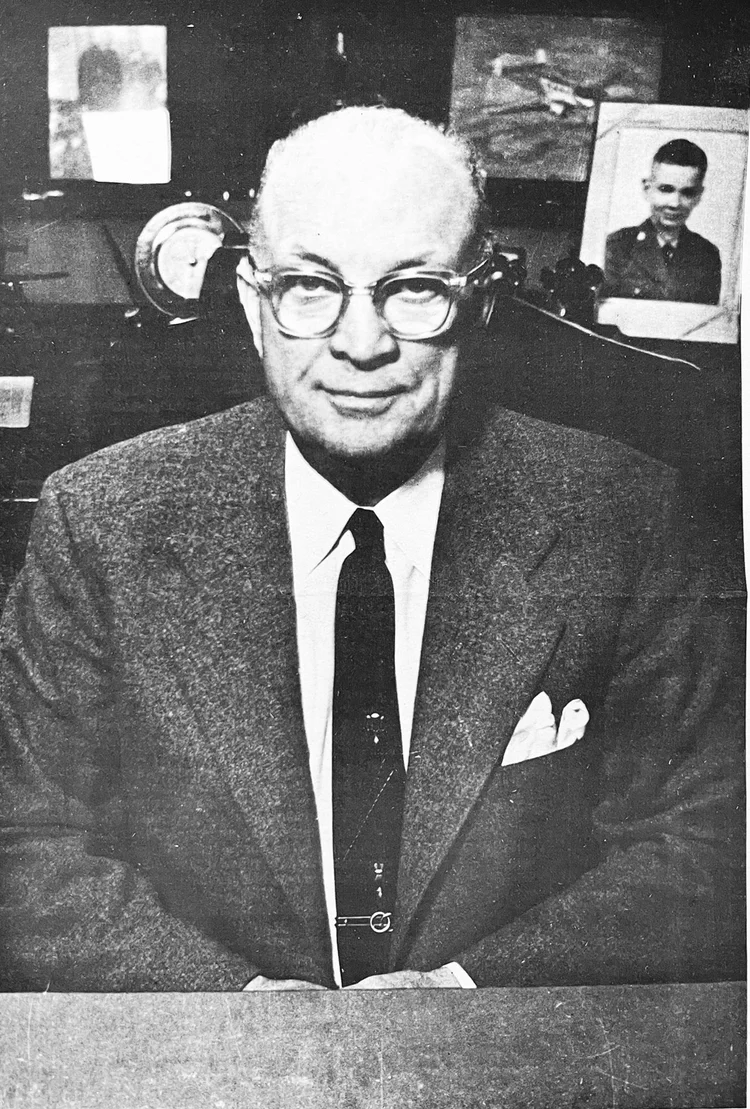
Overview
Ray W. Herrick did not invent the refrigerator, the air conditioner, or the hermetically sealed compressor that made both possible. What he did was take the assembly-line discipline he had absorbed in the Michigan auto industry and bend it around a single unglamorous part, the small motor-and-pump unit sealed inside every cooling machine, until Tecumseh Products of Tecumseh, Michigan, became the largest independent producer of refrigeration compressors on earth [1][2]. He built it not in Detroit but in a farm town sixty miles southwest, out of a company that had been four years from bankruptcy when he took control of it [1][5].
The firm began in 1930 as the Hillsdale Machine & Tool Company, a partnership Herrick formed with the local toolmaker C.F. "Bill" Sage to stamp out parts for Ford Motor Company; at the start Sage and his wife held two-thirds of the stock and Herrick one-third [1][2]. Revenue climbed astonishingly for a Depression start-up, from $26,000 in the first year to $284,000 by 1933, and by then Herrick had bought out most of the Sages and seized control [1]. Yet the firm was still teetering toward insolvency in 1934 [1][2].
What saved it was a relationship Herrick had cultivated for years. A master toolmaker who had come up through Michigan's auto economy, he had made himself a friend and adviser to Henry Ford, Harvey Firestone, and Thomas Edison [1][3], and had absorbed the auto industry's assembly-line methods well enough to carry them into an entirely different product [11]. In 1934 Ford intervened personally, by one account summoning Herrick to Dearborn and steering him toward an empty plant in Tecumseh, then helping him secure a line of credit with a Detroit bank [1][6]. Through a coordinated push by Herrick, Ford, private investors, and the city of Tecumseh, the company scraped together a little more than $12,000, took over an abandoned 30,000-square-foot building, and was reborn as Tecumseh Products [1][2].
The pivot that built the fortune came in 1936, when Herrick committed the plant to hermetically sealed refrigeration compressors, drawing on designs from engineers (Frank Smith, later joined by Curtis Brown and Jens Touborg in the firm Tresco) who could deliver inexpensive, reliable units to rival the big appliance makers' own [1]. By the end of the 1930s Tecumseh was turning out more than 100,000 compressors a year [1][2]. World War II turned the plant to defense work, 40-millimeter shell casings for the Navy and precision aircraft-engine parts, earning the company a Navy "E" award for excellence in April 1942 [2][4]. Then came the postwar boom in refrigerators and the new market for room air conditioners, and Tecumseh rode both: by 1950 sales had reached roughly $72 million and annual output topped two million compressors, with customers as large as General Electric [1]. By the late 1950s sales exceeded $160 million, and Herrick later bought the Tresco design firm outright for nearly $5 million [1][6].
Herrick ran the company as a near-autocrat with a theatrical, intensely religious streak, and the credo he stamped on it, "We believe in God, we mind our business and we work like hell", outlasted him by generations, still being quoted by his grandson decades later [1]. He installed a professional president, Joseph E. Layton, in 1955 while keeping the chairmanship, and at seventy-six in 1966 handed the presidency to his son Kenneth and took the vice-chairmanship [1]. When he died in 1973, Tecumseh had made well over 100 million compressors and 25 million small engines, and Herrick had become one of Michigan's great industrial philanthropists [1][3].
Early Life & Path
Raymond Wesley Herrick was born in 1890 and raised in rural Michigan, a toolmaker's son of the kind the state's exploding auto industry was built on [1][3]. He was, by his own record, restless: between 1911 and 1931 he worked for some ten different companies before he ever ran one of his own, accumulating the shop-floor command of tools, dies, and production flow that would define everything he later built [6]. He was a master toolmaker, not an engineer or a financier, a man whose authority came from knowing how a part was actually made.
In 1928 he joined the struggling Alamo Engine Company in Hillsdale, Michigan, rising to factory manager and then director of sales and production, a post he held until 1933 [1]. It was in Hillsdale, in 1930, that he and Bill Sage launched the machine-and-tool partnership that became the seed of Tecumseh, reputedly starting in a livery stable on Railroad Street before the work outgrew it [1][2]. The Hillsdale shop made parts for Ford, and it was through the Detroit auto world that Herrick built the friendships, with Ford above all, that would rescue him when the Depression nearly closed him down [1][3].
Those relationships were the hidden capital of his career. By the time Herrick was struggling in the early 1930s, he was on terms with Henry Ford, Harvey Firestone, and Thomas Edison, and it was Ford's personal intervention in 1934 that turned a failing tool shop into the company that would carry the town's name across the world [1][3][6].
Career Timeline
- 1890Raymond Wesley Herrick born in rural Michigan [1][3].
- 1911–1931Works for roughly ten different companies, mastering tools, dies, and production before running his own [6].
- 1928Joins the struggling Alamo Engine Company in Hillsdale, Michigan, rising to factory manager and director of sales and production [1].
- 1930Forms Hillsdale Machine & Tool Company with C.F. "Bill" Sage to make parts for Ford; Herrick holds one-third of the stock [1][2].
- 1933Revenue has grown from $26,000 to $284,000; Herrick buys out most of the Sages and takes control [1].
- 1934Near bankruptcy, the firm raises just over $12,000 with help from Henry Ford, private investors, and the city of Tecumseh; moves into an abandoned 30,000-sq-ft plant and is renamed Tecumseh Products [1][2][6].
- 1936Commits the company to hermetically sealed refrigeration compressors, the product that built its reputation [1].
- 1939By the end of the 1930s Tecumseh is producing more than 100,000 compressors a year [1][2].
- 1942Wartime defense work, Navy shell casings and aircraft parts, earns the company a Navy "E" award for excellence in April [2][4].
- 1950Sales reach about $72 million and output tops two million compressors a year, with customers including General Electric [1].
- 1955Installs Joseph E. Layton as president while keeping the chairmanship; later buys the Tresco design firm for nearly $5 million [1].
- 1958Endows the Ray W. Herrick Laboratories at Purdue University, founded under President Frederick L. Hovde to research heating, ventilation, air-conditioning, and refrigeration [7].
- 1966At seventy-six, hands the presidency to his son Kenneth G. Herrick and becomes vice-chairman [1].
- 1973Dies at age 82; the New York Times obituary headlines him "Ray W. Herrick, 82, Was Ford Associate" [3].
Key Ventures & Innovations
Hillsdale Machine & Tool Company (1930)
Herrick's partnership with Bill Sage, stamping parts for Ford out of a Hillsdale livery stable. Revenue leapt from $26,000 to $284,000 in three Depression years, and Herrick bought out his partners to take control by 1933 [1][2].
The 1934 rescue and rebirth as Tecumseh Products
Four years from collapse, Herrick assembled just over $12,000 from Ford, private investors, and the city of Tecumseh, moved into an abandoned 30,000-square-foot plant, and renamed the firm. Henry Ford personally helped secure the bank credit that kept it alive [1][2][6].
The hermetic compressor pivot (1936)
Herrick bet the company on the sealed compressor unit at the heart of every refrigerator and air conditioner, using outside designs (Frank Smith, later Tresco) cheap and reliable enough to rival the appliance giants. Output passed 100,000 units a year by decade's end [1].
Becoming the world's largest independent compressor maker
Riding the postwar refrigerator boom and the new room-air-conditioner market, Tecumseh hit roughly $72 million in sales and two million compressors a year by 1950, supplying customers as large as General Electric and over $160 million in sales by the late 1950s [1][6].
The Herrick Foundation and Herrick Laboratories
Herrick and his wife Hazel established the Herrick Foundation in 1949 with Tecumseh stock; it became one of Michigan's largest charities. In 1958 he endowed the Ray W. Herrick Laboratories at Purdue, still a leading center for HVAC and refrigeration research [5][7].
“We believe in God, we mind our business and we work like hell.”
From the Record
“We believe in God, we mind our business and we work like hell.”
“RAY W. HERRICK, 82, WAS FORD ASSOCIATE”
“As a result of a concerted effort by Herrick, the Ford Motor Company, private investors, and the city of Tecumseh, the Hillsdale Tool & Machine Company managed to raise a little more than $12,000.”
What Operators Can Learn
- 01
Relationships are capital you can't see on the balance sheet
Herrick's friendship with Henry Ford was worth more than the $12,000 it helped raise, it was a line of credit, a customer, and a teacher of methods. He spent years building those ties before he ever needed to draw on them.
- 02
Own the boring part everyone else takes for granted
Rather than compete to sell finished refrigerators, Herrick mastered the one component every maker needed and few wanted to build well. Dominating the hidden compressor made him indispensable to giants like GE.
- 03
Process discipline travels across industries
Herrick carried automotive assembly-line technique into a product the auto men had never made. The advantage wasn't a new invention but the relentless, low-cost manufacture of someone else's design.
- 04
Plan the handoff while you still hold the reins
Herrick brought in a professional president at 65 and passed the company to his son at 76, keeping a steadying role rather than dying in the chairman's seat. The succession he engineered kept the company in family hands for three generations.
Legacy
Ray Herrick's name survives in three places that have little to do with each other on the surface: a compressor industry he helped standardize, a hospital and library in southern Michigan, and a research laboratory at Purdue. Tecumseh Products outlived him by decades as a global supplier of compressors and small engines, and at his death the company had built well over 100 million of the units that quietly cool the modern world [1][3]. The Ray W. Herrick Laboratories he endowed at Purdue in 1958 remain among the foremost centers for research into heating, ventilation, air-conditioning, and refrigeration [7].
His larger inheritance was philanthropic. With his wife Hazel he created the Herrick Foundation in 1949, capitalizing it with Tecumseh stock; over the following decades it gave away hundreds of millions of dollars, favoring challenge grants and a deliberate institutional anonymity so that the communities it helped would own their own initiatives [5]. The hospital and library that carry the Herrick name in Michigan towns are its visible markers [5].
Herrick's story is also a cautionary one about family enterprise. The closely held company he passed to his son Kenneth and then to his grandson Todd eventually descended into a bitter boardroom feud in the 2000s, with ousters, competing director slates, and millions spent on litigation, the long tail of a firm built and controlled by one strong-willed founder and kept tightly within his bloodline [8]. The credo endured even as the family fractured: God, business, and hard work, in that order [1][9].
Further Reading
International Directory of Company Histories, Vol. 22, "Tecumseh Products Company", St. James Press (Jay P. Pederson, ed.) (1998)
The most detailed reference history of the company, with the founding figures, the Ford rescue, and the compressor pivot.
Tecumseh Products Company records, 1930–2009 (and Herrick Foundation records, 1947–2006), Bentley Historical Library, University of Michigan (2016)
The primary archival collection, corporate and foundation papers documenting Herrick's company and philanthropy.
Henry and Edsel: The Creation of the Ford Empire, Richard Bak (2003)
Context for the Ford world Herrick came out of and the patron who twice rescued his company.
The People's Tycoon: Henry Ford and the American Century, Steven Watts (2005)
Background on the Ford manufacturing methods and circle of advisers that shaped Herrick's career.
Sources
- 1.St. James Press (Jay P. Pederson, ed.), International Directory of Company Histories, "Tecumseh Products Company", St. James Press / Gale, 1998, book
- 2.St. James Press / Gale, Encyclopedia.com: "Tecumseh Products Company" (reprint of the International Directory of Company Histories entry), Gale Group, 2003, book
- 3.“"Ray W. Herrick, 82, Was Ford Associate" (obituary)”, The New York Times, April 15, 1973, newspaper
- 4.“Tecumseh Products Company records, 1930–2009 (finding aid)”, Bentley Historical Library, University of Michigan, 2016, archive
- 5.“History, The Herrick Foundation (founded by Ray W. Herrick, 1949)”, Herrick Foundation, 2024, archive
- 6.Steve VanderVeen, “"Who was the namesake of Herrick District Library?"”, The Holland Sentinel, February 27, 2021, newspaper
- 7.“History of Herrick Labs, Ray W. Herrick Laboratories”, Purdue University, College of Engineering, 2023, archive
- 8.“"Family Feud" (the Tecumseh Products / Herrick family boardroom battle)”, Ann Arbor Observer, 2007, newspaper
- 9.Profile of Tecumseh Products (quoting Todd Herrick on his grandfather's credo), Financial World, 1994, journal
- 10.“Tecumseh Products (founding, livery-stable origin, 1950 milestones)”, Wikipedia, 2024
- 11.Steven Watts, The People's Tycoon: Henry Ford and the American Century, Alfred A. Knopf, 2005, book
Researched and written with Claude + live web search.