Overview
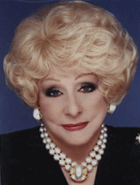
Mary Kay Ash did not invent direct selling, cosmetics, or the home demonstration party, all three were decades old when she opened her doors. What she invented was a company organized around a single, almost subversive idea: that the way to extract extraordinary effort from women was not to drive them but to make them feel important, and to reward them lavishly and publicly when they delivered [4][2]. After twenty-five years selling Stanley Home Products and World Gift cleaning and gift goods, watching men she had personally trained vault past her, at one point at roughly twice her salary, she quit in 1963 to write a book advising women in business, and found that her notes had quietly become the blueprint for the firm she wished she had worked for [2][3].
The launch nearly didn't happen. One month before opening, her husband George Hallenbeck dropped dead of a heart attack at the breakfast table while reviewing the new company's balance sheet [3][7]. Her accountant and attorney both warned her she would lose her life savings. She opened anyway. On Friday, September 13, 1963, a date she embraced as lucky and stamped on everything thereafter, Beauty by Mary Kay opened in a 500-square-foot Dallas storefront with nine "beauty consultants" and a single product line: a skin-care cream she had reformulated from a recipe she'd bought from the family of a Texas hide tanner, repackaged in pink and gold to look pretty on a 1963 bathroom shelf [3][6]. Her twenty-year-old son Richard Rogers handled the books [3].
First-year wholesale sales came to $198,514 with 318 consultants; the second year they topped $800,000 [5][6]. The growth engine was not advertising, Mary Kay barely advertised, but a recruiting and reward structure that turned every saleswoman into a recruiter of more saleswomen, layered with an almost ecclesiastical apparatus of recognition: diamond bumblebee pins, mink stoles, the famous pink Cadillacs first awarded in 1969, and the annual Dallas "Seminar," a revival meeting in all but name where thousands of women in evening gowns were crowned on stage [4][6][8]. Ash, who stood in high heels for hours personally hugging award winners, understood, as her newest biographer puts it, that for many of these women recognition mattered more than the money [3][4].
The company went public in 1967, and in 1976 Mary Kay Cosmetics became, by its own account, the first company on the New York Stock Exchange chaired by a woman [5][6]. But the publicly traded years grew uncomfortable: when sales slid from about $323 million in 1983 to roughly $250 million by 1985 and the consultant base was halved, Ash and Rogers concluded that quarterly disclosure was strangling the long-horizon, incentive-driven culture the business ran on [5][9]. In December 1985 they took the company private in a leveraged buyout financed by some $450 million in bank loans and high-yield bonds, buying out public shareholders [9][5]. Freed from Wall Street's clock, the firm roared back: retail sales crossed $1 billion by 1991 [5].
Ash's legacy is genuinely double-edged, and the serious literature insists on holding both halves. She opened a real ladder for hundreds of thousands of women, many of them homemakers with no other path to income or status, at a time when corporate America offered them almost none, and she did it with a folksy Christian gospel of "God first, family second, career third" [4][2]. Yet the same multilevel model that rewarded recruiting drew the perennial criticism leveled at all direct sales: that the riches at the top rest on the modest, sometimes negative, earnings of the many at the bottom, and that the euphoria of Seminar can paper over hard arithmetic [4][9]. She loathed the word "feminist," yet did as much as any feminist to put money and confidence into women's hands [3][4].
Early Life & Path
She was born Mary Kathlyn Wagner on May 12, 1918, in Hot Wells, Texas, to Edward Alexander Wagner and Lula Vember Hastings [1][7]. Her father was an invalid, tubercular and largely bedridden, so from early childhood Mary Kay's mother ran a Houston restaurant fourteen hours a day and Mary Kay, still a small girl, kept house and nursed her father. The voice she remembered most was her mother's down the telephone line, coaching her through tasks too big for a child with the refrain that became the spine of her whole philosophy: "You can do it" [7][1].
College, which she wanted, "just was not really available to women" of her circumstances; she married at sixteen and had three children, Ben, Marylin, and Richard, before she was out of her early twenties [3][1]. Her first husband, Ben Rogers, left after returning from World War II, and Mary Kay, a single mother, went to work in direct sales: first Stanley Home Products, hawking household goods at home parties [2][3]. She was, at first, terrible at it, averaging about $7 a party against a company expectation of $20, and nearly quit [3].
The turning point, vividly reconstructed in Mary Lisa Gavenas's 2026 history, came at a Stanley convention at the Adolphus Hotel in Dallas. Watching the company's reigning "Queen of Sales" crowned and handed an alligator handbag, Mary Kay cornered the winner and filled nineteen pages of a notebook with her methods, then walked up to founder Frank Stanley Beveridge, "Mr. Bev," famous for telling salespeople "you can achieve anything you want to achieve", and announced, "Next year I am going to be the Queen." The next year she was [3]. She had learned that recognition, ritual, and relentless encouragement could turn an ordinary woman into a phenomenon, the lesson she would later industrialize. After Stanley she moved to the World Gift Company, where she ran national training and engineered a 53 percent jump in sales, only to watch a man she had trained promoted over her; in 1963, at forty-five, she retired in frustration to write [2][3].
Career Timeline
- 1918Born Mary Kathlyn Wagner on May 12 in Hot Wells, Texas; raised largely by her working mother while caring for an invalid father [1][7].
- 1939Begins selling Stanley Home Products at home demonstration parties as a young single mother [2][3].
- 1953Moves to the World Gift Company, rising to national training director and driving a 53% sales increase [2].
- 1963Retires in frustration at being passed over for men she trained; begins writing what becomes a business plan [2][3].
- 1963Husband George Hallenbeck dies of a heart attack one month before launch while reviewing the company's books [3][7].
- 1963Opens Beauty by Mary Kay on Friday, September 13 in Dallas with $5,000, nine consultants, and son Richard Rogers running operations [3][6].
- 1964First-year wholesale sales reach $198,514 with 318 consultants; the first annual Seminar is held [5][6].
- 1967Mary Kay Cosmetics goes public [5][6].
- 1969Awards the first pink Cadillacs, five Coupe de Villes, at Seminar, launching the "career car" [6][8].
- 1976By the company's account becomes the first firm on the New York Stock Exchange chaired by a woman [5][6].
- 1978Receives the Horatio Alger Award, honoring success achieved over early adversity [10][1].
- 1983–1985Sales fall from about $323 million to roughly $250 million; the consultant base is halved [5][9].
- 1985Ash and Rogers take the company private in December via a ~$450 million leveraged buyout [9][5].
- 1991Retail sales surpass $1 billion as the privatized company rebounds [5].
- 2001Dies November 22 in Dallas at age 83; the company reports more than $1.2 billion in sales and 800,000+ consultants [1][7].
Key Ventures & Innovations
Beauty by Mary Kay (1963)
Launched with $5,000, nine consultants, and one reformulated skin-care line packaged in signature pink. Built on the home-party model she'd mastered at Stanley, but redesigned so that every consultant earned by both selling and recruiting [3][6].
The recognition machine, pins, prizes, and the pink Cadillac
Diamond bumblebee pins (from 1970), mink stoles, jewelry, and from 1969 the pink Cadillac, "trophies on wheels" in a color General Motors made exclusive to Mary Kay. Tangible, visible rewards substituted for the corner office most women were denied elsewhere [6][8][4].
Seminar
An annual Dallas convocation, part sales conference, part coronation, part revival meeting, where thousands of women in gowns are crowned on stage. Ash personally hugged winners for hours; the emotional theater was the product as much as the cosmetics [3][4].
Going public, then private (1967, 1985)
An early-1967 IPO funded national expansion and made Ash, by 1976, the first woman to chair an NYSE-listed company. But quarterly disclosure clashed with the long-horizon incentive culture, so in 1985 the family took the firm private in a ~$450 million leveraged buyout [5][6][9].
The Mary Kay Ash Charitable Foundation (1996)
Established to fund cancer research and, later, the fight against domestic violence, channeling the company's wealth and its overwhelmingly female network toward causes affecting women [4][7].
“Pretend that every single person you meet has a sign around his or her neck that says, 'Make me feel important.'”
From the Record
“Pretend that every single person you meet has a sign around his or her neck that says, 'Make me feel important.' Not only will you succeed in sales, you will succeed in life.”
“Everything seems to tell the bumblebee, 'You'll never get off the ground.' But I like to think that maybe, just maybe, our Divine Creator whispered, 'You can do it!,' so it did!”
“I decided on the spot that next year I would be Queen.”
What Operators Can Learn
- 01
Recognition can be a more powerful currency than cash
Ash's core insight was that praise, ritual, and public honor, a crown, a pin, a car in a color no one else could have, could motivate people more than a raise, especially people whom the wider economy refused to honor at all. She built the entire incentive system around being seen.
- 02
Design the company you wish you'd worked for
Twenty-five years of watching men she'd trained get promoted past her became the spec sheet. The 'book' she sat down to write in 1963 turned into the org chart of a firm engineered to give women the ladder she'd been denied.
- 03
Match your ownership structure to your operating rhythm
The public markets fund expansion but demand quarter-by-quarter results; an incentive culture built on long-horizon loyalty does not fit that clock. Going private in 1985 cost a fortune in debt but let the business run on its own time again.
- 04
A culture's greatest strength and its sharpest criticism are often the same thing
The euphoric, recruit-and-reward engine that empowered hundreds of thousands of women is the very feature critics point to in any multilevel model, that the top is built on the thin earnings of the many. Both are true at once, and an honest account holds them together.
Legacy
Mary Kay Ash died on November 22, 2001, in Dallas, at eighty-three. By then the company she had opened with $5,000 reported more than $1.2 billion in sales and a sales force of over 800,000 women in roughly three dozen countries, and Baylor University would name her the greatest female entrepreneur in American history [1][7][8]. Her most durable invention was cultural rather than chemical: a corporate liturgy of recognition, Seminar, the crowns, the bumblebee, the pink Cadillac, copied, knowingly or not, by motivational and direct-sales organizations the world over [4][8].
The verdict the best writing renders is split and meant to stay that way. To admirers she was a liberator who handed economic agency and dignity to women the postwar corporation had no use for, wrapping it in a sincere Golden Rule faith [4][2]. To skeptics the multilevel structure she perfected is precisely the problem: a machine that monetizes recruiting and can leave most participants earning little, its emotional pageantry obscuring the math [4][9]. That she rejected the label 'feminist' while doing as much as almost anyone to put money in women's hands only deepens the paradox [3][4].
The newest scholarship, Mary Lisa Gavenas's archival 2026 history, argues that Ash is best understood not as a beauty mogul but within the long, fraught story of working women in America: a saleswoman of genius who turned her own exclusion into an institution, and whose pink empire was, above all, in the business of selling opportunity [3].
Further Reading
Mary Kay (autobiography), Mary Kay Ash (1981)
Ash in her own words, the source of the bumblebee, the Golden Rule, and the founding myth she wished to project; essential primary reading.
Selling Opportunity: The Story of Mary Kay, Mary Lisa Gavenas (2026)
The first archival, independent biography, placing Ash within the long history of working women in America; the new standard.
Mary Kay on People Management, Mary Kay Ash (1984)
Her management credo set down as a how-to, recognition, the Golden Rule, and 'praising people to success.'
More Than a Pink Cadillac: Mary Kay Inc.'s Nine Leadership Keys to Success, Jim Underwood (2003)
The first outside author given full access to the company; a sympathetic anatomy of the culture and incentive system.
Miracles Happen: The Life and Timeless Principles of the Founder of Mary Kay Inc., Mary Kay Ash (1994)
A revised, expanded memoir restating her philosophy late in life, useful as a companion to the 1981 original.
Sources
- 1.“Mary Kay Ash, 83, Builder of Beauty Empire, Dies (obituary)”, The New York Times, November 24, 2001, newspaper
- 2.Mary Kay Ash, Mary Kay (autobiography), Harper & Row, 1981, book
- 3.Mary Lisa Gavenas, Selling Opportunity: The Story of Mary Kay, Viking (Penguin Random House), 2026, book
- 4.Jim Underwood, More Than a Pink Cadillac: Mary Kay Inc.'s Nine Leadership Keys to Success, McGraw-Hill, 2003, book
- 5.“Mary Kay Inc. (company history with founding figures, IPO, and 1985 buyout)”, Encyclopedia.com / International Directory of Company Histories, 2001, archive
- 6.“Our History”, Mary Kay Inc. (official corporate archive), 2023, archive
- 7.“Mary Kay Ash (biographical encyclopedia entry)”, Encyclopedia.com, 2018
- 8.“Pink Cadillacs and lucky 13: How Mary Kay Ash built a billion-dollar business”, Texas Standard, 2026, newspaper
- 9.“Firm's leveraged buyout plan may be in jeopardy (Mary Kay Cosmetics LBO)”, United Press International (UPI) Archives, August 7, 1985, newspaper
- 10.“Mary Kay Ash, 1978 Horatio Alger Award Member Profile”, Horatio Alger Association of Distinguished Americans, 1978, archive
Researched and written with Claude + live web search.