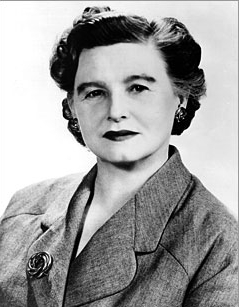
Overview
Margaret Fogarty Rudkin did not set out to build a food empire; she set out to feed one allergic child. In 1937, when commercial bakers were racing to make bread ever whiter, softer, and longer-lasting, the forty-year-old wife of a Wall Street stockbroker began baking dense, stone-ground whole-wheat loaves in her Fairfield, Connecticut kitchen because doctors believed the additives in store bread were aggravating her youngest son's asthma and allergies [1][7]. She had, by her own cheerful admission, never made a loaf of bread in her life, "My first loaf should have been sent to the Smithsonian Institution as a sample of Stone Age bread, for it was hard as a rock and about one-inch high" [1]. What began as medicine became, almost against her will, one of the most successful businesses ever built by an American woman [3][8].
The timing was improbable. The Rudkins had been wealthy, a 125-acre Fairfield estate named for the pepperidge (sour gum) trees on the land, polo ponies, servants, and then the 1929 crash and a polo accident that sidelined Henry Rudkin for months had stripped much of it away [2][5]. Margaret was selling apples and turkeys from the farm when the bread began [5]. Her family doctor, impressed by the loaf, asked her to bake for his other patients; a Manhattan specialty grocer, Charles & Co., placed a standing order, and Henry carried the loaves into New York on his commute to Wall Street [5][7]. Priced at twenty-five cents when ordinary bread sold for a dime, the bread sold anyway, to people who wanted exactly what the industry had engineered out [2][5].
The break that turned a kitchen into a company came in December 1939, when Reader's Digest condensed J.D. Ratcliff's article "Bread, de Luxe," and orders poured in from across the country and abroad [6][7]. Rudkin borrowed $15,000, moved into a former auto showroom in Norwalk, and within a year was turning out more than 50,000 loaves a week [4][7]. She ran it as a real manufacturer, recruiting Belgian engineers and a 150-foot oven to make her Distinctive cookies, importing the fish-shaped cracker she rechristened Goldfish, building a modern Norwalk plant in 1947 that could bake thousands of loaves an hour [2][4]. She hired mostly women, paid above-market wages, and put a cafeteria and a fifty-percent bread discount into the bargain [3][9].
By 1960 Pepperidge Farm was posting some $32 million in sales and $1.3 million in profit, and Margaret Rudkin sold it to the Campbell Soup Company for Campbell stock worth about $28 million [2][5]. She did not retire into the bargain: she stayed on as president, then chairman, of the subsidiary and became the first woman to sit on Campbell's board of directors [3][4]. In 1963 her autobiographical cookbook, half memoir, half country recipes, illustrated by the Danish artist Erik Blegvad, became, by wide account, the first cookbook to reach the New York Times best-seller list [1][3].
What made Rudkin remarkable was not invention but conviction: she bet that quality and honesty about ingredients could beat the entire industrial loaf, in the teeth of the cheapest, whitest, softest bread Americans had ever been offered [2][8]. She was a self-taught manufacturer and a relentless saleswoman, "I was petrified with fright," she said of pitching that first grocer, who nonetheless lectured three times at the Harvard Business School and was counted by Fortune among the most powerful women in American business [2][3]. She died of cancer in 1967, a year after her husband, having proved that a Depression-era housewife with a bad first loaf could build a brand that outlived her by generations [3][7].
Early Life & Path
She was born Margaret Loretta Fogarty on September 14, 1897, in New York City, the eldest of five children in an Irish-Catholic family, and grew up partly in her grandmother's Long Island household, the grandmother whose memory of old country baking she would later credit for her bread [3][4]. A sharp student, she graduated valedictorian of her Flushing high-school class and went straight to work rather than to college, taking a job as a bookkeeper and then as a teller [2][3].
It was in finance that she found both a career and a husband. Working at the Wall Street brokerage McClure, Jones & Co., she met Henry Albert Rudkin, a partner there and twelve years her senior; they married on April 8, 1923 [3][4]. The marriage carried her into the prosperous world of 1920s New York money, and in 1926 the couple bought a 125-acre property in Fairfield, Connecticut, building a Tudor-style home they named Pepperidge Farm after the pepperidge trees on the land [4][5]. "One of our whimsical ideas," she later wrote, "was to live a real country life" [1].
The whimsy ended with the Depression. The 1929 crash gutted the family's finances, and a polo accident left Henry unable to work for months [2][5]. The Rudkins economized hard, selling produce and poultry off the farm, and it was into this strained household that the bread arrived, not as a business plan but as a remedy for a child whose body could not tolerate the food America was busy industrializing [1][5]. Rudkin was forty when she baked that first inedible loaf, with, as she freely confessed, no knowledge of baking, marketing, pricing, or manufacturing whatsoever [1][8].
Career Timeline
- 1897Born Margaret Loretta Fogarty on September 14 in New York City, eldest of five [3][4].
- 1923Marries stockbroker Henry Albert Rudkin, a partner at McClure, Jones & Co., on April 8 [3][4].
- 1926The Rudkins buy a 125-acre Fairfield, Connecticut estate and name it Pepperidge Farm [4][5].
- 1929–1930sThe stock-market crash and a polo accident strain the family's finances; Margaret sells farm produce [2][5].
- 1937Bakes her first whole-wheat loaf for her allergic son; the family doctor and a Manhattan grocer, Charles & Co., begin buying [1][5][7].
- 1939Reader's Digest condenses J.D. Ratcliff's "Bread, de Luxe" in December, triggering nationwide orders [6][7].
- 1940Borrows $15,000 and moves the bakery into a former auto showroom in Norwalk, soon making 50,000+ loaves a week [4][7].
- 1947Opens a modern $625,000 Norwalk plant capable of baking thousands of loaves an hour [5][7].
- 1950sAdds Belgian-style Distinctive cookies and the imported fish cracker rebranded as Goldfish; plants open in Pennsylvania (1949) and Illinois (1953) [2][4].
- 1957On the company's 20th anniversary, Pepperidge Farm employs roughly 1,000 people [5].
- 1960With about $32 million in sales, sells Pepperidge Farm to Campbell Soup for stock worth roughly $28 million; becomes Campbell's first woman director [2][5].
- 1962Steps back from day-to-day management; son William becomes president [3].
- 1963Publishes The Margaret Rudkin Pepperidge Farm Cookbook (Atheneum), reportedly the first cookbook on the NYT best-seller list [1][3].
- 1966Henry Rudkin dies [3][4].
- 1967Dies of cancer on June 1 at Yale-New Haven Hospital, age 69 [7][10].
Key Ventures & Innovations
Pepperidge Farm whole-wheat bread (1937)
Stone-ground whole-wheat bread made with whole milk, butter, and honey and no preservatives, baked first for an allergic son and sold at twenty-five cents against the ten-cent industrial loaf, a deliberate bet that quality could command a premium [1][5].
The Norwalk bakeries (1940, 1947)
A $15,000 loan moved the operation from kitchen and garage into a Norwalk auto showroom; a $625,000 plant followed in 1947, scaling output to thousands of loaves an hour while keeping the hand-quality image [5][7].
Distinctive cookies and Goldfish (1950s)
Rudkin scouted Europe for new lines, importing Belgian engineers and a 150-foot oven for her city-named Distinctive cookies and bringing back the Swiss fish-shaped cracker she renamed Goldfish [2][4].
Sale to Campbell Soup (1960)
She sold Pepperidge Farm, then doing roughly $32 million in sales, to Campbell Soup for about $28 million in stock, stayed on to run it as a subsidiary, and became the first woman on Campbell's board of directors [2][3][5].
The Pepperidge Farm Cookbook (1963)
Part autobiography, part collection of country recipes and illustrated by Erik Blegvad, it became, by wide account, the first cookbook to reach the New York Times best-seller list [1][3].
“My first loaf of bread should have been sent to the Smithsonian Institution as a sample of Stone Age bread, for it was hard as a rock and about one-inch high.”
From the Record
“My first loaf of bread should have been sent to the Smithsonian Institution as a sample of Stone Age bread, for it was hard as a rock and about one-inch high.”
“Although I knew nothing of manufacturing, of marketing, of pricing or of making bread in quantities, with that phone call, Pepperidge Farm bread was born.”
“There isn't a worthwhile thing in the world that can't be accomplished with good hard work. You've got to want something first and then you have to go after it with all your heart and soul.”
What Operators Can Learn
- 01
Solve your own problem first
Rudkin wasn't chasing a market; she was trying to keep a sick child fed. Building obsessively for one real, urgent need produced a product that countless others turned out to want too.
- 02
Charge for quality, don't apologize for it
She priced bread at more than twice the going rate and refused the cheap, preservative-laden shortcuts of the industry. The premium was the point: it signaled, and funded, the honesty of the ingredients.
- 03
Amateurs can out-execute experts
She knew nothing of baking, pricing, or manufacturing and said so. What she had was standards and relentlessness, enough to teach herself an industry and beat the incumbents at their own product.
- 04
One story can change everything
A single 1939 Reader's Digest article converted a local curiosity into a national brand overnight. Earned attention from a credible third party did what no advertising budget she had could.
Legacy
Margaret Rudkin proved, decades before "natural" and "artisanal" became marketing categories, that a large market existed for food that was honest about its ingredients, and that a middle-aged woman with no commercial experience could build and run a national manufacturer to serve it [2][8]. Pepperidge Farm outlived her by generations under Campbell ownership, and her instincts about quality, premium pricing, and recognizable brand voice anticipated much of how packaged food would later be sold [4][7]. The Goldfish cracker and the Distinctive cookies she scouted in Europe remain in American pantries.
She also widened a door. As a guest lecturer at the Harvard Business School, the first woman on the Campbell Soup board, and a fixture on Fortune's lists of powerful businesswomen, Rudkin was held up, and held herself up, as proof of what women could do in industry at a time when that was hardly assumed [2][3]. "Look at what a bunch of women over 40 have done," she once said of her largely female workforce; "none of us had training or business experience" [2]. Her 1963 cookbook-memoir, the first of its kind to top the best-seller charts, fixed her story in the popular imagination as the housewife whose terrible first loaf became a household name [1][3].
Further Reading
The Margaret Rudkin Pepperidge Farm Cookbook, Margaret Rudkin (1963)
Her own memoir-and-recipes, the indispensable primary source, and the first cookbook to reach the NYT best-seller list.
Notable American Women: The Modern Period, Barbara Sicherman and Carol Hurd Green (eds.) (1980)
The authoritative scholarly biographical entry, with dates, figures, and a bibliography of contemporary coverage.
The Founders of Famous Food Companies, Barbara Kramer (2001)
A readable reference profile placing Rudkin among the entrepreneurs who built America's branded-food industry.
American National Biography (entry: Margaret Rudkin), John A. Garraty and Mark C. Carnes (eds.) (2000)
Concise, well-sourced life-and-career summary from the standard national biographical dictionary.
"Pepperidge Farm: Healthful Bread Builds a Business" (Connecticut Explored), Cathryn J. Prince (2015)
A regional-history feature on Rudkin's founding years in Fairfield and Norwalk.
Sources
- 1.Margaret Rudkin (illustrated by Erik Blegvad), The Margaret Rudkin Pepperidge Farm Cookbook, Atheneum, 1963, book
- 2.“"Business: Margaret Rudkin"”, Time, March 21, 1960, newspaper
- 3.Barbara Sicherman and Carol Hurd Green, eds., Notable American Women: The Modern Period, A Biographical Dictionary (entry: Rudkin, Margaret Fogarty), Harvard University Press / Belknap Press, 1980, book
- 4.Barbara Kramer, The Founders of Famous Food Companies (chapter on Margaret Rudkin / Pepperidge Farm), Salem Press / Magill's reference, 2001, book
- 5.“The Remarkable Life of Margaret Rudkin, Founder of Pepperidge Farm”, TASTE, 2021
- 6.J. D. Ratcliff, "Bread, de Luxe", Reader's Digest, December 1939, journal
- 7.“Margaret Rudkin, Founder of Pepperidge Farm, obituary”, The New York Times, June 2, 1967, newspaper
- 8.Harvard Business School, “Margaret F. Rudkin, 20th Century Great American Business Leaders Database”, Harvard Business School, 2003, archive
- 9.“Margaret Rudkin: Business Executive 1897–1967 (Wonder Women of Fairfield exhibit)”, Fairfield Museum and History Center, n.d., archive
- 10.Charles Moritz, ed., Current Biography Yearbook 1959 (entry: Rudkin, Margaret), H. W. Wilson Company, 1959, book
Researched and written with Claude + live web search.