Overview
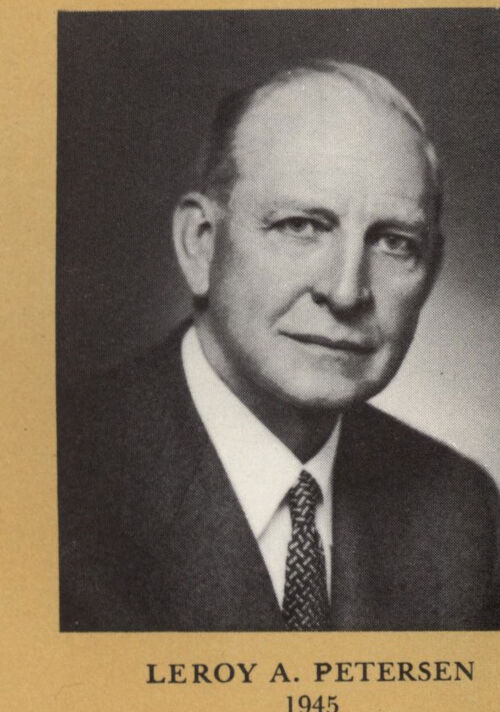
LeRoy A. Petersen did not found the Otis Elevator Company; he inherited it at the moment of its greatest strength and presided over the slow squandering of that strength [1][2]. When he became president and chairman in 1945, Otis was the dominant name in vertical transportation worldwide, the firm whose safety brake, demonstrated by Elisha Graves Otis at the 1854 New York Crystal Palace, had made the passenger elevator possible and the tall building practical [2][3]. The company emerged from the Second World War, in Petersen's own words, "stronger than ever," making elevators "at a rate substantially in excess of our prewar normal" [4].
The postwar boom was kind to Otis. Net sales passed roughly $90 million in 1948 and climbed toward $120 million by 1954 as American cities reached for the sky [5]. Petersen's engineers delivered the technology that defined the modern office tower: the Autotronic system, which from 1948 onward computed elevator traffic electromechanically and, beginning with the eleven-story Atlantic Refining Building in Dallas, made the human elevator operator obsolete [4][6]. In the technology that mattered, Otis stayed ahead of everyone.
In strategy, Petersen made the bet that would define, and damage, his legacy. He concluded that Otis should not think of itself as an elevator company at all but as a "short distance transportation company," and he pushed it into a sprawl of unrelated businesses [1]. As the historian Gary Hoover summarized it, "Under his leadership (or lack thereof), Otis bought a forklift truck maker, ventured into electric vehicles including buses, and purchased electronics companies" [1]. The forklift maker Baker-Raulang came in 1954; the electronics and pilot-trainer firm Temco in 1953; and in 1955 Otis plunged into the booming business of automatic bowling pinsetters [5].
The pinsetter gamble is the emblem of the era. "Going even further afield, Petersen even tried the bowling pinsetter business, then in a short-lived boom, against industry giants Brunswick and AMF," Hoover wrote, a fight a maker of elevators had no business picking [1]. After a strong start the operation fell into the red and was sold off in 1963 [1][5]. The verdict on the whole adventure is blunt: "None of this worked, the new ventures lost money, and Otis gradually became a weakened company despite its continuing leadership in elevator technology" [1].
Petersen relinquished the presidency in 1961 and stepped down as chairman and chief executive in 1966, ending a twenty-one-year tenure [1][5]. He left behind a company still technically supreme but strategically adrift and financially soft, a condition that helped make it a takeover target. In 1975–76 United Technologies absorbed Otis, by then a billion-dollar enterprise, in a hostile bid; the world's greatest elevator maker became a division of a conglomerate, never again to set its own course [5][7]. Petersen's career is a study in how a custodian can hold the crown jewels and still lose the kingdom, not by neglecting the core, but by chasing everything around it.
Early Life & Path
LeRoy A. Petersen was born in 1893 and came of age in the era when the safety elevator was already transforming American cities, turning the four- and five-story brick town into the steel skyscraper [1][6]. By the time he reached the top of Otis, the company was more than ninety years old, a Yonkers foundry start-up of 1853 that had grown into a global institution and the unquestioned leader of its industry [2][3].
Petersen rose through that institution rather than around it, and he took the long view of its inheritance seriously. In 1945, the same year he assumed command, he delivered an address to the Newcomen Society, published as "Elisha Graves Otis, 1811–1861, and His Influence Upon Vertical Transportation", celebrating the founder whose nerve at the Crystal Palace, cutting the rope on his own platform to prove the brake would hold, had launched the firm Petersen now led [3]. It was the testimony of a steward consciously placing himself in a lineage that ran back to Elisha Otis.
The engineering DNA he inherited was formidable. For more than three decades, from 1911 to 1944, Otis's advanced electrical engineering had been driven by the Swedish-born David L. Lindquist, whose work on motor control and high-speed gearless machines kept the company technically dominant [1][2]. Petersen took over a research culture already running far ahead of its rivals, an advantage he would preserve in the laboratory even as he dissipated it in the boardroom.
Career Timeline
- 1893LeRoy A. Petersen is born [1].
- 1945Becomes president and chairman of Otis Elevator Company as it emerges from World War II at full capacity [4][5].
- 1945Delivers and publishes his Newcomen Society address on Elisha Graves Otis and the rise of vertical transportation [3].
- 1948Otis introduces the Autotronic control system and posts net sales of roughly $90 million [4][5].
- 1950First fully attendant-free Autotronic elevators installed in Dallas's Atlantic Refining Building, ending the era of the human operator [4][6].
- 1953Acquires the electronics and pilot-trainer firm Temco; Korean War work accounts for about 22 percent of Otis's business that year [5].
- 1954Acquires the forklift truck maker Baker-Raulang; net sales approach $120 million [1][5].
- 1955Enters the automatic bowling pinsetter business against Brunswick and AMF [1].
- 1961Steps down as president of Otis while remaining chairman and chief executive [1][5].
- 1963The money-losing bowling pinsetter operation is sold off [1][5].
- 1966Ends his tenure as chairman and chief executive of Otis after twenty-one years [1][5].
- 1975–1976United Technologies acquires Otis, by then a billion-dollar company, in a hostile takeover [5][7].
Key Ventures & Innovations
The Autotronic elevator system (from 1948)
Otis's electromechanical traffic computer dispatched banks of high-speed cars, adjusted to demand, bypassed floors when full, and, beginning at Dallas's Atlantic Refining Building around 1950, eliminated the elevator operator entirely. It kept Otis the undisputed technical leader of its industry throughout Petersen's tenure [4][6].
The "short distance transportation company" strategy
Petersen's reframing of Otis as a mover of people and goods over short distances, rather than an elevator maker, was the intellectual license for the entire diversification program, and, in hindsight, its original error [1].
Baker-Raulang and the forklift / electric-vehicle push (1954)
Otis bought the forklift and industrial-truck maker Baker-Raulang and ventured into electric vehicles, including buses, reasoning these too were "short distance transportation." The new lines lost money rather than complementing the core [1][5].
Temco and the electronics ventures (1953)
Acquisitions of electronics and pilot-trainer firms such as Temco, paired with Korean War contracting, pulled Otis into defense and electronics, fields where it had no enduring advantage and would not stay [5].
The bowling pinsetter business (1955–1963)
Otis built automatic pinsetters during the postwar bowling craze, challenging Brunswick and AMF head-on. After a strong start the venture fell into the red and was sold in 1963, the clearest single emblem of diversification gone wrong [1][5].
“Otis should be a short distance transportation company.”
From the Record
“Going even further afield, Petersen even tried the bowling pinsetter business, then in a short-lived boom, against industry giants Brunswick and AMF. None of this worked, the new ventures lost money, and Otis gradually became a weakened company despite its continuing leadership in elevator technology.”
“Under his leadership (or lack thereof), Otis bought a forklift truck maker, ventured into electric vehicles including buses, and purchased electronics companies.”
“stronger than ever, making elevators at a rate substantially in excess of our prewar normal.”
What Operators Can Learn
- 01
Owning the technology is not the same as owning the future
Otis stayed years ahead in elevators throughout Petersen's tenure and still weakened, because leadership in the lab could not offset misallocation of capital in the boardroom.
- 02
Beware the seductive redefinition of your business
Calling Otis a "short distance transportation company" sounded visionary, but it licensed entry into forklifts, buses, electronics, and bowling, businesses united only by a slogan, not by any real advantage.
- 03
Adjacency is a claim that must be earned, not assumed
Each diversification looked plausibly related, yet competing against entrenched specialists like Brunswick and AMF required strengths Otis did not have. Plausible adjacency is not competitive advantage.
- 04
A strong inheritance can mask a weak strategy for years
Postwar demand and a commanding market position hid the cost of the failed ventures until the company had drifted far enough to become a takeover target.
Legacy
Petersen's legacy is doubled and uncomfortable. The Otis he ran put the modern skyline into smooth, automatic motion: the Autotronic systems of his era retired the elevator operator and made the postwar high-rise, and eventually the supertall tower, workable at scale [4][6]. In the discipline that mattered most, vertical transportation, Otis under Petersen never lost its lead, and the engineering inheritance he protected outlasted him [1][2].
Yet he is remembered in business history chiefly as a cautionary figure: the steward who, given the strongest hand in his industry, frittered it on the conglomerate fashion of the age. The forklifts, buses, electronics, and bowling pinsetters lost money and left Otis "a weakened company" precisely when it should have been at its most formidable [1]. That weakness helped set up the hostile 1975–76 absorption by United Technologies, after which the world's preeminent elevator maker was, for nearly half a century, somebody else's division [5][7].
The enduring lesson historians draw from his tenure is not about elevators at all. It is that a leader can keep the core business brilliant and still fail by chasing everything adjacent to it, that the most dangerous strategic move is often the visionary-sounding redefinition that turns a focused leader into an unfocused conglomerate [1][2].
Further Reading
Otis: Giving Rise to the Modern City, A History of the Otis Elevator Company, Jason Goodwin (2001)
The first full-length history of Otis; the essential narrative of the company Petersen led.
Elisha Graves Otis, 1811–1861, and His Influence Upon Vertical Transportation, LeRoy A. Petersen (1945)
Petersen in his own voice, honoring the founder in the year he took command, a revealing primary source.
International Directory of Company Histories, Vol. 39 (Otis Elevator Company, Inc.), Tina Grant (ed.) (2001)
Compact reference history with the postwar sales figures, acquisitions, and dates of the Petersen years.
Two Billion Passengers a Day: The Otis Story, Gary Hoover (2021)
A pointed business-historian's essay that frames Petersen's diversification as a cautionary tale.
Sources
- 1.Gary Hoover, “Two Billion Passengers a Day: The Otis Story”, American Business History Center, 2021
- 2.Jason Goodwin, Otis: Giving Rise to the Modern City, A History of the Otis Elevator Company, Ivan R. Dee, 2001, xv + 286 pp., book
- 3.LeRoy A. Petersen, Elisha Graves Otis, 1811–1861, and His Influence Upon Vertical Transportation, The Newcomen Society of England, American Branch, 1945, 24 pp., book
- 4.“Otis History, Elevator history timeline (Petersen era; Autotronic; postwar production)”, Otis Elevator Company, 1945–1950, archive
- 5.Tina Grant (ed.), International Directory of Company Histories, Vol. 39, Otis Elevator Company, Inc., St. James Press, 2001, book
- 6.“Otis Elevator Company”, Encyclopedia of Cleveland History, Case Western Reserve University, 2018, archive
- 7.“Otis Worldwide / United Technologies Corporation”, Wikipedia, 2024
- 8.How Otis Gets the Business, Fortune, July 1954, pp. 100–103, 124, 126, journal
Researched and written with Claude + live web search.