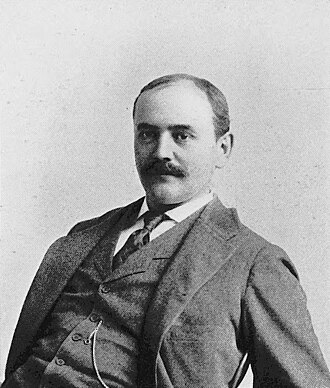
Overview
Joy Morton built an empire out of the most ordinary substance in the kitchen. Salt was a bulk commodity sold loose from barrels, indistinguishable from one merchant's to the next, when in 1880 the twenty-four-year-old Morton bought into a small Chicago salt-distribution house run by Ezra Wheeler, investing $10,000 to acquire a share and a fleet of lake boats to carry salt west [1][8]. When Wheeler died in 1885, Morton and his younger brother Mark took control and renamed the firm Joy Morton & Company [1][2][6]. By the mid-1890s the house handled the great bulk of the salt trade in its territory; by 1910 Morton, now a manufacturer as well as a merchant, incorporated the enterprise as the Morton Salt Company [1][6][8].
His decisive insight was that salt did not have to be a faceless commodity, it could be a brand. Ordinary table salt clumped and refused to pour in damp weather, a nuisance every cook knew. Morton's company added magnesium carbonate to keep the grains free-flowing and packed the salt in a distinctive round blue canister with a patented metal pouring spout [6][8]. Then, in 1914, the company gave the product a face. The advertising agency N. W. Ayer proposed a series for Good Housekeeping, and among the substitutes was a sketch of a little girl walking in the rain, umbrella up, a tilted package under her arm spilling salt as she went [5]. Joy's son Sterling, the company secretary, seized on it; the slogan, adapted from the proverb "it never rains but it pours," became "When It Rains It Pours", one of the longest-lived trademarks in American business [5][6].
Morton's company also lent its scale to a landmark in public health. After Michigan physicians led by Dr. David Cowie demonstrated that adding iodine to salt could prevent the goiter endemic to the Great Lakes and other iodine-poor regions, Morton Salt in 1924 became the first company to distribute iodized salt nationally, and within a decade iodized salt held more than ninety percent of the table-salt market [6]. It is hard to name a consumer product whose maker did more, in a single decision, for the bodies of ordinary Americans.
Morton was no narrow salt man. He was a fixture of Chicago's business and civic establishment, a backer of Daniel Burnham's 1909 Plan of Chicago, and an early bankroller of the teleprinter: through his Morkrum Company, built with the inventor Howard Krum, he helped bring the practical Teletype into being, a venture that eventually passed to AT&T [2][6]. He extended minority ownership in the salt company to trusted lieutenants such as Daniel Peterkin, who succeeded him as president in 1930 while Morton stayed on as chairman until his death [2][6].
Yet the deepest thread of his life ran back to the soil. His father, J. Sterling Morton, Nebraska politician, U.S. Secretary of Agriculture, and the originator of Arbor Day, had raised his sons under the family motto "Plant Trees" [3][4][7]. In 1909 Joy bought a country estate near Lisle, Illinois, named it Thornhill for its hill and hawthorns, and in December 1922 chartered on the surrounding acres the Morton Arboretum, a scientific collection of woody plants that he intended as a permanent institution [3][4][7]. The salt fortune, in the end, was the means; the trees were the legacy he cared most to leave [4][7].
A reserved, plainspoken man who distrusted government meddling and had little patience for labor agitation, he once dismissed a strike with "What fools these mortals be, especially strikers", Morton nonetheless built two institutions, one commercial and one civic, that outlasted him by a century [2][7]. The blue box still sits on American shelves, and the arboretum still grows on the DuPage [4][6].
Early Life & Path
He was born Joy Sterling Morton on September 27, 1855, in Detroit, Michigan, the eldest of the four sons of J. Sterling Morton and Caroline Joy French Morton, his given name a tribute to his mother's maiden name [1][2]. The family soon moved to the Nebraska Territory, settling at Nebraska City, where his father edited a newspaper, rose in territorial and state politics, and built the country estate Arbor Lodge [1][2]. Caroline was an accomplished gardener and musician; J. Sterling Morton would become Grover Cleveland's Secretary of Agriculture and the founder of Arbor Day, and he pressed on his sons a lifelong creed of tree-planting [2][3][7][10].
Joy's was a frontier boyhood among trees the family itself had planted on the treeless plains. In 1873, as a teenager, he accompanied his father on a visit to the new Arnold Arboretum in Boston, an experience that planted, decades early, the seed of his own arboretum [3][7]. He did not take naturally to formal schooling; he was drawn instead to practical work and the rhythms of the farm and the ledger [2][7]. After clerking and small-town banking, he worked for a time in the railroad business at Aurora, Illinois, around 1878 before following his younger brothers to Chicago [1][2].
It was in Chicago in 1880, at twenty-four, that he found his life's commodity. He went in with Ezra Wheeler, an established salt distributor handling Michigan salt, putting up $10,000 for an interest and the lake boats to move the product westward [1][8]. Wheeler's death in 1885 left Morton in command of the firm while he was barely thirty, the beginning of a half-century in salt [1][2][6].
Career Timeline
- 1855Born Joy Sterling Morton on September 27 in Detroit, Michigan, eldest son of J. Sterling Morton, future founder of Arbor Day [1][2].
- 1873Visits the Arnold Arboretum in Boston with his father, an early inspiration for his own arboretum [3][7].
- 1880Buys into Ezra Wheeler's Chicago salt-distribution business for $10,000, acquiring lake boats to ship salt west [1][8].
- 1885On Wheeler's death, takes control of the firm with brother Mark and renames it Joy Morton & Company [1][2][6].
- 1909Buys a country estate near Lisle, Illinois, names it Thornhill, and backs Daniel Burnham's Plan of Chicago [2][4].
- 1910Incorporates the enterprise, now manufacturer and merchant, as the Morton Salt Company [1][6][8].
- 1911Company adds magnesium carbonate to keep salt free-flowing and adopts the round blue canister with a patented pouring spout [6][8].
- 1914The Morton Salt Girl and the slogan "When It Rains It Pours" debut in Good Housekeeping [5][6].
- 1922Charters the Morton Arboretum on December 14 on the land around Thornhill, advised by Charles Sprague Sargent of the Arnold Arboretum [3][4][7].
- 1924Morton Salt becomes the first company to distribute iodized salt nationally, a public-health milestone [6].
- 1930Daniel Peterkin succeeds Morton as president; Morton remains chairman of the board [2][6].
- 1934Dies May 10 of heart failure at Thornhill, aged 78; buried in the Morton family cemetery on the arboretum grounds [1][7].
Key Ventures & Innovations
Joy Morton & Company / Morton Salt Company
From a $10,000 stake in Ezra Wheeler's salt house in 1880, Morton built the dominant salt distributor and then manufacturer of the Midwest, incorporated as the Morton Salt Company in 1910 [1][6][8].
Free-flowing salt and the blue canister
By adding magnesium carbonate and packing salt in a round blue box with a patented metal pouring spout, Morton turned a loose bulk commodity into a branded consumer product that poured even in damp weather [6][8].
The Morton Salt Girl and "When It Rains It Pours" (1914)
An N. W. Ayer concept, a girl in the rain, umbrella up, spilling salt from a tilted package, became, with son Sterling Morton's backing, one of the longest-running trademarks and slogans in American advertising [5][6].
National iodized salt (1924)
Building on Michigan physicians' anti-goiter campaign, Morton Salt was first to distribute iodized salt nationwide; within a decade it held over ninety percent of the table-salt market, a rare case of mass commerce advancing public health [6].
The Morkrum Company / Teletype
Morton bankrolled inventor Howard Krum's printing telegraph, building the Morkrum Company that helped commercialize the Teletype, a business later folded into AT&T [2][6].
The Morton Arboretum (1922)
Chartered on the land around his Thornhill estate and guided by Charles Sprague Sargent of the Arnold Arboretum, the arboretum was Morton's deliberate civic legacy, governed by a lifetime board of family and trusted executives [3][4][7].
“Plant Trees.”
From the Record
“What fools these mortals be, especially strikers.”
“Arboretum workers covered a two-wheeled garden cart, including the tires, with green paint. Around the skirt they arranged white pine boughs. Joy's body was placed on the cart; two workmen pulled it a short distance to the cemetery over a trail of lilacs.”
“Here was the whole story in a picture – the message that the salt would run in damp weather was made beautifully evident.”
What Operators Can Learn
- 01
A commodity can be made a brand
Salt was interchangeable until Morton gave it a reason to be chosen, free-flowing grains, a spouted box, a girl, and a slogan. He competed on trust and convenience where rivals competed only on price.
- 02
Solve the customer's actual annoyance
The whole brand rested on one real grievance: salt that clumped in humid weather. Fixing that small, universal frustration, and saying so plainly, did more than any abstract appeal could.
- 03
Doing public good can be good business
Being first to distribute iodized salt nationally was a humanitarian act and a commercial coup at once, it eliminated goiter for millions while making Morton the default choice for a generation.
- 04
Build institutions to outlast you
Morton spread ownership to trusted executives and locked his arboretum into a lifetime trust. He cared less about controlling everything than about ensuring both the company and the trees endured beyond his death.
Legacy
Joy Morton's commercial monument is almost invisible because it is so familiar: the round blue box of Morton Salt, with its umbrella girl and its century-old slogan, remains one of the most recognized brands in the American kitchen [5][6]. His company's 1924 decision to iodize and nationally distribute salt was, in public-health terms, among the most consequential business choices of the era, helping all but eliminate endemic goiter across the country within a decade [6]. He had taken the dullest of commodities and made it, simultaneously, a brand and an instrument of public welfare.
But Morton himself measured his life by the second of his creations. Heir to his father's Arbor Day creed of "Plant Trees," he poured salt money into the Morton Arboretum, chartered in 1922 on the land around his Thornhill estate and built with the counsel of the Arnold Arboretum's Charles Sprague Sargent into a serious scientific collection of woody plants [3][4][7]. He governed it through a lifetime board of family and company men so that it would survive him, and it has, today spanning well over a thousand acres on the DuPage River, a major center of tree research and conservation [3][4][9].
The man who joined salt and trees was, fittingly, carried to his grave in 1934 not in a hearse but on a green-painted garden cart drawn over a trail of lilacs by two of his arboretum's own workmen [7]. The first full biography, James Ballowe's A Man of Salt and Trees (2009), reads him as a sympathetic, family-devoted figure whose two legacies, the blue box and the living museum of trees, still stand a hundred years on [1][2].
Further Reading
A Man of Salt and Trees: The Life of Joy Morton, James Ballowe (2009)
The first and definitive full-length biography, drawn from the voluminous Morton family correspondence; the foundation for any serious study of Joy Morton.
A Great Outdoor Museum: The Story of The Morton Arboretum, James Ballowe (2003)
Companion institutional history of the arboretum Morton founded, tracing its growth from Thornhill into a major research collection.
J. Sterling Morton: Pioneer Statesman; Founder of Arbor Day, James C. Olson (1942)
Biography of Joy's father, the Arbor Day founder and Secretary of Agriculture whose 'Plant Trees' creed shaped Joy's legacy.
Sources
- 1.James Ballowe, A Man of Salt and Trees: The Life of Joy Morton, Northern Illinois University Press, 2009, book
- 2.Howard R. Stanger (Canisius College), Review of James Ballowe, A Man of Salt and Trees: The Life of Joy Morton, EH.Net (Economic History Association), January 2010, journal
- 3.“Arboretum History”, The Morton Arboretum, 2022, archive
- 4.“The Legacy of Joy Morton”, The Morton Arboretum, 2022, archive
- 5.“How a Little Girl Grew Up to Be an Icon”, Morton Salt (company heritage archive), 2014, archive
- 6.“Morton Salt (company history: founding, iodized salt, Morton Salt Girl)”, Wikipedia, 2025
- 7.Edward Russo, “Trees made him worth his salt”, Illinois Times, November 5, 2009, newspaper
- 8.“Joy Morton (biography: Wheeler partnership, $10,000, Morton Salt incorporation, Teletype, Arboretum)”, Wikipedia, 2025
- 9.James Ballowe, A Great Outdoor Museum: The Story of The Morton Arboretum, The Morton Arboretum, 2003, book
- 10.James C. Olson, J. Sterling Morton: Pioneer Statesman; Founder of Arbor Day, University of Nebraska Press, 1942, book
Researched and written with Claude + live web search.