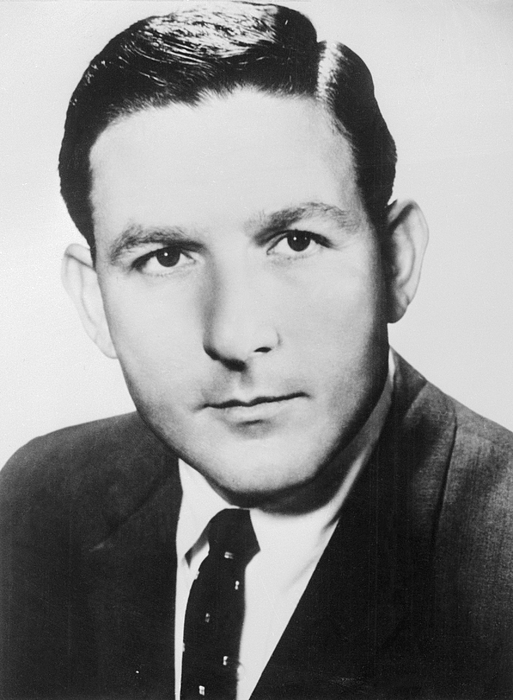
Overview
James Joseph Ling did not build a great product, invent a process, or open a market. What he built was a financial machine, a self-reinforcing loop of acquisitions, stock spin-offs, and bank debt, and for a dozen years it ran faster than almost anyone thought possible, carrying a Dallas electrical contractor from 204th to 14th on the list of America's largest corporations [1][6]. By 1969 Ling-Temco-Vought reported some $3.8 billion in sales across aerospace, electronics, steel, meatpacking, sporting goods, car rental, an airline, and a bank [3][7]. Then, with startling speed, the machine seized: a Justice Department antitrust suit, a money-losing steel takeover, and a falling stock market converged, and the man who owned roughly 80 percent of his own creation was forced out by his board and bankers in 1970 [2][5].
Ling's method had a name, "redeployment", and it was the purest expression of conglomerate-era finance. He would buy a sprawling company, then sell a minority slice of one of its divisions to the public as a separately traded stock [1][4]. The market, intoxicated by the conglomerate boom, repeatedly valued the parts far above the whole Ling had paid for; the rising share prices became fresh collateral for the next round of bank loans, which financed the next acquisition [2][4]. His biographer Stanley H. Brown described it bluntly: LTV "would literally create new borrowing power out of the air as the price of subsidiary shares rose on the stock market" [2].
The set piece came in 1967. Ling acquired the old-line meatpacker Wilson & Co. for about a billion dollars, then split it into three publicly traded pieces, Wilson & Co. (meat), Wilson Sporting Goods, and Wilson Pharmaceuticals, which Wall Street promptly nicknamed "Meat Ball," "Golf Ball," and "Goof Ball" [3][7]. The three slivers, sold to the public, were soon valued at far more than Ling had paid for the entire company, adding roughly a quarter-billion dollars of paper value almost overnight [3][7]. To admirers he was, in Fortune's phrase, "part prestidigitator, part brooding genius, and part wunderkind" [8].
The overreach was the 1968 tender for Jones & Laughlin Steel, a $425 million cash offer at $85 a share for a company whose earnings were already sliding [1][5]. Ling borrowed heavily to win it, and the debt arrived just as the Nixon administration's antitrust chiefs decided to make conglomerate mergers their test case. On March 22, 1969, the government filed suit; Ling, by one account, got the news while playing cards at his country club and wrote in his journal, "My God, every time we get our head up, somebody tries to knock it off" [7]. The consent decree eventually forced LTV to choose between keeping J&L or keeping Braniff Airways and the Okonite cable company, and barred it from raiding any of them to plug its own cash crisis [5].
When the conglomerate stocks collapsed, LTV fell from a 1967 high near $167 to about $11, the loop ran in reverse, and the debt that had built the empire now strangled it [3][6]. Ling, who had kept nearly all of his own and his children's fortune in LTV stock, was demoted in May 1970 and gone by June, replaced by W. Paul Thayer [1][6]. His comeback vehicles, chiefly the conglomerate Omega-Alpha, went bankrupt in 1975; none recaptured the old magic [3]. He had been the archetype of an age that lasted barely a decade, and his fall helped end it [2][6].
Early Life & Path
He was born December 31, 1922, in Hugo, Oklahoma, into hard circumstances and a fracturing family [3]. His mother died when he was about eleven, and his father, a Catholic convert of unusual intensity, eventually entered a Carmelite monastery, leaving the boy to be passed among relatives and to grow up partly around the Texas oil fields [3]. He never finished high school. What he had instead was restlessness, a head for numbers, and an instinct for self-instruction that would define everything that followed [1][3].
During World War II he served in the Navy and trained as an electrician at a service school, emerging a master electrician with a trade and almost nothing else [1][3]. In 1947 he put roughly $2,000, raised, by his own telling, from selling his house, into a Dallas electrical-contracting outfit he called Ling Electric Company, and for a time he lived in the back of the shop [1][3]. The business grew steadily on postwar Dallas construction; by the late 1950s it was grossing several million dollars a year [3].
His decisive break with the ordinary came in 1955, when he took Ling Electric public in a way no respectable underwriter would have countenanced. Shut out of conventional financing, Ling sold shares door-to-door and from a booth at the State Fair of Texas, handing prospectuses to passers-by and raising several hundred thousand dollars directly from the public [1][3]. It was a small, almost comic beginning, but it revealed the man: someone who understood that the real raw material of his ambition was not copper wire but capital, and that capital could be summoned by anyone bold and inventive enough to ask the crowd for it [2][3].
Career Timeline
- 1922Born December 31 in Hugo, Oklahoma; mother dies when he is about eleven, father later enters a Carmelite monastery [3].
- 1940sServes in the U.S. Navy in World War II and trains as a master electrician [1][3].
- 1947Founds Ling Electric Company in Dallas with roughly $2,000, living in the back of the shop [1][3].
- 1955Takes Ling Electric public, famously selling shares door-to-door and from a booth at the State Fair of Texas [1][3].
- 1956Acquires L.M. Electronics; the company is renamed Ling Electronics, beginning the acquisition spree [4][7].
- 1959Acquires Altec, the commercial sound-systems maker, becoming Ling-Altec [4][7].
- 1960Merges with Temco Electronics and Missiles to form Ling-Temco [3][4].
- 1961Takes over Chance Vought Aircraft; the firm becomes Ling-Temco-Vought [3][4].
- 1964Launches "Project Redeployment," splitting LTV into three publicly traded units, LTV Aerospace, Ling-Altec, and LTV Electrosystems [4].
- 1967Acquires Wilson & Co. for about $1 billion and splits it into meat, sporting-goods, and pharmaceutical companies, "Meat Ball, Golf Ball, Goof Ball" [3][7].
- 1968Buys Greatamerica (owner of Braniff Airways and National Car Rental) and tenders $425 million for Jones & Laughlin Steel at $85 a share [1][5].
- 1969On March 22 the Justice Department files an antitrust suit; LTV peaks near the 14th-largest U.S. company with roughly $3.8 billion in sales before its stock collapses [5][6][7].
- 1970Demoted in May and forced out by June amid the debt crisis; W. Paul Thayer succeeds him as chairman [1][6].
- 1975His comeback conglomerate, Omega-Alpha, goes bankrupt [3].
- 2004Dies December 17 of esophageal cancer at his home in Dallas, aged 81 [3].
Key Ventures & Innovations
Ling Electric Company (1947) and the fairground IPO (1955)
A $2,000 electrical-contracting shop that Ling grew on postwar Dallas building, then took public by hawking stock door-to-door and from a State Fair of Texas booth, an unorthodox start that taught him capital, not copper, was the constraint on his ambition [1][3].
The aerospace ladder: Altec, Temco, Chance Vought (1959–1961)
A rapid climb through electronics and defense, Altec, then Temco, then the hostile takeover of the much larger Chance Vought Aircraft, that created Ling-Temco-Vought and pushed sales past $325 million by the end of 1962 [3][4].
Project Redeployment (1964)
Ling's signature financial invention: carve the parent into separately traded public companies (LTV Aerospace, Ling-Altec, LTV Electrosystems) so the market would revalue the pieces above the whole, generating fresh borrowing power. Brown called it creating "new borrowing power out of the air" [2][4].
Wilson & Co., "Meat Ball, Golf Ball, Goof Ball" (1967)
The billion-dollar takeover of an old meatpacker, then split into three listed companies, meat, sporting goods, pharmaceuticals, whose combined market value soon dwarfed the purchase price, the showpiece of redeployment [3][7].
Greatamerica and Jones & Laughlin Steel (1968)
The acquisitions that broke the machine: Greatamerica brought Braniff Airways and National Car Rental, while the $425 million, $85-a-share grab for money-losing J&L Steel piled on debt and drew the antitrust suit that unwound the empire [1][5].
“My God, every time we get our head up, somebody tries to knock it off.”
From the Record
“LTV would literally create new borrowing power out of the air as the price of subsidiary shares rose on the stock market.”
“part prestidigitator, part brooding genius, and part wunderkind”
“My God, every time we get our head up, somebody tries to knock it off.”
What Operators Can Learn
- 01
Paper value is not the same as cash
Redeployment manufactured soaring market values, and Ling treated them as real capacity to borrow and buy. When the market reversed, the paper evaporated but the debt did not, the asymmetry that destroys leveraged empires.
- 02
The market that loves you can stop loving you overnight
Conglomerate stocks were bid to extraordinary multiples on the theory that financial engineers could keep compounding. The same belief that lifted LTV near $167 dropped it to about $11 when sentiment turned, Ling's machine only worked while the crowd cooperated.
- 03
Debt taken on at the top is the most dangerous kind
The Jones & Laughlin and Greatamerica deals loaded LTV with borrowing just as earnings, the stock market, and the regulatory climate all turned against it. Acquiring aggressively at a cyclical peak left no margin for the downturn that followed.
- 04
Concentrated ownership cuts both ways
Ling kept nearly all of his and his children's wealth in LTV stock, which aligned him perfectly with shareholders on the way up and wiped him out on the way down. Control without diversification is a bet, not a fortress.
Legacy
Ling was the emblematic figure of the 1960s conglomerate craze, the decade when financiers argued that management science and clever capital structures could weld unrelated businesses into something worth more than the sum of its parts [2][6]. For a few years the stock market believed it, and Ling rode that belief from an electrician's shop to the front rank of American industry [1][6]. His fall, alongside that of peers like Litton and Gulf+Western, helped puncture the theory; by the 1970s "conglomerate" had become a term of suspicion, and the long unwinding of LTV, through antitrust divestiture, near-collapse, a 1986 steel bankruptcy, and final liquidation, became a cautionary case study in business schools [5][6].
The company outlived its founder's exit by decades, surviving as a steelmaker until its assets were sold off in the 2000s [6]. But the more durable legacy is the playbook and its warning. Ling demonstrated, brilliantly and then catastrophically, how a small operator could use public markets and leverage to vault past far larger and older firms, and how the same leverage, applied at the peak and to a falling market, could erase a fortune just as fast [2][7]. He died in Dallas in 2004, remembered as the prototype of the financial deal-maker as celebrity, a Horatio Alger story that ran the full arc from rise to fall [3].
Further Reading
Ling: The Rise, Fall, and Return of a Texas Titan, Stanley H. Brown (1972)
The definitive biography by a Fortune writer who covered Ling closely, the essential source on redeployment and the LTV empire.
The Rise and Fall of the Conglomerate Kings, Robert Sobel (1984)
Places Ling alongside Geneen, Bluhdorn, and Thornton in a sharp history of the 1960s conglomerate era and its collapse.
The Go-Go Years: The Drama and Crashing Finale of Wall Street's Bullish 60s, John Brooks (1973)
A classic narrative of the speculative decade that made men like Ling possible, and then unmade them.
Texas Rich (and related Texas-fortune reporting), Harry Hurt III (1981)
Useful context on the postwar Dallas business culture and big-money milieu in which Ling rose.
Sources
- 1.Stanley H. Brown, Ling: The Rise, Fall, and Return of a Texas Titan, Atheneum, 1972, book
- 2.Stanley H. Brown, Ling: The Rise, Fall, and Return of a Texas Titan (on Project Redeployment), Atheneum (repr. Beard Books, 1999), 1972, book
- 3.Gale / Encyclopedia of World Biography, Ling, James Joseph (biographical entry, Encyclopedia of World Biography), Gale (Encyclopedia.com), 2004, book
- 4.“History of The LTV Corporation”, FundingUniverse, n.d.
- 5.U.S. District Court for the Western District of Pennsylvania, “United States v. Ling-Temco-Vought, Inc., 315 F. Supp. 1301 (W.D. Pa. 1970)”, Justia (U.S. Federal District Court decisions), 1970, archive
- 6.“The LTV Corporation (Handbook of Texas)”, Texas State Historical Association, n.d., archive
- 7.Life with the Merger King (review of Stanley Brown's Ling), The Texas Observer, n.d., journal
- 8.Stanley H. Brown, "Jimmy Ling's Wonderful Growth Machine", Fortune, January 1967, journal
- 9.“James J. Ling, Dallas Business Tycoon, Died Dec. 17, 2004”, The Buffalo News (wire report), December 2004, newspaper
Researched and written with Claude + live web search.