Overview
James Buchanan Duke did not invent the cigarette, and he did not invent the machine that would make him the richest tobacco man on earth. What he did was see, earlier and more ruthlessly than anyone else, that a despised novelty product and a balky, distrusted contraption could together remake an entire industry [1][2]. In 1884, with hand-rolling still the universal method and machine-made cigarettes regarded as inferior, the young manager of W. Duke, Sons & Company leased two of James Bonsack's experimental cigarette machines and bet his family's firm on them, each machine could do the work of roughly forty-eight hand rollers, and Duke, with the mechanic William T. O'Brien, coaxed them into reliability [2][6]. The cost of making a cigarette fell by half [6].
Production was the easy half of the problem. The hard half was that Americans in the 1880s barely smoked cigarettes, and Duke had just acquired the capacity to drown the market in them. His answer was to manufacture demand the way he manufactured cigarettes, at industrial scale. He poured an enormous share of revenue into advertising, premiums, coupons, and the collectible picture cards tucked into packs, by some accounts spending around a fifth of all revenue on promotion at the end of the 1880s [1][2][10]. He also extracted from the Bonsack Machine Company a secret contract guaranteeing him machine-leasing rates roughly twenty-five percent below what his rivals paid, a structural cost advantage his competitors could not see and could not match [2][6].
By 1889 W. Duke, Sons & Company was the largest cigarette maker in America, turning out close to half the nation's cigarettes [2][6]. Then Duke did the thing that made him a monopolist rather than merely a market leader: in 1890, at age thirty-three, he engineered the merger of his firm with its four principal rivals into a single combination, the American Tobacco Company, with himself as president [1][3]. Over the next two decades the trust swallowed the smoking-tobacco, plug, and snuff businesses too, controlling, depending on the segment and the year, somewhere between forty and ninety percent of the American market, and it pushed abroad into Canada, Japan, and China [2][3]. In 1902 Duke negotiated a treaty-like settlement of a price war with Britain's Imperial Tobacco, carving the world into spheres and creating the British-American Tobacco Company, of which his side took roughly two-thirds [1][2].
The empire's very completeness invited its destruction. In 1907 the federal government sued under the Sherman Act, and in 1911, on the same day it dismembered Rockefeller's Standard Oil, the Supreme Court found the American Tobacco combination an illegal restraint of trade and ordered it broken apart [4]. In a final irony, it fell largely to Duke himself, working with the court, to design the dissolution that split the trust into the successor firms, a new American Tobacco, Liggett & Myers, P. Lorillard, R. J. Reynolds, and others, the oligopoly that would dominate American smoking for the rest of the century [3][4].
Duke walked away from tobacco and into water and current. Beginning with the Catawba and Southern Power companies he founded in 1904–05, he built the hydroelectric network that electrified the Piedmont textile belt of the Carolinas, the enterprise that survives today as Duke Energy [1][5]. And in December 1924 he signed the indenture creating The Duke Endowment, a $40 million trust whose beneficiaries included hospitals, orphanages, rural Methodist churches, and a small Methodist college in Durham, Trinity, which he offered to enlarge into a great university if it would take his father's name [1][7].
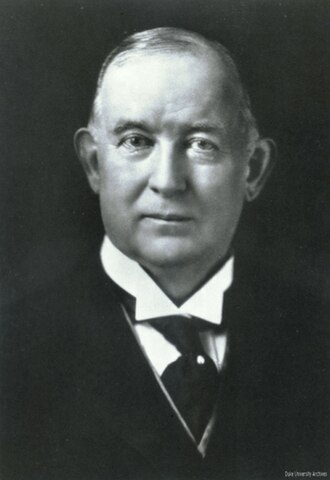
Duke was a soft-spoken, plainly dressed man with a Carolina accent "as thick as butter," who cared nothing for society and everything for the architecture of cost and scale [1]. He was the prototype of the modern American mass marketer and the modern American monopolist at once, and the antitrust order that broke his trust helped define how the United States would govern bigness for a hundred years [3][4].
Early Life & Path
He was born December 23, 1856, on his father's hardscrabble farm north of Durham, in what was then Orange County, North Carolina, the youngest son of Washington Duke and Artelia Roney Duke [1][3]. The family called him "Buck." His mother died when he was a small child, and the Civil War nearly erased the Dukes: Washington Duke came home from Confederate service in 1865 to a farm stripped almost bare, with little left but some leaf tobacco the soldiers had not carried off [6]. Out of that remnant the family began manufacturing smoking tobacco in a small log building, branding it "Pro Bono Publico," and Washington Duke hawked it across eastern North Carolina from a broken-down wagon drawn, in the family legend, by two blind mules [6].
James Duke's schooling was thin and intermittent, local academies, the New Garden School near Greensboro, and a few months at Eastman Business College in Poughkeepsie, New York [1][3]. His real education was the family business, which he mastered from the curing barn to the sales ledger. In April 1874 Washington Duke bought two acres by the railroad in Durham and built a proper factory; the partnership took the name W. Duke, Sons and Company, and in 1878 the Baltimore merchant George W. Watts bought in, broadening the firm's capital [6]. The Dukes had entered the smoking-tobacco trade late and small, hopelessly behind Durham's dominant Bull Durham brand [2][6].
That lateness made the young Buck Duke a gambler by necessity. Unable to win the established game, he chose to play a different one, the cigarette, then a marginal product, and in 1884 he went to New York himself to run the firm's new branch factory, arriving, in his biographer's phrase, "a slim, clean-shaven young man with a Southern accent 'as thick as butter'" [1]. He worked with a ferocity that became proverbial. "I hated to close my desk at night and was eager to get back to it early the next morning," he recalled. "I needed no vacation or time off. There ain't a thrill in the world to compare with building a business and watching it grow before your eyes" [1].
Career Timeline
- 1856Born December 23 on Washington Duke's farm near Durham, North Carolina [1][3].
- 1865Washington Duke returns from the Civil War and the family begins making "Pro Bono Publico" smoking tobacco from leftover leaf [6].
- 1878George W. Watts buys into the firm, which takes the name W. Duke, Sons and Company [6].
- 1884Duke leases two Bonsack cigarette machines and moves to New York to run the branch factory, betting the firm on machine-made cigarettes [2][6].
- 1885Secures a secret contract from the Bonsack Machine Company for machine-leasing rates about 25% below those charged competitors [2][6].
- 1889W. Duke, Sons & Company becomes the largest U.S. cigarette maker, producing close to half the nation's cigarettes, on heavy advertising spending [2][6].
- 1890At age 33 engineers the merger of his firm with four rivals into the American Tobacco Company and becomes its president [1][3].
- 1902Ends a price war with Britain's Imperial Tobacco by creating the British-American Tobacco Company, taking roughly two-thirds of its stock [1][2].
- 1904–1905Founds the Catawba Power and Southern Power companies, beginning to electrify the Carolina Piedmont (later Duke Energy) [1][5].
- 1907The federal government files its Sherman Act antitrust suit against the American Tobacco combination [3][4].
- 1911The U.S. Supreme Court rules the trust an illegal restraint of trade and orders it dissolved; Duke helps design the breakup [3][4].
- 1912His only child, Doris Duke, is born November 22 to his second wife, Nanaline Holt Duke [1][3].
- 1924Signs the indenture creating The Duke Endowment on December 11; Trinity College is renamed Duke University weeks later [1][7].
- 1925Dies October 10 in New York City, leaving an estate later valued near $100 million [1][3].
Key Ventures & Innovations
The Bonsack machine bet (1884)
When competitors dismissed machine-made cigarettes as inferior, Duke leased two of James Bonsack's experimental rollers, each doing the work of about 48 hand rollers, and, with the mechanic William T. O'Brien, made them reliable, cutting the cost of a cigarette in half [2][6].
The secret Bonsack contract
Duke extracted a confidential agreement leasing him the machines at roughly 25% below the rate charged rivals, a hidden, structural cost advantage his competitors could neither see nor overcome [2][6].
Mass marketing of demand
Having gained the capacity to flood a market that barely smoked cigarettes, Duke manufactured demand at industrial scale, coupons, premiums, collectible cards, and billboards, pouring a large share of revenue into promotion to absorb his own output [1][2].
The American Tobacco Company (1890)
Duke merged his firm with its four chief rivals into a single combination, then extended the trust across smoking tobacco, plug, and snuff, controlling much of the industry and reaching into Canada, Japan, and China [1][3].
British-American Tobacco (1902)
Rather than fight Britain's Imperial Tobacco to exhaustion, Duke settled the price war by dividing world markets and forming BAT, with his side holding roughly two-thirds of the stock, a global cartel by treaty [1][2].
Southern Power and the Duke Endowment
After tobacco, Duke built the hydroelectric system that powered the Carolina textile belt (today's Duke Energy), and in 1924 endowed hospitals, churches, colleges, and the university that bears his father's name with a $40 million trust [1][5][7].
“I am going to give a good part of what I make to the Lord, but I can make better interest for Him by keeping it while I live.”
From the Record
“I hated to close my desk at night and was eager to get back to it early the next morning. I needed no vacation or time off. There ain't a thrill in the world to compare with building a business and watching it grow before your eyes.”
“James Buchanan Duke arrived in New York in 1884, a slim, clean-shaven young man with a Southern accent "as thick as butter."”
“education, when conducted along sane and practical, as opposed to dogmatic and theoretical, lines, is, next to religion, the greatest civilizing influence.”
What Operators Can Learn
- 01
Win on a new game when you can't win the old one
The Dukes were hopelessly behind in the established smoking-tobacco trade dominated by Bull Durham. Rather than fight on that ground, Buck Duke moved to the marginal, scorned cigarette, and made it the main event.
- 02
Capacity is worthless without demand you create
The Bonsack machine handed Duke the power to flood a market that barely existed. His real innovation was treating demand as something to be manufactured at the same industrial scale as the product itself.
- 03
A hidden cost advantage beats a visible one
The secret 25% discount on Bonsack machines let Duke undercut rivals who never understood why they couldn't match his prices. Structural advantages your competitors can't see are the most durable.
- 04
Total dominance invites the state
Controlling up to ninety percent of a market made the American Tobacco trust a target it could not survive. The completeness of Duke's monopoly is exactly what triggered the antitrust order that broke it.
- 05
A fortune is a tool with a second act
Forced out of tobacco, Duke redeployed his capital and methods into electric power and then into a permanent endowment, turning a controversial industrial fortune into hospitals, churches, and a university.
Legacy
Duke's commercial inheritance is double-edged and immense. He built the template of the modern mass-market consumer business, machine production matched to manufactured demand through relentless advertising, and he built the first great American industrial monopoly outside petroleum [1][2]. The 1911 Supreme Court decree that dismembered his trust, handed down the same day as the Standard Oil decision, became a foundational moment in American antitrust law, even as the oligopoly it created, a reborn American Tobacco, Reynolds, Liggett & Myers, Lorillard, dominated smoking for the rest of the century and embedded the cigarette in American life [3][4].
He also left a more deliberate legacy. The hydroelectric enterprise he began in 1904–05 grew into Duke Energy, one of the largest electric utilities in the United States [5]. And The Duke Endowment, signed in 1924, still funds hospitals, child-care institutions, and rural Methodist churches across the Carolinas, and transformed a modest Methodist college into Duke University, named for the father whose blind-mule wagon had carried the family's first tobacco to market [1][7]. Duke himself was characteristically blunt about the calculus of giving, "I am going to give a good part of what I make to the Lord," he liked to say, "but I can make better interest for Him by keeping it while I live" [1].
Historians have rendered a divided verdict. Robert F. Durden's Bold Entrepreneur (2003), the first scholarly biography, and the company history The Dukes of Durham frame him as a genuine organizational genius whose ruthlessness and monopolism were inseparable from his achievement [1][3]. To public-health historians like Allan Brandt, Duke is the man who, more than any other, made the deadliest consumer product of the twentieth century cheap, abundant, and universal [2]. Both are true at once.
Further Reading
Bold Entrepreneur: A Life of James B. Duke, Robert F. Durden (2003)
The first full scholarly biography, by the unofficial historian of the Duke family, the foundational modern account of his tobacco, power, and philanthropic careers.
The Dukes of Durham, 1865–1929, Robert F. Durden (1975)
The definitive family-and-company history, strongest on the Bonsack machine and the building of the American Tobacco trust.
The Cigarette Century: The Rise, Fall, and Deadly Persistence of the Product That Defined America, Allan M. Brandt (2007)
A sweeping social and business history that places Duke at the origin of mass-marketed smoking and its public-health consequences.
James B. Duke: Master Builder, John Wilber Jenkins (1927)
The admiring contemporary biography published just after Duke's death, useful as a period source close to its subject.
The Bright-Tobacco Industry, 1860–1929, Nannie May Tilley (1948)
The classic scholarly study of the bright-leaf tobacco economy from which the Dukes rose.
Sources
- 1.Robert F. Durden, Bold Entrepreneur: A Life of James B. Duke, Carolina Academic Press, 2003, book
- 2.Allan M. Brandt, The Cigarette Century: The Rise, Fall, and Deadly Persistence of the Product That Defined America, Basic Books, 2007, book
- 3.Robert F. Durden, The Dukes of Durham, 1865–1929, Duke University Press, 1975, book
- 4.U.S. Supreme Court (White, C.J.), “United States v. American Tobacco Co., 221 U.S. 106 (1911)”, Justia, U.S. Supreme Court Center, 1911, archive
- 5.NCpedia, “Duke, James Buchanan”, State Library of North Carolina, 1986
- 6.“Cultivation of a Tobacco Empire”, North Carolina Historic Sites, Duke Homestead, n.d., archive
- 7.James B. Duke, “The Indenture of Trust (establishing The Duke Endowment)”, Board of Trustees, Duke University, 1924, archive
- 8.John Wilber Jenkins, James B. Duke: Master Builder, George H. Doran Company, 1927, book
- 9.“James Buchanan Duke (1856–1925)”, Duke University Libraries, Rubenstein Library, University Archives, n.d., archive
- 10.Patrick G. Porter, Origins of the American Tobacco Company, Business History Review, Vol. 43, No. 1 (Spring 1969), Spring 1969, pp. 59–76, journal
Researched and written with Claude + live web search.