Overview
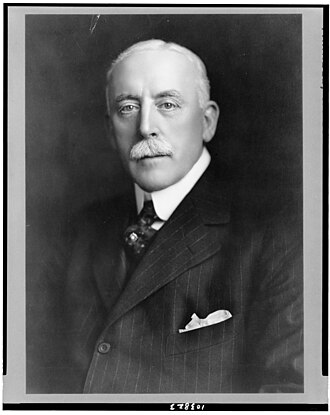
James Augustine Farrell was the rarest kind of executive in the age of the trusts: a man who reached the very top of the world's largest corporation not through finance, family, or law, but by knowing the work with his hands. He began as an unskilled laborer in a New Haven wire mill at sixteen, made himself one of the best wire-drawers in the country, and ended as president of the United States Steel Corporation for twenty-two years, from 1911 to 1932 [2][8]. When Judge Elbert H. Gary, U.S. Steel's chairman, died in 1927, Farrell was the man actually running a company whose 1901 capitalization of $1.4 billion had made it the first billion-dollar corporation in history [7][3].
Farrell's genuine and original contribution was foreign trade. In November 1903 Gary consolidated the corporation's scattered export operations into the United States Steel Products Export Company and named Farrell to run it [1]. Farrell set himself the goal of selling a fifth of U.S. Steel's entire output abroad, and though he never quite hit it, the record was formidable: the nation's iron and steel exports rose in value from $99 million in 1903 to over $305 million in 1913, with U.S. Steel regularly accounting for well over 75 percent of the trade, operating through some 268 agencies in 60 countries [1]. American steel exports climbed past every other export but cotton [1].
His promotion to the presidency in 1911 owed something to that record and something to luck: the historian John A. Garraty judged that Farrell rose in part because of his "neutrality" amid the bitter corporate infighting of 1910 [1]. Whatever the reason, the wire-drawer now sat in the president's office on the eighteenth floor, a silver-haired, Catholic son of a New Haven shipowner among the Episcopalian financiers of Wall Street [4]. He led the corporation through the export boom of the First World War, its prosperous 1920s, and into the first shock of the Depression, expanding its annual steel output roughly fivefold, from about 6 million tons to 29 million tons, over his tenure [8].
Farrell believed in exports the way other men believed in religion. When the First World War erupted in 1914, he argued that it had done more in a single week to convince Americans that foreign trade was vital to their domestic prosperity than years of academic argument had managed [1]. That conviction made him, in 1914, the founding chairman of the National Foreign Trade Council, an office he held until his death, under the banner "Greater Prosperity through Greater Foreign Trade" [1]. To carry the steel itself, he had already pushed U.S. Steel into shipping, organizing the Isthmian Steamship Company in 1910 [2].
In temperament he was a builder, not a brawler. He shared the corporation's hard anti-union line, refusing to negotiate during the great steel strike of 1919, and worked comfortably inside Gary's regime of cooperation and price stability that had helped U.S. Steel win its landmark antitrust case in 1920, when the Supreme Court ruled by a single vote that mere size was no offense [2]. By 1932, Farrell, sensing his era closing as Myron C. Taylor reorganized the company, startled the business world by retiring a year early at sixty-nine [4][6].
The sea ran beneath all of it. The boy whose father, a ship's captain, had been lost at sea bought in 1923 the Tusitala, the last full-rigged commercial sailing ship under the American flag, and sailed her for trade and pleasure until she became a training vessel, the romantic emblem of an industrialist who never stopped looking out past the breakwater [9][2].
Early Life & Path
He was born February 15, 1863, in New Haven, Connecticut, to John Guy Farrell, a ship owner and captain, and Catherine Whalen [2]. The defining catastrophe of his childhood was the sea: his father was lost in a wreck when James was not yet sixteen, and the boy went to work to help support the family [2]. The seafaring inheritance never left him, but the path open to a poor Irish-Catholic boy in the Connecticut of the 1870s ran not to the deck but to the mill.
He took a job as an unskilled laborer in a New Haven wire mill and, by sheer application, made himself an expert wire-drawer, one of the best in the country, by reputation. He moved to Pittsburgh, the capital of American steel, where he became foreman in charge of some 300 men at the Pittsburgh Wire Company [2][8]. It was the kind of apprenticeship almost no future titan of the corporation shared: Farrell knew the heat, the dies, and the men, and he carried that authority of the shop floor with him for the rest of his life.
When the trust-building wave of the 1890s swept the wire makers into the American Steel and Wire Company, soon folded into the new United States Steel Corporation of 1901, Farrell rose with it, first as a salesman, then as a manager by 1899, his gift turning out to be not just making wire but selling it, especially abroad [2][7]. He had married Catherine McDermott of Brooklyn in 1889; he would raise his family, in time, at a fieldstone estate called Rockledge in Rowayton, Connecticut, on the Long Island Sound water that had taken his father and that he loved all his life [2].
Career Timeline
- 1863Born February 15 in New Haven, Connecticut, son of ship captain John Guy Farrell [2].
- c. 1879Father lost at sea; the boy, not yet sixteen, takes work in a New Haven wire mill [2].
- 1880sBecomes an expert wire-drawer and foreman over 300 men at the Pittsburgh Wire Company [2][8].
- 1899Rises to manager in the American Steel and Wire export business [2][7].
- 1901American Steel and Wire is folded into the new United States Steel Corporation, capitalized at $1.4 billion, the first billion-dollar company [3][7].
- 1903Named in November to head the new U.S. Steel Products Export Company; sets a goal of exporting a fifth of output [1].
- 1910Organizes the Isthmian Steamship Company to carry U.S. Steel cargoes [2].
- 1911Promoted to president of U.S. Steel, Garraty notes his 'neutrality' in the 1910 infighting helped [1].
- 1914Founds and chairs the National Foreign Trade Council; declares the war proves foreign trade vital to prosperity [1].
- 1919Refuses to negotiate during the Great Steel Strike, holding the corporation's anti-union line [2].
- 1920Supreme Court clears U.S. Steel of antitrust violation by a 4-to-3 vote, size alone is no offense [2].
- 1923Buys the Tusitala, the last full-rigged commercial sailing ship under the U.S. flag [9].
- 1932Retires a year early, at sixty-nine, as Myron C. Taylor reorganizes the company [4][6].
- 1943Dies March 28 in New York City; some 1,500 attend his funeral [2].
Key Ventures & Innovations
U.S. Steel Products Export Company (1903)
Gary handed Farrell the corporation's tangled export operations to consolidate; Farrell built a global selling machine of some 268 agencies in 60 countries, lifting U.S. steel exports in value from $99 million in 1903 to over $305 million by 1913, with U.S. Steel taking the lion's share [1].
Isthmian Steamship Company (1910)
To move its steel cheaply and reliably to distant markets, U.S. Steel under Farrell organized its own ocean fleet, a vertical reach into shipping that suited a man raised among ships and anticipated the Farrell shipping dynasty his sons would build [2].
The presidency of U.S. Steel (1911–1932)
For twenty-two years Farrell was the operating head of the world's largest corporation, expanding its annual steel output roughly fivefold, from about 6 million tons to 29 million tons, through war boom, postwar prosperity, and the onset of Depression [8].
The National Foreign Trade Council (1914)
Farrell was the principal founder and lifelong chairman of the NFTC, the leading institutional voice of American exporters, organized under the slogan 'Greater Prosperity through Greater Foreign Trade' and working with Wilson's Commerce Secretary William C. Redfield to shape national trade policy [1].
The Tusitala (1923)
Farrell bought and operated the last full-rigged American merchant sailing ship, running her in trade between New York and Hawaii and using her to train sailors before she became a maritime-service training vessel, part romance, part conviction that sail still made good seamen [9].
“West of you lies the Orient with the teeming millions of hard-working thrify people... the Pacific area is perhaps the most rapidly developing market in the world.”
From the Record
“West of you lies the Orient with the teeming millions of hard-working thrify people... the Pacific area is perhaps the most rapidly developing market in the world.”
“He began as an unskilled laborer in a wire mill in New Haven, Connecticut, at the age of sixteen.”
“Mr. Farrell organized the Council in 1914 and has always been its chairman.”
What Operators Can Learn
- 01
Mastery of the work is its own ladder
Farrell rose from the mill floor to the top of the largest corporation on earth by becoming genuinely excellent at a craft and then at selling its product. In an age of financiers and lawyers, his shop-floor authority was a distinctive and durable kind of power.
- 02
Find the lever no one else is pulling
While rivals fought over the domestic market, Farrell built export trade into a global system. Owning a problem everyone else neglected, foreign sales, made him indispensable and carried him to the presidency.
- 03
Control the chain that serves your strategy
Believing in exports, Farrell did not stop at selling steel; he organized ships to carry it. When a strategy depends on a fragile link, owning that link can be worth more than the margin it costs.
- 04
Institutions outlast tenures
By founding the National Foreign Trade Council, Farrell turned a personal conviction into a permanent organization that shaped American trade policy long after he left U.S. Steel, and which he chaired until he died.
Legacy
Farrell's legacy is double. Inside U.S. Steel he was the operating hand that ran the colossus through its most prosperous decades, the proof that the corporation could be led by a man who had drawn wire rather than floated securities. Outside it, he was the era's foremost evangelist of American exports, the founder of an institution, the National Foreign Trade Council, that still carries his idea that the nation's prosperity is bound to its trade with the world [1][8]. The Pennsylvania mill town of Farrell was renamed in his honor, and the Farrell Lines his sons built grew into a major American merchant fleet [2].
History has been quieter about him than about the showmen of steel, Carnegie and Schwab, or the patriarch Gary, and he made no revolution in production to rank with Ford's assembly line [1]. He shared the corporation's worst reflexes too, the refusal to bargain with labor that helped make the steel strike of 1919 a defeat for the workers [2]. But he embodied something the more glamorous founders did not: the immigrant's-son competence that actually ran the machine, and a stubborn, almost romantic faith that America's economic destiny pointed outward, across the oceans his own father had sailed and died on [9][1].
Further Reading
The Life of Elbert H. Gary: The Story of Steel, Ida M. Tarbell (1925)
The authorized life of U.S. Steel's chairman, the indispensable portrait of the regime within which Farrell rose and ran the company.
The Authentic History of the United States Steel Corporation, Arundel Cotter (1916)
A contemporary insider chronicle of the corporation's first fifteen years, including its export drive and the men who led it.
A Nation of Steel: The Making of Modern America, 1865–1925, Thomas J. Misa (1995)
The leading modern scholarly history of the American steel industry through Farrell's era, strong on technology, markets, and the trust.
Steelworkers in America: The Nonunion Era, David Brody (1960)
The classic account of labor under U.S. Steel's anti-union regime, essential for understanding the 1919 strike Farrell helped defeat.
"The Abortive Attempt to Internationalize the American Steel Industry" (vol. 16), Business and Economic History (Business History Conference) (1987)
A scholarly article that places U.S. Steel's foreign-trade campaign, Farrell's life work, at the center of the corporation's global ambitions and their limits.
Sources
- 1."The Abortive Attempt to Internationalize the American Steel Industry", Business and Economic History (Business History Conference), Second Series, Volume 16, 1987, pp. 229–248, journal
- 2.“James A. Farrell Sr.”, Wikipedia, 2024
- 3.Ida M. Tarbell, The Life of Elbert H. Gary: The Story of Steel, D. Appleton and Company, 1925, book
- 4.“"Business: Foreign Traders" (14th National Foreign Trade Convention, Detroit)”, TIME, 1928, newspaper
- 5.Arundel Cotter, United States Steel: A Corporation with a Soul, Doubleday, Page & Company, 1921, book
- 6.“"Out of the Mill" (Business)”, TIME, 1932, newspaper
- 7.Arundel Cotter, The Authentic History of the United States Steel Corporation, The Moody Magazine and Book Company, 1916, book
- 8.“James A. Farrell, 20th Century Great American Business Leaders”, Harvard Business School, Baker Library, 2003, archive
- 9.“Records of the Ship TUSITALA (Manuscripts Collection 72)”, G. W. Blunt White Library, Mystic Seaport Museum, 1924–1939, archive
- 10.Thomas J. Misa, A Nation of Steel: The Making of Modern America, 1865–1925, The Johns Hopkins University Press, 1995, book
- 11.James A. Farrell, 1863–1943 (memorial), Bulletin of the Business Historical Society, 1943, journal
- 12.James A. Farrell, “James A. Farrell, 1932 speech on Pacific trade (text preserved online)”, History of Metropolitan Vancouver (vancouverhistory.ca), 1932, archive
Researched and written with Claude + live web search.