Overview
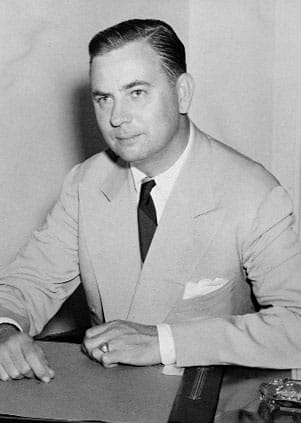
James Chadbourn Bolles is the rare twentieth-century industrialist whose name is fused to a product almost no one thinks about until a seam splits at the worst possible moment. He did not invent the stocking, nor the nylon it was knit from, nor even the company that bore his middle name. What he did, across thirty-four years, was take a small, ordinary Burlington, North Carolina sock business, Rufus D. Wilson, Inc., a firm with roughly half a million dollars in annual sales, and bend acquisition, research, and an obsessive eye for distribution around a single proposition: that women's hosiery could be made cheaper to stock, easier to fit, and eventually impossible to ruin [3][10]. By the time he retired in 1970, the enterprise he had renamed and rebuilt, Chadbourn Gotham, Inc., booked some $68 million in sales and ran eleven plants on two continents [3][10].
Bolles came to manufacturing sideways. A 1929 graduate of the Wharton School at the University of Pennsylvania, he began in finance at the American Trust Company before joining Wilson's hosiery operation in the late 1930s; when Rufus Wilson died around 1940, Bolles emerged as president and majority owner of the firm [3][10][6]. He moved fast. Through the mid-1940s, as wartime demand tripled output, he bought mills outright, most importantly the Larkwood Hosiery Company in 1945, and in 1946 relocated the headquarters to Charlotte, planting the now-landmarked smokestack with CHADBOURN spelled vertically down its brick [8][2]. By 1953 the company owned seven plants in three states [2].
The pivotal stroke was timing the move from the dying full-fashioned (seamed) stocking to the seamless one, and from plain nylon to stretch nylon. In 1946 a Chadbourn mill manager named Bill Leath received an unusually elastic sock from a French salesman; over the next eight years Leath, Gene Bobo, and Robert Matthews worked out how to tame the "wild" 15-denier yarn into a knittable sheer fabric, filing for patent in 1954 [6]. The breakthrough collapsed the retailer's nightmare, ten sizes and dozens of style-color combinations, into three stretch sizes that could hang in a drugstore as easily as a department store [6]. It also drew the covetous attention of Burlington Mills, the country's largest hosiery maker, whose Herbert Kaiser threatened a patent war before the two sides settled into a shared licensing vehicle, Patentex [6].
In 1955 Bolles merged with the forty-year-old, New York–based Gotham Hosiery Company, creating Chadbourn Gotham, Inc., and through the late 1950s and 1960s he diversified hard, out of pure women's hosiery and into lingerie, sleepwear, leisure wear, and men's and boys' clothing, with sales offices opening in Chicago, Los Angeles, San Francisco, and Montreal [2][10]. He also looked abroad earlier than most of his peers: on a European holiday he bought the Opel Strumpfwerke AG plant in Hamburg, declaring his intent "to gain a foothold in the European Common Market", a bet that kept Chadbourn's sales rising even as U.S. hosiery demand began its long slide [10][3].
The defining drama of Bolles's late career was the race for the runproof stocking. In 1962 Chadbourn Gotham announced "Foreva," a runless, seamless women's stocking, going head-to-head with Hanes to be first to market a stocking that was both seamless and would not run [4]. It was the logical end of everything Bolles had chased, the indestructible product, the universal fit, and yet it foundered on the same shoals that always wreck hosiery innovations: runproof yarns knit up meshier and less sheer, and fashion wanted sheer [4]. Within a few years the miniskirt and pantyhose remade the whole category, and the seamed-stocking world Bolles had so shrewdly abandoned was simply gone [6][9].
Bolles retired in 1970 at the peak of the numbers, handing off a company that looked like a triumph of diversification [3][10]. The triumph was brittle. Changing fashion gutted demand for Chadbourn's core hosiery lines almost immediately; the company was acquired by Alabama's W. B. Davis Hosiery in 1973, and the Charlotte plant, once employing more than 2,500 people, was shuttered in 1978 [2]. The empire outlived its builder's working life by barely a decade. What survives is the smokestack, the patents, and a textbook case in reading a market's future correctly and still being overtaken by it.
Early Life & Path
James Chadbourn Bolles was born September 2, 1905, in North Carolina, into a professional family, his father was not a mill man but a member of the professions, which placed the young Bolles closer to the ledger than to the loom from the start [1][6]. The middle name Chadbourn, which would one day be stamped down the side of a Charlotte smokestack, came from family; the town of Chadbourn, North Carolina, like the name itself, traces to a lumber family of the same name rather than to any hosiery enterprise [6].
He went north for his education, taking an undergraduate degree from the University of Pennsylvania's Wharton School in the class of 1929, a finance and manufacturing training that, in the depths of the coming Depression, would prove a more useful foundation for a textile career than any apprenticeship on the knitting floor [3][10]. He did not go straight into mills. His first job was at the American Trust Company, a Charlotte bank, where he learned the discipline of capital, valuation, and the cold arithmetic of acquisitions that he would later turn loose on the hosiery business [10].
The pivot to manufacturing came in the late 1930s, when Bolles joined Rufus D. Wilson, Inc., a hosiery firm in Burlington, North Carolina [3][6]. He was a banker walking onto a mill floor, and when Rufus Wilson died around 1940, it was the banker, not a hosiery lifer, who took control as president and majority owner [6]. The man who would build one of the South's most aggressive textile-and-apparel complexes began, in other words, not by knitting a single sock but by understanding what a struggling sock company was worth and how to buy more of them [3][10].
Career Timeline
- 1905Born September 2 in North Carolina, son of a professional family [1][6].
- 1929Graduates from the Wharton School, University of Pennsylvania; begins his career at the American Trust Company [3][10].
- c. 1938Joins Rufus D. Wilson, Inc., a hosiery firm in Burlington, North Carolina [3][6].
- c. 1940Becomes president and majority owner after Rufus Wilson's death [6].
- 1945Acquires the Larkwood Hosiery Company as wartime output triples [2][8].
- 1946Moves headquarters to Charlotte; expands the mill with a new boiler house, cafeteria, and air conditioning [2][8].
- 1946Mill manager Bill Leath receives an unusually elastic sock from a French salesman, the seed of Chadbourn's stretch-nylon program [6].
- 1953Company owns seven manufacturing plants in three states [2].
- 1954Chadbourn files its stretch-nylon yarn patent application (Aug. 3); six U.S. patents issue between 1955 and 1957 [6].
- 1955Merges with New York's Gotham Hosiery Company to form Chadbourn Gotham, Inc., headquartered in Charlotte [2][10].
- 1958Loses an appeal in Chadbourn Gotham, Inc. v. Vogue Manufacturing Corp. over royalties on a licensed stocking-fabric patent [7].
- 1962Announces "Foreva," a runless, seamless stocking, in a public race with Hanes [4].
- 1960sDiversifies into lingerie, sleepwear, leisure wear, and men's and boys' clothing; buys the Opel Strumpfwerke plant in Hamburg for a European foothold [2][10].
- 1970Retires with the company at roughly $68 million in sales and eleven plants on two continents [3][10].
- 1987Dies March 5 [1].
Key Ventures & Innovations
Rufus D. Wilson, Inc. → Chadbourn Hosiery Mills
The small Burlington sock firm Bolles took over around 1940, with about $500,000 in sales. He renamed it for his own middle name and turned it into the acquisition vehicle for a regional roll-up of hosiery mills [3][10][6].
The Larkwood acquisition and the Charlotte move (1945–46)
Buying Larkwood Hosiery in 1945 and relocating headquarters to Charlotte in 1946 set the company's center of gravity. The CHADBOURN smokestack added later became a Charlotte landmark; the plant eventually employed more than 2,500 [2][8].
Stretch nylon
From a 1946 French sample, Chadbourn engineers Bill Leath, Gene Bobo, and Robert Matthews tamed "wild" 15-denier yarn into knittable sheer stretch fabric, patenting it in the mid-1950s. Three stretch sizes replaced ten full-fashioned sizes, opening drugstore and supermarket distribution and forcing a licensing truce with industry giant Burlington Mills via Patentex [6].
The Gotham merger (1955)
Combining with the forty-year-old New York firm Gotham Hosiery created Chadbourn Gotham, Inc., pairing Southern manufacturing scale with an established Northern brand and sales network [2][10].
"Foreva" runproof stocking (1962)
Chadbourn Gotham's bid to win the race for a seamless, runless stocking against Hanes. The product embodied Bolles's lifelong chase for the indestructible, universal stocking, and ran headlong into fashion's preference for sheerness over durability [4].
European expansion
Bolles bought the Opel Strumpfwerke AG plant in Hamburg, Germany to "gain a foothold in the European Common Market," an unusually early international move that kept sales climbing as U.S. hosiery demand eroded [10][3].
“to gain a foothold in the European Common Market.”
From the Record
“The name announced by Chadbourn Gotham Inc. for its new runless and seamless stockings is "Foreva."”
“unless we come to some agreement, we intend to fight you and your patent application with everything we have.”
“Under Bolles' dynamic direction, which spanned 34 years, Chadbourn grew from a small hosiery operation with $500,000 in annual sales to an international and diversified textile and apparel complex with $68 million in sales.”
What Operators Can Learn
- 01
A balance sheet is a tool a craftsman never had
Bolles read hosiery as a banker, not a knitter. Seeing the business as a portfolio of mills to buy, value, and consolidate let him grow faster than rivals who only knew how to run a single floor.
- 02
Solve the retailer's problem, not just the product's
Stretch nylon's real genius was collapsing ten sizes into three. Bolles understood that cutting a store's inventory burden, not just improving the sock, was what unlocked drugstore and supermarket distribution and a far larger market.
- 03
Being right about the future is not the same as surviving it
Bolles correctly abandoned the seamed stocking for the seamless, stretch one, and still watched the miniskirt and pantyhose wave wash over the entire category. Reading the trend early protects you only until the next trend you didn't see.
- 04
Diversification that looks like strength can be camouflage
The $68 million, eleven-plant complex of 1970 looked diversified and durable. Within three years it was sold and within eight the flagship plant was closed, a reminder that breadth built on a declining core buys time, not immunity.
Legacy
Bolles's legacy is double-edged, like the runproof stocking he chased. On one side is a genuine industrial achievement: he turned a half-million-dollar sock mill into a $68-million transatlantic textile-and-apparel company, helped pioneer the stretch-nylon technology that made seamless hosiery cheap and universally fitting, and moved into European manufacturing earlier than most American peers [3][6][10]. The development of stretch nylon at his Charlotte and Burlington plants is now treated as a hinge moment in the history of modern hosiery, the step that made the disposable, one-size-stretches-all stocking possible [6][9].
On the other side is the speed of the unraveling. The fashion revolution of the late 1960s, miniskirts, pantyhose, and the collapse of the formal stocking, gutted Chadbourn's core almost the moment Bolles stepped down in 1970 [2][6]. The company passed to W. B. Davis Hosiery in 1973, and the Charlotte plant that had employed more than 2,500 people closed in 1978, swept up in the broader decline of the Southern textile industry under foreign competition and globalization [2]. Today the firm's most visible monument is the landmarked Larkwood-Chadbourn mill in Charlotte's NoDa district, its smokestack still spelling CHADBOURN, redeveloped for a city that no longer makes stockings [2][8]. Bolles endures less as a household name than as a clean case study, in business-school collections like Harvard's roster of twentieth-century leaders, of how far disciplined capital and well-timed technology can carry a commodity business, and how quickly fashion can take it all back [3].
Further Reading
The Textile Industry in North Carolina: A History, Brent D. Glass (1992)
The standard short history of the industry that made and unmade Chadbourn, from colonial handlooms to the consolidations and closings of the late twentieth century.
Like a Family: The Making of a Southern Cotton Mill World, Jacquelyn Dowd Hall et al. (1987)
The classic oral-history portrait of Piedmont mill life, essential context for the world Chadbourn's thousands of hosiery workers inhabited.
Hanging by a Thread: Social Change in Southern Textiles, Jeffrey Leiter, Michael Schulman, and Rhonda Zingraff (eds.) (1991)
Sociologists and historians on the decline of Southern textiles, the structural undertow that swept Chadbourn away within a decade of Bolles's retirement.
20th-Century Dress in the United States, Jane Farrell-Beck and Jean Parsons (2007)
Useful on the hosiery-to-pantyhose transition and the fashion shifts that overtook the seamed-stocking business Bolles built and then abandoned.
Sources
- 1.“James Chadbourn Bolles (1905–1987), memorial record”, Find a Grave, 1987, archive
- 2.Charlotte-Mecklenburg Historic Landmarks Commission, “Larkwood-Chadbourn Hosiery Mill Plant Designation Report”, Charlotte-Mecklenburg Historic Landmarks Commission, 2021, archive
- 3.Harvard Business School, “J. Chadbourn Bolles, 20th Century Great American Business Leaders Database”, Harvard Business School, archive
- 4.Fashion: Sheer Delight, TIME, 1962, journal
- 5.Jacquelyn Dowd Hall, James Leloudis, Robert Korstad, Mary Murphy, Lu Ann Jones, Christopher Daly, Like a Family: The Making of a Southern Cotton Mill World, University of North Carolina Press, 1987, book
- 6.“The Development of Stretch Nylon”, NC State University, Textiles History
- 7.U.S. Court of Appeals for the Fourth Circuit, “Chadbourn Gotham, Inc. v. Vogue Manufacturing Corporation, 259 F.2d 909”, Justia (U.S. Court of Appeals, 4th Circuit), 1958, archive
- 8.Rufus K. Smith and John J. Edwin, “U.S. Patent 3,331,506, Hosiery finishing and sorting range (assignee Chadbourn Gotham Inc.)”, United States Patent Office, 1967, archive
- 9.Brent D. Glass, The Textile Industry in North Carolina: A History, North Carolina Division of Archives and History, 1992, book
- 10.Int'l Foothold in U.S. Manufacturing: James Chadbourn Bolles W29, Wharton Magazine, University of Pennsylvania, journal
- 11.Jeffrey Leiter, Michael D. Schulman, and Rhonda Zingraff (eds.), Hanging by a Thread: Social Change in Southern Textiles, ILR Press, Cornell University, 1991, book
Researched and written with Claude + live web search.