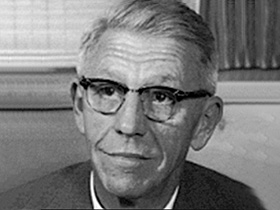
Overview
Herman Guy Fisher was not a toymaker by trade, he was an advertising and sales man who, at the bottom of the Great Depression, bet his career on the idea that ordinary parents would pay a fair price for a well-made plaything that actually did something [1][4]. In 1930, in the village of East Aurora, New York, he joined with Irving L. Price, the town's mayor and a retired Woolworth executive, and Helen M. Schelle, who had run a toy shop in Binghamton, to incorporate the Fisher-Price Toy Company; Price helped raise the roughly $100,000 in capital, and Margaret Evans Price, a nationally known children's-book illustrator and Irving's wife, designed the earliest line, she is often counted the fourth founder [2][4][6].
None of them really knew how to manufacture a toy [4]. What Fisher brought was a creed, set down in the company's first catalogue and never abandoned: every toy had to have "intrinsic play value, ingenuity, strong construction, good value for the money and action" [4][6]. The same catalogue promised "gay, cheerful, friendly toys with amusing action, toys that do something new and surprising and funny!" [3]. On a cold February morning in 1931, three of the founders carried sixteen handmade pull-toys, the line they called the "sixteen hopefuls," among them Granny Doodle and Dr. Doodle, dressed-up wooden ducks with beaks that clacked when pulled, to the American International Toy Fair in New York [4][5]. The buyers placed orders, and a company was born [6].
Profit did not come quickly. Fisher-Price lost something close to two-thirds of its capital in its first four years before turning a profit late in the 1930s [7]. The turn came with toys that became Americana: the wooden Snoopy Sniffer beagle of 1938, whose padded paws and floppy ears made it an instant hit, and a 1935 license that made Fisher-Price the first toy company permitted to put Walt Disney's characters on its products [1][8]. By the end of the decade the little East Aurora plant was turning out more than two million action toys a year and booking some $1.6 million in sales [8].
Fisher's method was famously unglamorous. He carried a sack of prototypes door to door through East Aurora, talked his way into the dining rooms of families with small children, set the toys on the floor, and then said nothing, he simply watched which ones a child reached for, abandoned, or kept coming back to [1][9]. He studied his own three children the same way [1]. It was market research conducted on hands and knees, and it gave the company an almost uncanny instinct for what would survive a toddler and hold a toddler's attention. He paired that with a paternalistic loyalty to his workforce, sharing profits with employees, bonuses reportedly running as high as twenty percent of wages and sometimes paid out in silver dollars to dramatize the money flowing into the local economy [5][6].
The postwar suburban boom carried Fisher-Price upward [8]. Fisher shifted carefully from Ponderosa pine to plastic, Buzzy Bee's wings, around 1950, were the company's first plastic parts, without surrendering the durability that was the brand's whole point [4][6]. He sold aggressively into the new discount mass-merchandisers, and by the time he stepped down as president in 1966 in favor of Henry Coords, recruited from Western Electric, annual sales had climbed past $26 million [4][8]. In 1969, at seventy-one, Fisher retired completely and sold the company to The Quaker Oats Company, ending one of the quietest and most durable founder runs in American consumer goods [1][4].
He was never a household name the way his toys were. But Herman Fisher had done something rare: he built a brand that two and three generations of parents would trust on sight, on the strength of a stubborn, unfashionable conviction that a cheap toy and a good toy did not have to be different things [1][8].
Early Life & Path
He was born November 2, 1898, in Unionville, a small town in Centre County, Pennsylvania, and grew up of modest means [1]. He worked his way through the Pennsylvania State College, selling brushes door to door, clerking in a clothing store, laboring in a steel mill, and working in a movie theater, and graduated in 1921 with a degree in commerce and finance, having also served in the R.O.T.C. and worked on the campus yearbook and humor magazine [1]. The door-to-door selling that paid his tuition would, decades later, become the literal method by which he tested his toys [1][9].
After a stint studying surety bonds in New York City and a job with a bond company in Rochester, Fisher found his way into the business that would define him [1]. In 1926 he became sales-promotion and advertising manager at Alderman-Fairchild Company, a Rochester maker of specialty paper boxes and games, and from there he moved to become vice president and general manager of All Fair, Inc., a toy and game manufacturer in Churchville, New York [1][4]. It was at All Fair that the advertising man learned the toy trade from the inside, and grew convinced that the industry was selling children flimsy, cynical goods that broke or bored them within days [1].
When the chance came to start fresh on his own terms, Fisher took it in the worst possible year for a new consumer-goods venture: 1930, with the Depression deepening [4][6]. He found his partners and his backing in East Aurora, a village south of Buffalo with a craft tradition rooted in the Roycroft arts-and-crafts community, and he set up shop in a converted frame-and-concrete-block house on Church Street, where the plant opened on October 1, 1930 [4][5].
Career Timeline
- 1898Born November 2 in Unionville, Centre County, Pennsylvania [1].
- 1921Graduates Pennsylvania State College in commerce and finance, having worked his way through school [1].
- 1926Becomes sales-promotion and advertising manager at Alderman-Fairchild Co. in Rochester, New York; later VP and general manager of the toymaker All Fair, Inc. [1][4].
- 1930Co-founds the Fisher-Price Toy Company in East Aurora, New York, with Irving L. Price and Helen M. Schelle; the Church Street plant opens October 1 [4][5][6].
- 1931Three founders carry sixteen wooden pull-toys, the "sixteen hopefuls," including Dr. Doodle and Granny Doodle, to the American International Toy Fair in New York; Dr. Doodle becomes the first toy sold [4][5][6].
- 1934Early years bring heavy losses; the company sheds roughly two-thirds of its capital before finding its footing [7].
- 1935Fisher-Price becomes the first toy company licensed to make Walt Disney character toys [1].
- 1938Introduces the Snoopy Sniffer wooden pull-dog, an instant and enduring hit [1][8].
- 1939By the end of the 1930s the company makes over two million action toys a year and books about $1.6 million in sales [8].
- 1942During World War II the plant converts to war work, ship fenders, glider ailerons, and medical chests [1].
- 1950Adopts plastic for the first time, in the wings of Buzzy Bee, while keeping the line built to survive hard play [4][6].
- 1966Steps down as president, becoming chairman; Henry Coords, recruited from Western Electric, succeeds him as sales pass $26 million [4][8].
- 1969Retires at 71 and sells Fisher-Price to The Quaker Oats Company; named a Penn State Distinguished Alumnus the same year [1][4].
- 1975Dies September 26 at Millard Fillmore Hospital in Buffalo, New York, at 76 [1][10].
Key Ventures & Innovations
The Fisher-Price Toy Company (1930)
A Depression-era partnership of an ad man (Fisher), a retired retail executive and mayor (Price), and a toy-shop owner (Schelle), backed by roughly $100,000 in raised capital and the design hand of illustrator Margaret Evans Price. Its founding creed, intrinsic play value, ingenuity, strong construction, good value, and action, outlasted every one of them [2][4][6].
The "sixteen hopefuls" and Dr. Doodle (1931)
The first line of sixteen Ponderosa-pine pull-toys, decorated with non-toxic lithographs and joined with steel parts, debuted at the 1931 New York Toy Fair. Dr. Doodle, a quacking wooden duck, became the first Fisher-Price toy ever sold and set the template for the action pull-toy [4][5][6].
Snoopy Sniffer and the Disney license
A 1935 license made Fisher-Price the first toymaker allowed to use Disney characters, and the 1938 Snoopy Sniffer, a floppy-eared wooden beagle that woofed and waddled when pulled, became a decades-long bestseller, anchoring the company's first sustained profits [1][8][11].
Door-to-door play testing
Fisher's signature R&D was to take prototypes into neighbors' homes, set them before children, and watch in silence to see which toys held attention and survived abuse, a hands-and-knees market research that gave the brand its instinct for what children actually wanted [1][9].
Profit-sharing and the postwar mass market
Fisher shared profits with his East Aurora workers, with bonuses reportedly up to twenty percent of wages and sometimes paid in silver dollars, while pushing the line into postwar discount retailers and easing pine over to plastic, lifting sales past $26 million by 1966 [4][5][8].
“Fisher-Price toys should have intrinsic play value, ingenuity, strong construction, good value for the money and action.”
From the Record
“Fisher-Price toys should have intrinsic play value, ingenuity, strong construction, good value for the money and action.”
“gay, cheerful, friendly toys with amusing action, toys that do something new and surprising and funny!”
“Herman G. Fisher, who with two associates founded the Fisher-Price Toy Company in 1930 and built it into one of the nation's largest makers of preschool toys, died Friday in Millard Fillmore Hospital. He was 76 years old.”
What Operators Can Learn
- 01
Watch behavior, don't ask for opinions
Fisher's genius was a method, not a product: put the thing in front of the real user and shut up. Children can't fill out surveys, but they vote with their hands, and a toy a toddler keeps returning to is worth more data than any focus group.
- 02
Cheap and good are not opposites
The whole brand rested on refusing the industry's assumption that an affordable toy had to be a disposable one. Durability plus fair price, held to stubbornly for decades, is what earned multigenerational trust.
- 03
A clear creed can outlast its author
Five plain principles written into the first catalogue gave every later designer a test to pass. Codifying what 'good' means lets a standard survive growth, succession, and even acquisition.
- 04
Survive the lean years to reach the boom
Founded in the Depression's depths, Fisher-Price bled two-thirds of its capital before it turned a profit. Fisher's willingness to grind through losing years positioned the company to ride the postwar baby boom it could never have predicted.
Legacy
Herman Fisher proved that a consumer brand could be built on trust rather than novelty. The principles he wrote into the first catalogue, play value, ingenuity, durability, value, action, became a genuine institutional standard, the reason parents who had pulled a Snoopy Sniffer as children handed Fisher-Price toys to their own kids without a second thought [4][6]. Long after he sold the company to Quaker Oats in 1969, the East Aurora operation he started in a converted house remained, for a time, the world's largest maker of preschool toys, and East Aurora kept its identity as a kind of American Toy Town, complete with a museum and resource library devoted to the company's history [1][4].
He was honored late and modestly for a man whose products were everywhere: a Penn State Distinguished Alumnus in 1969, with Fisher Plaza on the campus he had worked his way through, and posthumous induction into the Toy Industry Hall of Fame in 1985 [1]. His more lasting monument is methodological. The discipline of designing for the actual child, observed, not imagined, and of treating affordability and quality as a single problem rather than a trade-off, became a default expectation of the entire juvenile-products industry [1][8]. Fisher never claimed to have invented the toy; like the best of his generation of founders, he simply figured out how to make a good one that a Depression-era parent could afford, and then refused to stop [3][6].
Further Reading
Fisher-Price: Historical, Rarity, and Value Guide, 1931-Present, Bruce R. Fox and John J. Murray (2002)
The standard reference by two longtime Fisher-Price insiders and collectors; the most detailed catalogue of the company's toys and early history.
Fisher-Price, 1931-1963: A Historical, Rarity, Value Guide, John J. Murray and Bruce R. Fox (1991)
The earlier volume focused on the founding decades under Herman Fisher, rich on the wooden-toy era.
Fisher-Price Toys: A Pictorial Price Guide to the More Popular Toys, Gary Combs and Brad Cassity (2003)
A photo-driven guide to the classic toys, useful for dating and identifying the products Fisher built the company on.
Looking Back at East Aurora, Robert J. Mulvany (2006)
Local history of the village that became Fisher-Price's home and 'Toy Town,' giving context to the company's roots.
Sources
- 1.Pennsylvania Center for the Book, “Herman Guy Fisher (biographical profile)”, Penn State University Libraries, archive
- 2.“Herman Fisher”, Wikipedia
- 3.Fisher-Price, Inc. (company history), Encyclopedia.com / International Directory of Company Histories, journal
- 4.History of Fisher-Price Inc., FundingUniverse / International Directory of Company Histories, journal
- 5.“The Genesis of Toytown”, East Aurora Advertiser, 2020, newspaper
- 6.Bruce R. Fox and John J. Murray, Fisher-Price: Historical, Rarity, and Value Guide, 1931-Present, Krause Publications, 2002, book
- 7.John J. Murray and Bruce R. Fox, Fisher-Price, 1931-1963: A Historical, Rarity, Value Guide, Books Americana, 1991, book
- 8.Harvard Business School, “Herman G. Fisher, 20th Century Great American Business Leaders”, Harvard Business School, Leadership database, archive
- 9.“Upstate New York: The Birthplace of Fisher-Price's Timeless Toys”, 98.1 The Hawk
- 10.“Herman G. Fisher Is Dead at 76; Was President of Toy Company”, The New York Times, September 28, 1975, p. 59, newspaper
- 11.Gary Combs and Brad Cassity, Fisher-Price Toys: A Pictorial Price Guide to the More Popular Toys, Collector Books, 2003, book
Researched and written with Claude + live web search.