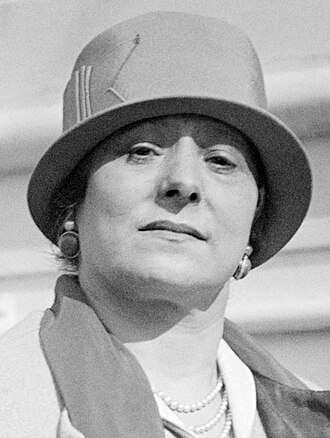
Overview
Helena Rubinstein did not invent face cream, and she did not invent vanity. What she invented was the modern beauty business: the idea that a jar of cream could be sold not as a folk remedy or an actress's secret but as a scientific treatment, dispensed by a trained "specialist" in a clinical salon, backed by advertising that taught ordinary women to scrutinize their own faces and find them wanting [1][2]. At a moment when respectable women did not paint their faces, makeup belonged to actresses and prostitutes, she built, almost single-handedly and from nothing, one of the first global cosmetics empires, and she ran it as an autocrat for half a century [1][5].
The origin myth she told and retold began with her own skin. A poor girl from the Jewish quarter of Kraków, she arrived in the Australian bush around 1894 carrying jars of a family face cream, and found that the sunburned women of Victoria envied her pale complexion and would pay for the secret [3][6]. In 1902 she opened a salon in Elizabeth Street, Melbourne, on a borrowed £100, selling "Crème Valaze", a confection of mineral oil, ceresine wax and sesame dressed up with a story about rare Carpathian herbs and a chemist named Dr. Lykusky, that cost tenpence to make and sold for six shillings [1][6]. Within two years the cream had earned roughly £12,000, and she left for London in 1908 reportedly carrying £100,000 to invest [6].
From Melbourne she leapt to the capitals of the world: a salon at 24 Grafton Street in Mayfair in 1908, another on the rue Saint-Honoré in Paris in 1909, and, driven across the Atlantic by the First World War, her first American salon, the Maison de Beauté Valaze, in New York in 1915 [1][2][7]. America became, in her own phrase, her life's work [2]. She codified skin into types, dry, oily, combination, sensitive, so that there was a product for every diagnosis, pioneered medicated and tinted creams and waterproof mascara, and surrounded the whole enterprise with the white-coated authority of a laboratory [5]. Her great rival, Elizabeth Arden, was doing much the same thing a few blocks away; the two women ran dueling empires for forty years, poached each other's executives, copied each other's products, and famously never once met in person [1][5].
In 1928 she pulled off the deal of her life. Persuaded that the American market was peaking and wanting to concentrate on Europe, she sold the controlling interest in her U.S. company to Lehman Brothers for $7.3 million [4][7]. Then the Crash came. Watching the stock she had sold collapse, and convinced the bankers were cheapening her brand, she bought the controlling interest back for roughly $1.5 million, having pocketed the difference and reclaimed her company at a fraction of the price [4][7]. It is one of the shrewdest founder buybacks in business history, and she told it as a parable about men who did not understand women's business.
She was, by every account, a tiny, imperious, contradictory monarch, four feet ten inches tall, draped in ropes of pearls and jade over violently colored tweeds, hoarding modern masterpieces by Picasso, Matisse and Modigliani "hugger-mugger" in her apartments, demanding to be addressed as "Madame," and clutching a paper-bag lunch in a hand crusted with emeralds [1][9]. When a Park Avenue building refused in 1941 to rent to a Jew, she bought the building [8]. When three robbers held her at gunpoint in that apartment in 1964, the ninety-two-year-old hid the key to her safe in her bosom and told them they could shoot her; they left with about two hundred dollars [2][8]. She died on April 1, 1965, at ninety-four, one of the richest self-made women in the world, still going to the office [7][10].
Early Life & Path
She was born Chaja Rubinstein on December 25, 1870, in the Kazimierz quarter of Kraków, then in Austrian-ruled Poland, the eldest of eight daughters of Augusta (Gitel) and Horace (Naftali Hertz) Rubinstein, a kerosene and egg wholesaler of modest means [1][7]. She grew up in a crowded Orthodox household where eight girls in a family that had hoped for sons was something close to a calamity, and where a daughter's only future was the right marriage [1][2]. She was clever, willful, and, the family lore holds, refused the match her father arranged with a widower, a defiance serious enough to require her removal from Kraków [2][7].
Around 1894 she was sent to Australia to relatives, landing eventually in Coleraine in the western Victorian bush, where she clerked in an uncle's general store and took English lessons [3][6]. The legend that became her brand's foundation begins here: the local women, weathered by sun and wind, admired the porcelain complexion she credited to a face cream made in Kraków, and asked where they could get it [3][6]. Whether the chemist "Dr. Lykusky" and the Carpathian herbs were real or invented hardly mattered, she had found, in the gap between rough colonial skin and European refinement, a market nobody else had seen [1][6].
In 1902 she opened her Melbourne salon with a small loan and an enormous instinct for theater, and by 1908 she was rich enough to set sail for London and conquer Europe [6]. That year she married Edward William Titus, an American-Polish journalist and bibliophile, at a London register office; he wrote her advertising copy and gave her two sons, Roy and Horace, before the marriage curdled into a long-distance arrangement and finally divorce in 1938 [2][7]. She had begun life as a surplus daughter in a Kraków tenement; she would end it as "Madame," the empress of a global trade she had largely conjured into being [1][5].
Career Timeline
- 1870Born Chaja Rubinstein on December 25 in the Kazimierz Jewish quarter of Kraków, eldest of eight daughters [1][7].
- 1894Emigrates to Australia, settling for a time at Coleraine in rural Victoria [3][6].
- 1902Opens her first salon in Elizabeth Street, Melbourne, on a borrowed £100, selling Crème Valaze [1][6].
- 1908Opens a London salon at 24 Grafton Street, Mayfair; marries Edward Titus in July, leaving Australia with a reported £100,000 [6][7].
- 1909Opens a Paris salon on the rue Saint-Honoré; son Roy born that year, Horace following in 1912 [2][7].
- 1915Driven from Europe by the war, opens her first New York salon, the Maison de Beauté Valaze [1][7].
- 1910s–1920sCodifies skin into types and pioneers medicated, tinted and waterproof products as her U.S. salon chain spreads to Boston, Chicago, Philadelphia and beyond [5][7].
- 1928Sells controlling interest in her U.S. company to Lehman Brothers for $7.3 million [4][7].
- 1929–1930After the Crash, buys the controlling interest back for roughly $1.5 million, regaining her company at a fraction of the sale price [4][7].
- 1938Divorces Edward Titus and marries Prince Artchil Gourielli-Tchkonia, becoming a princess and launching a men's line under his name [2][7].
- 1941Refused an apartment by a Park Avenue building that barred Jews, she buys the building, 625 Park Avenue [8].
- 1953Establishes the Helena Rubinstein Foundation to fund women's and children's health, education and the arts [7].
- 1964Held at gunpoint by robbers in her Park Avenue apartment at ninety-two, she hides her safe key and refuses; they leave with about $200 [2][8].
- 1965Dies April 1 in New York at ninety-four, still running her company; her estate is auctioned by Sotheby's in catalogues running to six volumes [7][9].
Key Ventures & Innovations
Crème Valaze and the Melbourne salon (1902)
The cream that started everything cost about tenpence to compound and sold for six shillings, wrapped in a story of rare Carpathian herbs and a learned chemist. In two years it earned some £12,000, proof that women would pay luxury prices for science and self-improvement, not just grease [1][6].
The international salon network (1908–1915)
London, Paris, then New York and a chain of American cities. Each salon was staged as a clinic, white coats, diagnoses, treatments, turning the buying of cosmetics into a respectable, even therapeutic, ritual and exporting one brand across the world [1][7].
Skin science and the product system
Rubinstein sorted skin into types, dry, oily, combination, sensitive, so every customer needed several products, and pioneered medicated creams, tinted foundations and waterproof mascara. The pseudo-medical framework was both marketing genius and the seed of an entire industry's logic [5].
The Lehman Brothers sale and buyback (1928–1930)
She sold control of her U.S. business to Lehman Brothers for $7.3 million in 1928, then repurchased it after the Crash for about $1.5 million, keeping the cash, reclaiming the company cheaply, and turning a near-disaster into the shrewdest deal of her career [4][7].
The art-and-image empire
She built the brand around her own legend, the jewels, the modern-art collection, the title 'Madame,' the buildings, understanding before almost anyone that in beauty the founder's persona was itself the product [1][5].
“There are no ugly women, only lazy ones.”
From the Record
“There are no ugly women, only lazy ones.”
“Chaja Rubinstein and Florence Nightingale Graham, both born into poverty and both lacking any formal education, defied nineteenth-century notions of class and gender to become two of the twentieth century's most powerful and influential businesswomen.”
“It was not easy being a hard-working woman in a man's world many years ago.”
What Operators Can Learn
- 01
Sell the diagnosis, not just the jar
By dividing skin into types and dressing the salon as a clinic, Rubinstein turned an undifferentiated commodity into a system of products and treatments. The science was largely theater, but it created demand, repeat purchase, and a reason to charge luxury prices.
- 02
The founder can be the product
Her jewels, her art, her accent, her title 'Madame', all of it was brand-building. She grasped that in beauty, where the promise is intangible, the proprietor's own glamour and authority are what customers are really buying.
- 03
Know what your business is worth better than the bankers do
Selling to Lehman Brothers at the top and buying back after the Crash for a fifth of the price worked because she understood her customers and her brand more intimately than any financier. Conviction about intrinsic value beat market timing.
- 04
Turn exclusion into ownership
Barred from an apartment for being Jewish, she bought the building. The instinct, to answer a closed door by acquiring the door, runs through a career built by an outsider in markets that did not expect her.
Legacy
Helena Rubinstein, with Elizabeth Arden and later Charles Revson and Estée Lauder, created the modern cosmetics industry, a multibillion-dollar global trade that did not meaningfully exist before she willed it into being [1][5]. The conventions she pioneered are now invisible because they are universal: the branded salon and counter, the product line organized by skin type, the white-coated language of science, the founder-as-icon, the relentless education of women into both aspiration and anxiety about their own faces [1][5]. Feminist historians argue over her ambiguous legacy, emancipator who gave women a respectable trade and a measure of control, or merchant of insecurity, but no one disputes that she changed how the twentieth century looked at itself [2][5].
She was also a self-made immigrant Jewish woman who became one of the richest people of her sex on earth in an era that offered women almost no path to wealth or command, and who ran her empire as an absolute and frequently impossible monarch into her nineties [1][7]. Her great modern-art collection was dispersed at auction, but the Helena Rubinstein Foundation she endowed in 1953 poured her fortune for decades into women's and children's health, education and the arts [7]. In 2014 the Jewish Museum in New York mounted a full retrospective under the title she might have chosen herself, drawn from her own creed, Beauty Is Power [5].
Further Reading
War Paint: Madame Helena Rubinstein and Miss Elizabeth Arden, Their Lives, Their Times, Their Rivalry, Lindy Woodhead (2003)
The definitive dual biography of the two women who built the beauty industry; vivid on the decades-long rivalry and the business itself.
Helena Rubinstein: The Woman Who Invented Beauty, Michèle Fitoussi (2013)
A richly researched single-volume life by a former editor of French Elle, strong on the Kraków origins and the European years.
Madame: An Intimate Biography of Helena Rubinstein, Patrick O'Higgins (1971)
An insider's portrait by the man who was her personal assistant for fifteen years, affectionate, unsparing, and full of first-hand scenes.
My Life for Beauty, Helena Rubinstein (1966)
Her posthumous memoir and beauty manual, primary source and self-made myth in equal measure.
Helena Rubinstein: Beauty Is Power, Mason Klein (ed.) (2014)
The scholarly catalogue of the Jewish Museum retrospective, placing her in the histories of art, gender, and Jewish modernity.
Sources
- 1.Lindy Woodhead, War Paint: Madame Helena Rubinstein and Miss Elizabeth Arden, Their Lives, Their Times, Their Rivalry, John Wiley & Sons, 2003, book
- 2.Michèle Fitoussi (trans. Kate Bignold and Lakshmi Ramakrishnan Iyer), Helena Rubinstein: The Woman Who Invented Beauty, Gallic Books, 2013, book
- 3.Helena Rubinstein, My Life for Beauty, Simon & Schuster, 1966, book
- 4.Patrick O'Higgins, Madame: An Intimate Biography of Helena Rubinstein, Viking Press, 1971, book
- 5.Mason Klein (ed.), Helena Rubinstein: Beauty Is Power, The Jewish Museum / Yale University Press, 2014, book
- 6.Australian Dictionary of Biography, “Rubinstein, Helena (1870–1965)”, National Centre of Biography, Australian National University, 1988, archive
- 7.Jewish Women's Archive (Encyclopedia), “Helena Rubinstein”, Jewish Women's Archive
- 8.“7 Things To Know About Helena Rubinstein”, The Forward, 2015
- 9.'Helena Rubinstein: The Woman Who Invented Beauty', by Michèle Fitoussi, review, The Spectator, 2014, journal
- 10.Helena Rubinstein dies in New York, History Today, 2015, journal
Researched and written with Claude + live web search.