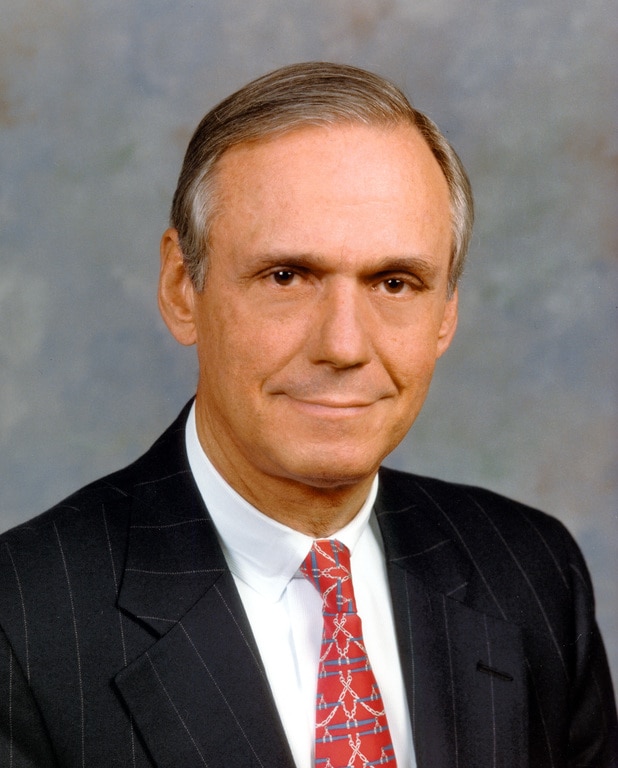
Overview
Hans W. Becherer is not a household name the way the men whose surnames hang over the door usually are, he was the seventh chief executive of Deere & Company and the second from outside the founding family, but he ran the green-and-yellow empire through the decade that made it modern [1][3]. He took the top job in September 1989, in the long hangover of the 1980s farm-debt crisis that had pushed the industry to the brink, and he handed it off in 2000 to Robert W. Lane with the company larger, more international, and more diversified than it had ever been [1][2][3]. Where his predecessor Robert Hanson had fought to keep Deere alive, Deere was, famously, the only major full-line maker that neither changed ownership nor shuttered its core factories through the worst of the crisis, Becherer's assignment was to make it grow again, and to grow it in places John Deere had barely sold a plow [4][9].
His whole résumé pointed at that mission. Becherer had joined Deere in 1962 straight out of Harvard Business School as a marketing representative, and almost the entire first half of his career was spent abroad: by 1969 he was running Deere's export operation out of Mannheim, West Germany, and he held a string of marketing and management posts in Europe into the early 1980s [1][9]. He was, in other words, an internationalist inside a deeply Midwestern company, and when he reached the chairman's office in May 1990 he set about making Deere look more like the world it sold into [1][3]. Under the banner he called "Genuine Value", a program of continuous improvement, quality, and disciplined global growth, Deere pushed into China, India, South America, and the former Soviet republics, hunting for the next generation of mechanizing farmers [1][3].
The diversification was just as deliberate. Becherer leaned hard on the businesses that did not rise and fall with the corn price: he built up John Deere Credit, expanded a health-care (HMO) operation, grew construction equipment, and spun lawn-and-grounds-care into its own division, watching that consumer line cross a billion dollars in sales for the first time [3][6][7]. He bought Homelite in 1994 to put chainsaws and hand-held power equipment under the Deere umbrella, and Cameco Industries, a sugarcane-harvester maker, in 1998 [7]. By 1998 roughly a quarter of Deere's revenue came from outside the United States and nearly half its product mix was non-agricultural, a remarkable reweighting for a firm whose identity was the row-crop tractor [1][2][3].
The numbers, for most of the decade, vindicated him. After a $20 million loss in the recession year of 1991, Deere reeled off record results: fiscal 1997 brought a then-record $960.1 million in net income on $12.79 billion of net sales and revenues, and Becherer, who rarely sought the spotlight, credited "strong worldwide demand for the company's products" and "the company's continuous improvement and quality initiatives" [3][6][8]. He also poured the company's prosperity back into its hometown: the John Deere Pavilion opened on the Moline, Illinois riverfront in 1997 and became one of the state's top tourist attractions, the visible heart of a downtown-and-riverfront renewal Becherer helped drive [1][7]. In 1997 he tied the brand to the PGA Tour, beginning the sponsorship of the John Deere Classic and making Deere the tour's official golf-course-equipment supplier [1][7].
His last full year was harder, and it tested the very diversification he had championed. A collapse in farm income, the worst since the 1980s, drove agricultural-equipment demand down hard; worldwide net sales and revenues fell to $11.75 billion in fiscal 1999 from $13.82 billion the year before, and Deere announced aggressive production cutbacks to clear inventory [5][8]. Speaking to the Des Moines Rotary Club in May 1999, Becherer framed the slump in the global terms that had defined his tenure, quoting a farmer who had told a Deere internet forum, "The quality of the green tractor is there... The quality of the green money to pay for it isn't" [5]. He retired in 2000 having proved both the promise and the limits of his strategy: a global, multi-line Deere could grow faster in good years, but it could not escape the iron weather of the farm cycle [3][5].
Early Life & Path
Hans Walter Becherer was born April 19, 1935, in Detroit, Michigan, a city of machines, though of a very different kind from the ones he would spend his life selling [1][2]. He went east for college, graduating from Trinity College in Hartford, Connecticut, in 1957, where he was a member of the St. Anthony Hall society [2]. Two years in the United States Air Force followed, and then Harvard Business School, where he earned his MBA in 1962 [1][2][9].
He joined Deere & Company that same year, 1962, as a marketing representative, the bottom rung of the side of the business he would master [1][9]. Almost from the start his path ran through Europe rather than the Illinois corn belt. By 1969 he had been promoted to run Deere's export operation out of Mannheim, West Germany, overseeing sales and distribution across European markets, and he stayed largely overseas, in marketing and management roles, into the early 1980s [9]. That long apprenticeship abroad was the making of him: he learned the company as an exporter sees it, from the far end of the supply chain looking back at Moline.
The ascent home was rapid once it began. In 1983 he was elected senior vice president of Deere's Overseas Farm and Consumer Products Division; in 1986 executive vice president for worldwide farm equipment and consumer products; in 1987 president and chief operating officer; and in September 1989 president and chief executive officer [1][9]. When Robert Hanson, the first non-family CEO, who had steered Deere through the farm crisis, retired in May 1990, Becherer was elected chairman, uniting both titles in the hands of a man whose formative years had been spent making John Deere a name in Europe [1][3][4].
Career Timeline
- 1935Born April 19 in Detroit, Michigan [1][2].
- 1957Graduates from Trinity College, Hartford, Connecticut; serves two years in the U.S. Air Force [1][2].
- 1962Earns an MBA from Harvard Business School and joins Deere & Company as a marketing representative [1][9].
- 1969Promoted to run Deere's export operation in Mannheim, West Germany [9].
- 1983Elected senior vice president of Deere's Overseas Farm and Consumer Products Division [1][9].
- 1987Elected president and chief operating officer of Deere & Company [1][9].
- 1989Becomes president and chief executive officer in September, succeeding Robert Hanson as CEO [1][3].
- 1990Elected chairman in May upon Hanson's retirement, taking full control of the company [1][3].
- 1994Acquires Homelite, adding chainsaws and hand-held outdoor power equipment to Deere's lines [7].
- 1997Posts a then-record $960.1 million net income on $12.79 billion in net sales and revenues; opens the John Deere Pavilion in Moline and launches the John Deere Classic PGA Tour sponsorship [1][6][7][8].
- 1998Acquires Cameco Industries (sugarcane harvesters); by year-end about 25% of revenue is from outside the U.S. and nearly 50% of the product mix is non-agricultural [1][2][7].
- 1999A farm-income collapse cuts net sales and revenues to $11.75 billion from $13.82 billion; Deere orders production cutbacks. Becherer's May 13 Des Moines Rotary Club speech, 'All Farming Is Global,' is entered into the Congressional Record by Sen. Charles Grassley [5][8].
- 2000Retires; Robert W. Lane is elected to succeed him as CEO [1][3].
- 2016Dies October 6 in Colorado, aged 81 [1].
Key Ventures & Innovations
"Genuine Value" and global expansion
Becherer's signature program tied continuous improvement and quality to disciplined growth in new markets, China, India, South America, and the former Soviet republics, drawing on the two decades he had spent selling Deere equipment in Europe [1][3]. By 1998 roughly a quarter of revenue came from outside the United States [1][2].
Diversification beyond the farm
He deliberately built up the businesses that did not track the corn price, John Deere Credit, construction equipment, an HMO health operation, and lawn-and-grounds-care, which he spun into its own division and watched cross $1 billion in sales, diversifying a company long defined by the row-crop tractor [11] until non-agricultural lines were nearly half the product mix [3][6][7].
Acquisitions: Homelite and Cameco
Deere bought Homelite in 1994 to add chainsaws and hand-held power equipment, and Cameco Industries, a sugarcane-harvester maker, in 1998, bolt-ons that widened the product range and the geographic footprint [7].
Record profits, 1994–1997
After a $20 million loss in 1991, Deere strung together record years, peaking at $960.1 million net income on $12.79 billion in net sales and revenues in fiscal 1997. Becherer attributed the result to 'strong worldwide demand' and the company's quality initiatives [3][6][8].
Reviving the Moline riverfront
Becherer was a driving force behind the renewal of downtown Moline, Illinois. The John Deere Pavilion opened on the riverfront in 1997 and became one of the state's leading tourist attractions, anchoring the John Deere Commons development [1][7].
The PGA Tour partnership
In 1997 Becherer made Deere the PGA Tour's official golf-course-equipment supplier and began the long-running sponsorship of the John Deere Classic, a marketing alliance that fused the brand with the turf-care business [1][7].
“But in truth, ladies and gentlemen, all farming is global.”
From the Record
“Deere & Company Chairman and Chief Executive Officer Hans W. Becherer said, "The higher profits resulted from strong worldwide demand for the company's products. Operating margins remained at strong levels as a result of the company's continuous improvement and quality initiatives."”
“But in truth, ladies and gentlemen, all farming is global. Every ear of corn, or pod of soybean produced in Iowa makes an impact on the world market . . . and affects farmers in faraway places such as Australia and Argentina.”
“One farmer, on an Internet message board devoted to Deere, recently summed it up this way: "The quality of the green tractor is there," he said. "The quality of the green money to pay for it isn't."”
What Operators Can Learn
- 01
Sell where the future farms are
Becherer spent his whole career convinced that growth lay outside the saturated North American market. Two decades selling in Europe taught him to see Deere as a global company before its leadership did, and he pointed it toward the mechanizing farms of Asia, Latin America, and Eastern Europe.
- 02
Diversify against your own weather
A maker of farm machinery lives or dies by the farm economy. Becherer built credit, construction, consumer, and health-care lines precisely to dampen that cycle, and by 1998 nearly half the product mix no longer depended on the price of corn.
- 03
Quality and cost are the same project
His 'Genuine Value' program refused to treat continuous improvement as a cost cut and quality as a luxury. He insisted the two reinforced each other, better products at lower cost widened the margin, as the record 1997 results showed.
- 04
Diversification softens the blow but does not repeal the cycle
The 1999 downturn proved both halves of his strategy. The non-farm businesses helped, but a collapse in farm income still cut revenue by more than $2 billion in a single year, a reminder that a company can hedge its core risk without escaping it.
Legacy
Becherer's decade reset what Deere & Company was. He inherited a survivor, a firm whose green-and-yellow identity had been built over more than a century and a half by the founding Deere family [10][4], and turned it into a deliberately global, multi-line industrial company, with a quarter of its revenue from abroad and half its products no longer tied to agriculture [1][2][4]. The international push he began, and the diversification into credit, construction, consumer, and turf-care equipment, became the structural shape that his successors Robert Lane and beyond would build the modern Deere upon [1][3].
His fingerprints are also literally on the landscape of the Quad Cities. The John Deere Pavilion and the riverfront renewal he championed reanimated downtown Moline, and the PGA Tour partnership he struck in 1997 still carries the company's name onto television every summer [1][7]. Honored in his retirement, inducted into the Junior Achievement U.S. Business Hall of Fame in 2004 and named to the Harvard Business School roster of great American business leaders of the twentieth century, Becherer is remembered less as a visionary founder than as the rare professional manager who arrived with exactly the skill his company needed at exactly the moment it needed it, and who used it to carry a venerable American name into global markets and a new century [1][2]. He died in Colorado on October 6, 2016, at 81 [1].
Further Reading
John Deere's Company: A History of Deere & Company and Its Times, Wayne G. Broehl Jr. (1984)
The exhaustive, document-grounded scholarly history of the company from the 1837 steel plow through the start of the non-family-CEO era, the foundation for understanding the institution Becherer would lead.
The John Deere Story: A Biography of Plowmakers John and Charles Deere, Neil Dahlstrom and Jeremy Dahlstrom (2005)
A concise, archive-based account of the founding family and the origins of the brand, by Deere's own corporate archivist.
John Deere: A History of the Tractor, Randy Leffingwell (2004)
An illustrated history of the product line that was Deere's heart, useful for seeing what Becherer's farm-equipment business actually built and sold.
John Deere Tractors and Equipment, Volume Two: 1960–1990, Don Macmillan (1991)
A detailed catalog of the machines of the era in which Becherer rose through marketing and into the executive suite.
Sources
- 1.“Hans Becherer, Past Leaders”, Deere & Company (official company history), 2016
- 2.“Hans W. Becherer”, Wikipedia, 2024
- 3.“Hans W. Becherer, Great American Business Leaders of the 20th Century”, Harvard Business School, Leadership Initiative, 2005
- 4.Wayne G. Broehl Jr., John Deere's Company: A History of Deere & Company and Its Times, Doubleday & Company, 1984, book
- 5.Sen. Charles Grassley, “Recognizing the May 13, 1999, Speech of Hans W. Becherer, Chairman and CEO of Deere and Company, Before the Des Moines Rotary Club ("All Farming Is Global")”, Congressional Record (Bound Edition), Vol. 145, Pt. 16, p. 22622, 1999, archive
- 6.“Deere & Co.”, Encyclopedia.com (International Directory of Company Histories), 2006
- 7.“Hans W. Becherer, former Deere CEO/Chair, has died”, The Dispatch-Argus / QCOnline (Quad-Cities), October 12, 2016, newspaper
- 8.Deere & Company, “Deere & Company Fourth Quarter 1997 Earnings (Form 8-K), incl. Becherer's record-profit statement and full-year figures”, U.S. Securities and Exchange Commission (EDGAR), 1997, archive
- 9.“Hans Walter Becherer, World Biographical Encyclopedia”, Prabook, 2017
- 10.Neil Dahlstrom and Jeremy Dahlstrom, The John Deere Story: A Biography of Plowmakers John and Charles Deere, Northern Illinois University Press, 2005, book
- 11.Randy Leffingwell, John Deere: A History of the Tractor, Voyageur Press, 2004, book
Researched and written with Claude + live web search.