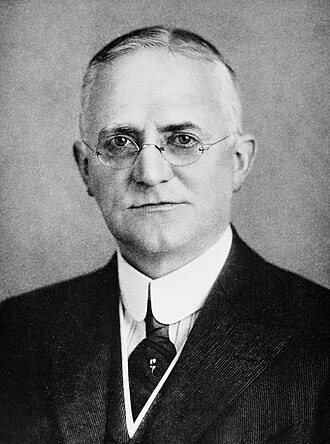
Overview
George Eastman did for the photograph what Henry Ford would later do for the automobile: he found a craft that belonged to specialists, full of glass plates, darkrooms, and noxious chemistry, and engineered it into a product that an ordinary person could buy, carry, and use without understanding any of it [1][3]. He was not a great inventor in the lone-genius mold; he was a manufacturer and systems-builder of relentless precision who believed, before the phrase existed, that the way to a mass market was machinery, low price, worldwide distribution, and ceaseless advertising [1][3]. By the time he died he had built one of the most recognizable brands on earth and given away a fortune comparable, among Americans then living, only to Rockefeller and Carnegie [1][8].
The pivotal product was the Kodak camera of 1888, a plain black box, pre-loaded with a roll of film for 100 exposures, priced at $25 [4][7]. The customer simply pointed and pressed; when the roll was finished he mailed the entire camera back to Rochester, where for $10 the factory developed the negatives, made the prints, reloaded fresh film, and returned the camera ready to shoot again [4][7]. The slogan Eastman coined for it, "you press the button, we do the rest", was within a year a household phrase on two continents, and it captured the whole philosophy: the company would swallow the complexity so the customer never had to see it [1][7]. Eastman invented the very name "Kodak" with an anagram set, because he wanted a word short, hard to misspell, and meaningless in every language; the letter K, he said, "seems a strong, incisive sort of letter" [1][3].
The enterprise had begun far more modestly. In 1881 Eastman, then a junior clerk at the Rochester Savings Bank, formed the Eastman Dry Plate Company with the buggy-whip manufacturer Henry A. Strong as president and chief investor, and quit the bank to pursue it full time [1][3]. The early years nearly broke him: a batch of defective plates forced him to recall and replace stock at his own ruinous expense, a lesson in quality he never forgot [1]. But the recovery taught the model, controlled manufacturing, branded product, an emulsion-coating machine he had patented in 1879, and after 1885 the breakthrough of flexible roll film that freed photography from the heavy glass plate [3][5][9]. Reorganized as the Eastman Company and then incorporated as the Eastman Kodak Company in 1892, the firm drove the price of its cameras and film steadily down as volume climbed [1][3].
That dominance brought legal reckonings. The transparent nitrocellulose film at the heart of Kodak's business collided with a patent held by a New Jersey clergyman-inventor, the Reverend Hannibal Goodwin, whose claims Ansco eventually acquired and pressed; after years of litigation Kodak was found to infringe and the matter was settled in Ansco's favor in 1914 [2]. More serious was the antitrust suit: on August 24, 1915, Judge John R. Hazel of the federal court in western New York ruled that Eastman and his company had illegally monopolized the amateur photography trade between 1895 and 1910 through acquisitions and exclusionary practices, ordering a breakup that Kodak fought to the Supreme Court before accepting a consent decree in 1921 [2][7][9].
Eastman ran his company as an industrial paternalist a generation ahead of his peers. In 1899 he distributed $178,000 of his own profit to roughly 3,000 employees as a personal bonus; in 1912 he instituted the "wage dividend," sharing company profits with workers on a continuing formula; and in 1919 he gave one-third of his own Kodak holdings, then worth about $10 million, to his employees [8][3]. He believed loyalty and goodwill, not patents alone, sustained a firm, and he extended the same conviction to a philanthropy so vast and so deliberately living that he scorned those who waited to die before giving as "pie-faced mutts" [8][6].
The end was characteristically controlled. Crippled by a degenerative spinal disorder that left him stooped and shuffling, and having watched his own mother spend her last two years in a wheelchair from the same affliction, Eastman shot himself through the heart on March 14, 1932, leaving a note of seven words: "To my friends: My work is done. Why wait?" [1][4][7].
Early Life & Path
George Eastman was born July 12, 1854, in the village of Waterville, New York, the youngest child and only son of George Washington Eastman, who ran a commercial college in Rochester, and Maria Kilbourn Eastman [1][7]. His father moved the family to Rochester and then died in 1862, when George was seven, leaving Maria to keep the household together by taking in boarders [1][7]. The boy's childhood was shadowed by genteel poverty and by his devotion to his mother, a bond that would define his finances, his living arrangements, and ultimately his death [1][3]. He left school at fourteen to go to work, first as an office boy and messenger, and his ledgers from those years show a teenager already recording every penny he earned and spent [1].
By 1874 he had become a junior clerk at the Rochester Savings Bank at a comfortable salary, and he might have lived an unremarkable life as a careful bank man but for a planned trip [3][7]. In 1877, contemplating a real-estate excursion to Santo Domingo, the twenty-three-year-old Eastman bought a complete photographic outfit on a colleague's suggestion that he document the journey, a cumbersome kit of camera, tripod, glass plates, tent, and chemicals so elaborate that it required lessons to use [3][7]. The trip never happened, but the obsession did. He began reading British photographic journals describing gelatin dry-plate emulsions that, unlike the prevailing wet-plate process, could be prepared in advance [3][5].
For three years Eastman kept his bank job by day and experimented by night, mixing and coating emulsions in his mother's kitchen until, as his biographer recounts, he sometimes collapsed on the floor too exhausted to climb the stairs [1][3]. In 1879 he patented a machine to coat dry plates uniformly, the foundation of everything to come, and in April 1880 he leased a third-floor loft on State Street in Rochester to manufacture them [3][5]. Capital and friendship arrived together in the person of Henry A. Strong, a family boarder and whip manufacturer who put up money and, in a note Eastman treasured, wrote: "You are a queer cuss, Geo. … but I want you to know … that I am always with you heart and hand" [3]. When he was passed over for promotion at the bank in 1881, Eastman resigned to devote himself entirely to the new company [7].
Career Timeline
- 1854Born July 12 in Waterville, New York; the family moves to Rochester, where his father dies in 1862 [1][7].
- 1874Becomes a junior clerk at the Rochester Savings Bank [3][7].
- 1877Buys a costly photographic outfit for a Santo Domingo trip that never occurs, and is hooked on photography [3][7].
- 1879Patents a machine for coating gelatin dry plates uniformly, the basis of mass-produced photographic materials [3][5].
- 1881Forms the Eastman Dry Plate Company with Henry A. Strong on January 1 and resigns from the bank [1][3][7].
- 1885Introduces flexible roll film and the Eastman–Walker roll holder, freeing photography from heavy glass plates [3][5].
- 1888Launches the Kodak camera, preloaded for 100 exposures at $25, with the slogan "you press the button, we do the rest" [1][4][7].
- 1892Reorganizes the business as the Eastman Kodak Company [1][3].
- 1899Distributes $178,000 of his own profit as a personal bonus to roughly 3,000 employees [8].
- 1912Begins making anonymous gifts to MIT as "Mr. Smith" and institutes the Kodak "wage dividend" profit-sharing plan [3][6].
- 1914Kodak is found to infringe the Reverend Hannibal Goodwin's film patent; the suit is settled in Ansco's favor [2].
- 1915Judge John R. Hazel rules on August 24 that Kodak illegally monopolized amateur photography; a consent decree follows in 1921 [2][7].
- 1924On December 10 signs away some $30 million at once to the University of Rochester, MIT, Hampton, and Tuskegee [6][8].
- 1932Dies March 14 by suicide in Rochester, leaving the note "My work is done. Why wait?" [1][4][7].
Key Ventures & Innovations
Dry plates and the coating machine (1879–1880)
Eastman's first business turned photography's chemistry into a factory product: a patented machine coated glass plates with gelatin emulsion uniformly and in quantity, replacing the messy, made-on-the-spot wet-plate process and giving the young firm a manufacturing edge [3][5].
Roll film (1885)
The flexible roll, paired with the Eastman–Walker roll holder, let a camera carry dozens of exposures instead of a single fragile plate. Transparent nitrocellulose film soon followed and became the substrate not only of snapshots but of the motion-picture industry [3][5].
The Kodak camera and the mail-back system (1888)
A $25 box loaded for 100 pictures that the owner shipped back to Rochester for $10, develop, print, reload, return. It separated taking a picture from making one, and turned Kodak into a service business as much as a hardware maker [1][4][7].
The wage dividend and employee stock (1899–1919)
Eastman gave $178,000 from his own pocket in 1899, launched a continuing profit-sharing wage dividend in 1912, and in 1919 handed employees a third of his personal stock, worth about $10 million, believing goodwill, not patents, was a company's real asset [8][3].
Living philanthropy (1912–1932)
He funneled some $20 million to MIT (long anonymously, as "Mr. Smith"), endowed the University of Rochester and its Eastman School of Music, built dental clinics in Rochester, London, and Europe, and aided Tuskegee and Hampton, giving away roughly $100 million while he lived [3][6][8].
“You press the button, we do the rest.”
From the Record
“At night he would return to the rented house faithfully kept by his mother, eat supper, then go into the kitchen to measure, pour, stir, and test for hours on end.”
“You are a queer cuss, Geo., … but I want you to know . . . that I am always with you heart and hand.”
“To my friends: My work is done. Why wait?”
What Operators Can Learn
- 01
Sell the result, hide the complexity
Eastman's customers did not want to master chemistry; they wanted pictures. By absorbing the developing, printing, and reloading into a mail-back service, he made the hard parts disappear, the essence of "you press the button, we do the rest."
- 02
Price down to grow the market
Like Ford after him, Eastman treated cost reduction as a flywheel: better machinery and larger volume let him cut the price of cameras and film again and again, each cut enlarging the very market that made the next cut possible.
- 03
Quality is cheaper than its absence
A near-fatal batch of defective dry plates early on forced a costly recall that nearly ruined him, and convinced Eastman that reliable, standardized product was not an expense but the foundation of a brand people would trust sight unseen.
- 04
Give while you can still aim it
Eastman insisted on directing his fortune himself, in his lifetime, dismissing those who deferred their giving to their estates. Whatever one makes of his judgment, he treated philanthropy as an active design problem, not a posthumous formality.
Legacy
Eastman's machinery and his marketing together created the snapshot, the casual, personal, universal photograph, and with it the modern visual record of ordinary life. Transparent roll film, his other great contribution, became the physical medium of the motion-picture business, so that an industry of memory and an industry of dreams both ran, literally, on Kodak [3][5]. For most of the twentieth century "Kodak moment" was shorthand for the experiences people most wanted to keep, and the company he built dominated photography until the digital era it had helped seed at last overtook it [1][7].
His philanthropy reshaped institutions still standing. The University of Rochester and its Eastman School of Music, the dental clinics in Rochester and London, and a transformed MIT, long the secret beneficiary of "Mr. Smith", all carry his imprint, the product of roughly $100 million given away while he lived [3][6][8]. The record is not unmixed: his company was found a monopolist, his film built on a patent the courts said belonged to another man, and his recurring donations to the American Eugenics Society sit uneasily with modern eyes [2][1]. But the central achievement endures. A careful Rochester bookkeeper, working nights in his mother's kitchen, turned a specialist's craft into a possession of the whole human race, and then spent the fortune it made on others before deciding, with the same cold clarity he had always applied to a problem, that his work was done [1][3][8].
Further Reading
George Eastman: A Biography, Elizabeth Brayer (1996)
The definitive modern life, drawing for the first time on Eastman's personal papers and Kodak corporate records; nominated for a Pulitzer Prize.
George Eastman, Carl W. Ackerman (1930)
The first biography, published during Eastman's lifetime with his cooperation, factual and close to the source, if reticent about the man within.
The Story of Kodak, Douglas Collins (1990)
An illustrated corporate history tracing the company and its products from the dry plate through the twentieth century.
Images and Enterprise: Technology and the American Photographic Industry, 1839 to 1925, Reese V. Jenkins (1975)
The standard scholarly study of the industry Eastman came to dominate, strong on the technology and the antitrust context.
Kodak and the Lens of Nostalgia, Nancy West (2000)
A cultural history of how Kodak's advertising taught Americans to see photography, and memory itself, through its products.
Sources
- 1.Elizabeth Brayer, George Eastman: A Biography, Johns Hopkins University Press, 1996, book
- 2.U.S. District Court for the Western District of New York, “United States v. Eastman Kodak Co., 226 F. 62 (W.D.N.Y. 1915) (Hazel, J.)”, Federal Reporter, 1915, archive
- 3.Bernard A. Weisberger, "You Press the Button, We Do the Rest", American Heritage, Vol. 23, No. 6, October 1972, journal
- 4.The New York Times, “"George Eastman a Suicide; Camera Magnate Was 77" (obituary)”, The New York Times, March 15, 1932, newspaper
- 5.Carl W. Ackerman, George Eastman, Houghton Mifflin Company, 1930, book
- 6.MIT Museum, “MIT's Most Famous Donor, "Mr. Smith", George Eastman, 1912–1920”, The MIT 150 Exhibition, Massachusetts Institute of Technology, 2011, archive
- 7.American Experience, “George Eastman”, PBS / WGBH, 2008
- 8.The Philanthropy Roundtable, “George Eastman (Philanthropy Hall of Fame)”, The Philanthropy Roundtable, 2015
- 9.Reese V. Jenkins, Images and Enterprise: Technology and the American Photographic Industry, 1839 to 1925, Johns Hopkins University Press, 1975, book
Researched and written with Claude + live web search.