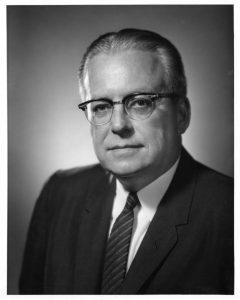
Overview
Eugene N. Beesley is not the kind of founder who gets a statue. He invented no blockbuster molecule, patented no machine, and left behind no quotable manifesto. What he did was rarer in a family firm: in April 1953 he became the fifth president of Eli Lilly and Company and the first leader from outside the Lilly bloodline, the man chosen to carry a proud Indianapolis dynasty into the era of professional management [1][2]. He had joined the company as a salesman after graduating from Wabash College in 1929, and he rose, associate director of sales in 1949, vice president for administration in 1951, executive vice president in 1952, by being the steady, data-minded organization man that the founding family's grandsons trusted to mind the store [1][2].
The trust was earned in the numbers. Across Beesley's roughly two decades at the top, Lilly's sales multiplied more than sixfold, climbing from the low hundreds of millions to about $700 million by 1972, and the workforce swelled past 20,000 as the company planted plants and subsidiaries across the world to reach foreign markets [1][2]. The product list of his era reads like a tour of mid-century medicine: Lilly was chosen as a principal manufacturer of Jonas Salk's polio vaccine in the mid-1950s and made a large share of the nation's supply; it launched the analgesic Darvon (propoxyphene) in 1957, the cancer drug Velban (vinblastine) in 1961, and the cephalosporin antibiotic Keflin in 1964 [3][6]. Beesley also pushed Lilly beyond human medicine, building out the agricultural and veterinary business that became Elanco [6].
Because he ran a company whose patriarchs had grown fabulously rich, Beesley spent an unusual amount of his presidency in the nation's political crossfire. As an industry spokesman, and chairman of the Pharmaceutical Manufacturers Association, he testified on September 13, 1960, before Senator Estes Kefauver's Subcommittee on Antitrust and Monopoly, the marathon inquiry into "administered" drug prices that, after the thalidomide tragedy, produced the Kefauver–Harris Drug Amendments of 1962 and gave the FDA sweeping new power over the industry he represented [1][7][8][10].
Then came the strangest assignment of his career. After the failed Bay of Pigs invasion of April 1961 left more than 1,000 members of Brigade 2506 in Cuban prisons, Fidel Castro demanded ransom; the deal that finally freed them in late 1962 was paid not in cash but in food and medicine. At the request of Attorney General Robert F. Kennedy, Beesley coordinated the delivery of several million dollars' worth of pharmaceuticals toward that ransom, a Cold War humanitarian airlift run, in part, out of Indianapolis [1].
Beesley's other life was philanthropy. He sat on the board of Lilly Endowment, Inc., one of the largest charitable foundations in America, built on the family's company stock, from 1951 until his death, serving as its vice president from 1960 to 1971 and then, again as the first non-family member to hold the post, as its president from 1972 to 1976. Under him the Endowment's annual grant payouts for education, religion, and community development rose from about $10 million to more than $50 million [1].
He was, in sum, the transitional figure every long-lived family company eventually needs: the trusted outsider who proves the firm can outgrow its founders without losing its character. When Beesley handed the company to Richard D. Wood in the early 1970s, Lilly was no longer a family business that happened to be large; it was a large, professionally managed corporation that happened to bear a family's name [1][2][4].
Early Life & Path
He was born Eugene Nevin Beesley on January 29, 1909, on a farm near Thorntown, in Boone County, Indiana, the son of a farmer [1][5]. Nothing about the beginning forecast a corner office: he was a Hoosier farm boy who went off to Wabash College, the small all-male liberal-arts school in Crawfordsville, and took his bachelor's degree there in 1929, the year the stock market crashed [1]. He started law studies at the University of Toledo and would not finish a law degree until 1943, by night, at the Indiana University School of Law after he had already moved to Indianapolis and gone to work [1].
What he did in 1929 was take a job, and the job was selling. Beesley joined Eli Lilly and Company as a salesman, learning the firm from the road and the drugstore counter up rather than from the laboratory or the boardroom [1][2]. It was an unglamorous apprenticeship, but it gave him the two things that would define his rise: an intimate feel for how Lilly's medicines actually reached patients, and a reputation as a methodical, numbers-driven manager rather than a self-promoter [2].
That reputation mattered because of where he worked. Eli Lilly and Company had been founded in 1876 by Colonel Eli Lilly, a Union cavalry officer turned pharmaceutical chemist, and run ever since by his descendants, his son Josiah K. Lilly Sr. and grandsons Eli Lilly Jr. and Josiah K. Lilly Jr. [4][9]. The grandsons were aging, immensely wealthy, and increasingly absorbed in art-collecting and philanthropy, and they faced the classic dynastic question: who runs the company when the family no longer wants to? Their answer, in 1953, was the salesman from Thorntown [1][2].
Career Timeline
- 1909Born January 29 on a farm near Thorntown, Boone County, Indiana [1][5].
- 1929Graduates from Wabash College and joins Eli Lilly and Company as a salesman [1][2].
- 1943Completes a law degree at the Indiana University School of Law in Indianapolis [1].
- 1949Named associate director of sales at Lilly [1].
- 1951Becomes vice president for administration; joins the Lilly Endowment board [1].
- 1952Promoted to executive vice president [1].
- 1953In April becomes the fifth president of Eli Lilly, the first from outside the Lilly family, as Josiah K. Lilly Jr. moves to chairman [1][2][4].
- 1955Lilly serves as a principal manufacturer of the Salk polio vaccine, producing a large share of the U.S. supply [3][6].
- 1957Lilly launches the analgesic Darvon (propoxyphene) [6].
- 1960As a chairman of the Pharmaceutical Manufacturers Association, testifies September 13 before the Kefauver antitrust subcommittee on drug prices [1][7][8].
- 1961At Robert F. Kennedy's request, coordinates the delivery of several million dollars of drugs toward the Cuban ransom for Bay of Pigs prisoners; Lilly introduces the cancer drug Velban [1][6].
- 1962The Kefauver–Harris Drug Amendments become law, vastly expanding FDA authority over the industry Beesley represented [7][8].
- 1969Becomes chairman of the board of Eli Lilly and Company, succeeding Eli Lilly Jr. [4][5].
- 1972Sales reach about $700 million as Beesley steps back from running the company and becomes president of Lilly Endowment, Inc.; Richard D. Wood rises to lead the firm [1][2][4].
- 1976Dies February 8 in Indianapolis at age 67, while serving as president of the Lilly Endowment [1][5].
Key Ventures & Innovations
The transition to professional management (1953)
Beesley's appointment as the first non-family president was the venture. It tested whether a 77-year-old dynasty could be run by a hired manager without losing its identity, and his sixfold growth in sales over two decades was the proof that it could [1][2][4].
Global expansion
Under Beesley the company built plants and subsidiaries around the world to reach foreign markets, growing past 20,000 employees; Beesley himself served as a director of Eli Lilly International Corporation and several foreign subsidiaries [1][2].
A mid-century product engine
His era delivered Lilly's share of the Salk polio vaccine (1955), the painkiller Darvon (1957), the anticancer vinca alkaloid Velban (1961), and the cephalosporin Keflin (1964), a run of products spanning prevention, pain, oncology, and antibiotics [3][6].
Industry statesman before Kefauver (1960)
As a PMA chairman and Lilly president, Beesley was a leading voice defending the drug industry's pricing and research model before Senator Kefauver's subcommittee, the hearings that, after thalidomide, produced the landmark 1962 amendments [1][7][8].
Lilly Endowment leadership (1951–1976)
Beesley spent a quarter-century on the board of one of America's great foundations, and as its president from 1972 raised annual grants from about $10 million to more than $50 million for education, religion, and community development [1].
From the Record
“Eugene N. Beesley, 67, retired president and chairman of the board of Eli Lilly and Company, died Sunday in Indianapolis, Indiana.”
“Residents of Wickenburg remember Mr. Beesley as a great naturalist who loved the desert climate and landscape.”
“Following the unsuccessful Bay of Pigs invasion of Cuba (1961), Beesley, at the request of U.S. Attorney General Robert F. Kennedy, coordinated the delivery of several million dollars' worth of drugs to ransom over 1,000 prisoners of war.”
What Operators Can Learn
- 01
A company can outgrow its founders without betraying them
The Lilly grandsons handed the presidency to a salesman, not a son, and the firm kept its character while shedding its dependence on the bloodline. The hardest succession in a family business is the first one to an outsider, and getting it right is its own achievement.
- 02
Steady operators beat charismatic ones over twenty years
Beesley left no famous quotes and invented nothing, yet sales rose more than sixfold under his methodical, data-driven management. Compounding competence, sustained for two decades, is a kind of genius that rarely makes the headlines.
- 03
When you sell something people need, you will be hauled before Congress
Running a profitable drug company made Beesley a political target, Kefauver's hearings, the 1962 amendments, the scrutiny of prices. Leaders in essential industries must learn to be public advocates, not just managers.
- 04
Wealth creation and stewardship can be the same job
Beesley ran both the company that generated the fortune and the endowment that gave it away, raising the foundation's payouts fivefold. He treated philanthropy as a discipline requiring the same management seriousness as the business.
Legacy
Beesley's monument is institutional rather than molecular. He proved that Eli Lilly and Company, founded by a Civil War colonel and run by his heirs for three generations, could thrive under professional management, and he set the template of the trusted, growth-minded executive that his successors Richard D. Wood and beyond would follow into the company's later, blockbuster decades [1][2][4]. The global, research-heavy, professionally run Lilly that would one day give the world Prozac and modern insulins was structurally the company Beesley built out and handed on.
His second legacy is civic. Through a quarter-century on the board of Lilly Endowment, Inc., and its presidency from 1972, Beesley helped steer one of the nation's largest foundations toward Indiana's colleges, churches, and communities, multiplying its annual giving fivefold [1]. And in the strange episode of the Bay of Pigs ransom, he showed how a corporation's resources could be turned, quietly and at a government's request, to freeing more than a thousand prisoners, a reminder that the reach of a great pharmaceutical company is not only commercial [1]. The Hoosier farm boy who started as a drug salesman ended as a maker of both medicines and institutions, remembered in his adopted desert winter home, fittingly, less as a tycoon than as "a great naturalist who loved the desert" [5].
Further Reading
All in a Century: The First 100 Years of Eli Lilly and Company, E. J. Kahn, Jr. (1976)
The authorized centennial history of the company Beesley led, the essential narrative of Lilly's first hundred years, written as Beesley's own era closed.
Eli Lilly: A Life, 1885–1977, James H. Madison (1989)
Biography of Eli Lilly Jr., the family patriarch and philanthropist who chose Beesley as the company's first outside president; the best window on the dynasty Beesley inherited.
The Real Voice, Richard Harris (1964)
Classic account of Senator Kefauver's drug-price hearings and the fight over the 1962 amendments, the political battle in which Beesley was an industry witness.
Reputation and Power: Organizational Image and Pharmaceutical Regulation at the FDA, Daniel Carpenter (2010)
Definitive scholarly history of how the FDA gained the regulatory power Beesley's industry confronted after 1962.
Eli Lilly and Company: A Pictorial History, Gene E. McCormick and others (1989)
Illustrated company history covering the mid-century growth, products, and global expansion of Beesley's tenure.
Sources
- 1.Encyclopedia of Indianapolis, “Eugene Nevin Beesley”, Indiana Historical Society / IUPUI (indyencyclopedia.org), archive
- 2.Harvard Business School, “Eugene N. Beesley, 20th Century Great American Business Leaders”, Harvard Business School, Leadership database
- 3.“Eli Lilly and Company and the Salk Polio Vaccine”, Indiana Historical Society, archive
- 4.E. J. Kahn, Jr., All in a Century: The First 100 Years of Eli Lilly and Company, Eli Lilly and Company, Indianapolis, 1976, book
- 5.“Obituary: Eugene N. Beesley, retired president and chairman of Eli Lilly and Company”, Wickenburg Sun (Wickenburg, Arizona), February 12, 1976, newspaper
- 6.Encyclopedia of Indianapolis, “Eli Lilly and Company”, Indiana Historical Society / IUPUI (indyencyclopedia.org), archive
- 7.Daniel Carpenter and Dominique A. Tobbell, Reform, Regulation, and Pharmaceuticals, The Kefauver–Harris Amendments at 50, New England Journal of Medicine, vol. 367, no. 16 (PMC4101807), 2012, journal
- 8.Eugene N. Beesley, “Statement of Eugene N. Beesley, President of Eli Lilly and Company, before the Subcommittee on Antitrust and Monopoly, Senate Committee on the Judiciary, Sept. 13, 1960, Washington, D.C.”, Indiana State Library (catalog record), 1960, archive
- 9.James H. Madison, Eli Lilly: A Life, 1885–1977, Indiana Historical Society, 1989, book
- 10.Richard Harris, The Real Voice, Macmillan, 1964, book
Researched and written with Claude + live web search.