Overview
Estée Lauder did not invent face cream, the fragrance counter, or the department store, and the skin cream that launched her was concocted not by her but by her uncle, a chemist named John Schotz [4][1]. What she invented was a way of selling, intimate, relentless, and tactile, and a brand so wrapped around her own striving personality that the two became indistinguishable [3][6]. Starting with a few jars of "Super-Rich All-Purpose Creme" sold to beauty shops and beach clubs in the 1930s, she and her husband Joseph formally founded Estée Lauder Inc. in 1946, working out of a former restaurant on Manhattan's Upper West Side and a single account at Saks Fifth Avenue [1][7].
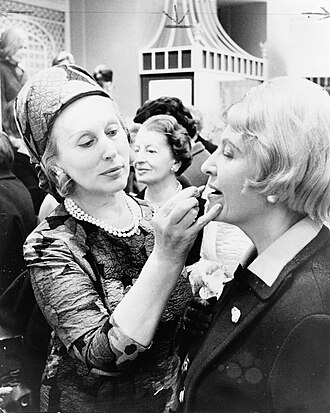
Her method was to put her hands on the customer. "Telephone, telegraph, tell-a-woman," she liked to say, but the real engine was the demonstration: she would corner a woman at a counter, apply the cream to her face, and refuse to let her leave unconvinced [3][5]. When Saks gave her a counter in 1948, she won her first big order, about $800 of product, and notified the store's best customers by mail that a gift came with every purchase [7][6]. The Saks stock sold out in days. That "gift-with-purchase," along with the free sample, became her signature contributions to retailing, copied eventually by the entire industry [5][7].
The turning point was 1953 and a product called Youth-Dew: a bath oil that doubled as a perfume, priced at $8.50, so that a woman could buy fragrance for herself without waiting for a man to give it to her [1][7]. It transformed a kitchen-table operation into a real company; where a store might have sold $300 of Lauder products a week, Youth-Dew pushed the figure into the thousands, and the line that sold 50,000 bottles its first year was doing roughly $150 million by the mid-1980s [1][7]. With it she also seized the prestige strategy, sell only through the best stores, never discount, control the counter and the salesgirls, that Harvard's Nancy Koehn would later study as a textbook case of building a luxury brand from nothing [6].
There was a second, less flattering invention: Estée Lauder, the persona. For decades she fed the press a story of genteel European origins, a Viennese mother, a courtly father, a childhood of stables and chauffeurs in fashionable Flushing [3][2]. The truth, exposed in Lee Israel's unauthorized 1985 biography, was that she was Josephine Esther Mentzer, daughter of immigrant Jewish shopkeepers in Corona, Queens [2][4]. The two books, Israel's exposé and Lauder's own rushed memoir, landed in stores the same season, and reviewers noted that the most fascinating thing about the cosmetics queen was that she was "a New Yorker and not an aristocrat at all" [3][8].
By the time she stepped back, she had made herself, by many accounts, the wealthiest self-made woman in America, the only woman on Time's 1998 list of the twenty most influential business geniuses of the century [4][8]. The company she and Joseph began with a few creams became a multibrand house, Aramis in 1964, Clinique in 1968, Prescriptives in 1979, that crossed a billion dollars in sales in 1983 and went public in 1995 [1][7]. She had grasped, earlier and harder than her rivals, a single commercial truth she stated without embarrassment: never underestimate a woman's desire to be beautiful [3].
Early Life & Path
She was born Josephine Esther Mentzer on July 1, 1908, in Corona, a working-class corner of Queens, the daughter of Max Mentzer and Rose Schotz Mentzer, Central European Jewish immigrants, her mother from Hungary, her father from the region around Bratislava [4][2]. Her father ran a hardware and feed store, and the family lived above and behind the shop; the girl who would later sell genteel European origins to the press grew up among nails, grain, and her mother's heavy accent, embarrassed, by her own later admission, by everything that marked the household as immigrant [2][4]. She attended Newtown High School in Elmhurst and, in the family telling she preferred, dreamed of being an actress, hence "Estée," a reworking of a childhood nickname [4][1].
The real apprenticeship came from her mother's brother, John Schotz, a chemist who ran a small concern called New Way Laboratories and cooked beauty creams in makeshift conditions [4][1]. Young Esther stood at his side learning to blend and, crucially, learning that a face could be improved. She began selling his "Six-In-One" cold cream and a "Super-Rich All-Purpose Creme" to beauty salons, demonstrating on the customers herself, the hands-on technique that became her life's signature [4][6]. In 1930 she married Joseph Lauter, who soon adjusted the family name to Lauder; their son Leonard was born in 1933 [1][4].
The marriage strained against her ambition. The couple divorced in 1939, Estée spending time in Miami Beach selling creams to a wealthier clientele, and then, in 1942, remarried, this time as full business partners; their second son, Ronald, arrived in 1944 [1][4]. Two years later, in 1946, with Joseph handling production and finance while Estée handled the selling, they launched Estée Lauder Inc. She was already in her late thirties, twice-married to the same man, and carrying a uncle's formulas and an unshakable conviction that she could talk any woman in America into wanting to look better [4][1].
Career Timeline
- 1908Born Josephine Esther Mentzer on July 1 in Corona, Queens, to immigrant Jewish shopkeepers Max and Rose Mentzer [4][2].
- 1920s–30sLearns to blend and sell skin creams alongside her chemist uncle, John Schotz, of New Way Laboratories [4][1].
- 1930Marries Joseph Lauter, who adapts the surname to Lauder; son Leonard born 1933 [1][4].
- 1939Divorces Joseph; sells cosmetics to a wealthier clientele, including in Miami Beach [1][4].
- 1942Remarries Joseph as a business partner; son Ronald born 1944 [1][4].
- 1946Founds Estée Lauder Inc. with Joseph in New York [1][7].
- 1948Wins a counter at Saks Fifth Avenue and an order of about $800; the stock sells out in days [7][6].
- 1953Launches Youth-Dew, a $8.50 bath oil that doubles as perfume, turning the firm into a real business [1][7].
- 1960sExpands overseas to London (Harrods) and Paris (Galeries Lafayette), where she reportedly spilled Youth-Dew to create demand [1].
- 1964Introduces Aramis, a men's fragrance and grooming line [1][7].
- 1968Launches Clinique, the allergy-tested, fragrance-free skincare line [1][7].
- 1978Named a Chevalier of the French Legion of Honor on January 16 [4].
- 1983Company sales pass $1 billion; husband Joseph dies the same year [1][7].
- 1985Publishes her memoir 'Estée: A Success Story' as Lee Israel's unauthorized biography appears the same season [3][2].
- 2004Dies April 24 at her home in Manhattan, aged 95 [4].
Key Ventures & Innovations
The counter demonstration and gift-with-purchase
Lauder's foundational innovation was a selling method, not a product. She physically applied cream to customers' faces and, beginning with her 1948 Saks account, mailed the store's best customers an offer of a free gift with purchase, a tactic, along with the free sample, that the whole cosmetics industry eventually copied [5][7][6].
Youth-Dew (1953)
A bath oil that doubled as a long-lasting perfume, priced at an accessible $8.50 so a woman could buy scent for herself rather than wait for a gift. It exploded sales from hundreds of dollars a week to thousands and remade the firm; from 50,000 bottles its first year it grew to roughly $150 million in annual sales by the mid-1980s [1][7].
The prestige strategy
Lauder insisted on selling only through the finest department stores, never discounting, and controlling the look and training of the counter staff, a deliberate construction of a luxury aura that Harvard's Nancy Koehn later analyzed as a model of brand-building [6][1].
Aramis (1964) and Clinique (1968)
Rather than dilute the flagship name, Lauder built a house of distinct brands: Aramis brought the company into men's fragrance and grooming, and the dermatologist-guided, fragrance-free Clinique opened a new science-led category that became one of the firm's largest businesses [1][7].
The Estée Lauder persona
Her most audacious creation was herself, a glamorous figure of invented European pedigree who courted royalty and society and embodied the aspiration she sold. The fiction was exposed in 1985, but the carefully managed image had done its commercial work for decades [3][2].
“I have never worked a day in my life without selling. If I believe in something, I sell it, and I sell it hard.”
From the Record
“I have never worked a day in my life without selling. If I believe in something, I sell it, and I sell it hard.”
“Telephone, telegraph, tell-a-woman.”
“They later said I did it on purpose. I'll never tell.”
What Operators Can Learn
- 01
Sell the demonstration, not the description
Lauder's edge was tactile and personal: she put the product on the customer's skin and made the benefit undeniable in the moment. The free sample and gift-with-purchase were the same instinct scaled, let people experience the thing before they pay for it.
- 02
Build the brand above the product
The cream came from her uncle and could be imitated; the prestige aura could not. By controlling the stores, the price, and the counter, Lauder turned commodities into a luxury identity that competitors found far harder to copy than any formula.
- 03
Image is a product you can manufacture
Lauder constructed a glamorous persona, partly fictional, because she understood that women were buying aspiration, not just emollients. The lesson and the warning travel together: the same myth-making that built her was the thing a biographer could puncture.
- 04
Own the whole funnel
From mailing the customer to training the salesgirl to setting the non-negotiable price, Lauder refused to hand control of the customer experience to the retailer. The discipline of selling only through the best channels, and never discounting, protected the brand for decades.
Legacy
Estée Lauder left behind two empires: a company and a way of selling beauty. The gift-with-purchase, the free sample, the trained counter consultant who touches your face, practices now so universal they seem to have always existed, were largely her doing, and the prestige-brand playbook she wrote is taught in business schools as a founding example of how an entrepreneur builds consumer trust and a luxury identity from a kitchen table [6][5]. The firm she and Joseph started with a handful of creams grew into a multibillion-dollar, multibrand house that went public in 1995 and made the Lauders one of the wealthiest families in America [1][4].
She also became a symbol larger than her ledgers: the immigrant's daughter who willed herself into glamour, the only woman on Time's 1998 roll of the century's twenty greatest business minds, proof that a woman with no capital and no chemistry degree could out-sell the giants of an industry [4][8]. The shadow on the legacy is the one her biographer drew, the decades of disguising her Queens, Jewish, shopkeeping origins behind a borrowed European pedigree, and the uncle whose formulas seeded the fortune [2][4]. Yet even that obscuring was of a piece with her genius: she understood, before almost anyone in American business, that the most powerful thing she could sell was a story about who you might become [3][6].
Further Reading
Estée: A Success Story, Estée Lauder (1985)
Her own glossy, self-mythologizing memoir, indispensable as primary source and as a window into the image she wished to project.
Estée Lauder: Beyond the Magic, An Unauthorized Biography, Lee Israel (1985)
The skeptical counter-narrative that uncovered her real Queens, Jewish, immigrant origins and her debt to her chemist uncle.
Brand New: How Entrepreneurs Earned Consumers' Trust from Wedgwood to Dell, Nancy F. Koehn (2001)
Harvard business historian's analysis placing Lauder's prestige-brand strategy alongside Wedgwood, Heinz, Schultz, and Dell.
Business Builders in Cosmetics, Jacqueline C. Kent (2003)
Accessible comparative history situating Lauder among the founders of the modern beauty industry.
The Company I Keep: My Life in Beauty, Leonard A. Lauder (2020)
Her son's memoir of growing the company at his mother's side, an insider's account of the family and the business.
Sources
- 1.Estée Lauder, Estée: A Success Story, Random House, 1985, book
- 2.Lee Israel, Estée Lauder: Beyond the Magic, An Unauthorized Biography, Macmillan, 1985, 226 pp., book
- 3.TIME (Stefan Kanfer), “"Books: Esty, Mistress of Makeup" (review of Estée: A Success Story and Beyond the Magic)”, Time, November 11, 1985, newspaper
- 4.Jewish Women's Archive, Estée Lauder, Shalvi/Hyman Encyclopedia of Jewish Women, Jewish Women's Archive, 2009, journal
- 5.Estée Lauder and the Origins of the Free Gift with Purchase, Yahoo Lifestyle / WWD, 2021, journal
- 6.Nancy F. Koehn, Brand New: How Entrepreneurs Earned Consumers' Trust from Wedgwood to Dell, Harvard Business School Press, 2001, book
- 7.“Our Founder, Estée Lauder”, The Estée Lauder Companies Inc. (corporate heritage archive), 2023, archive
- 8.Enid Nemy, “Estée Lauder, Pursuer of Beauty and Cosmetics Titan, Dies at 97”, The New York Times, April 26, 2004, newspaper
Researched and written with Claude + live web search.