Overview
Elizabeth Arden was born Florence Nightingale Graham on a hardscrabble market-garden farm outside Toronto, and she invented nearly everything about herself afterward, the name, the accent, the air of patrician refinement, and even the year she was born [1][6]. What she did not invent she perfected: the idea that cosmetics could be sold to respectable American women not as the paint of actresses and prostitutes but as "treatment," as science, as a form of self-respect [1][4][9]. When she opened a small salon on Fifth Avenue in 1910 and painted its door a defiant red, makeup was something a lady applied in secret, if at all. By the time she died in 1966 she had made beauty an industry, and herself one of the richest self-made women in America [4][5].
The business began in 1910 as a partnership with another beauty operator, Elizabeth Hubbard, at 509 Fifth Avenue [3][6]. When the partnership dissolved within a year, Graham kept going alone and needed a name for the door; she kept "Elizabeth" from the sign already painted there and added "Arden", a surname later traced variously to Tennyson's poem "Enoch Arden" and to a railroad baron's estate [1][3]. A 1912 trip to Paris was decisive: she saw Frenchwomen rouged and powdered in the open, and brought tinted lip and cheek color, eye makeup, and the whole grammar of "the made-up face" back to a wary American market, wrapping it in the reassuring vocabulary of creams, tonics, and treatments [3][6].
Her genius was never chemistry, she hired chemists for that, but positioning, packaging, and theater [1][4]. She sold not a jar but an idea of oneself, dressed her salons and her signature shade "Arden pink" to look like a wealthy woman's boudoir, and pioneered the total beauty regimen: the multi-step routine, the makeup demonstration, the coordinated lipstick-and-fingernail look she introduced in the 1930s [1][4]. By 1920 her products reached more than five thousand drug and department stores; eventually they sold in scores of countries, and her salons fronted by the famous Red Door spread across Europe, South America, and Australia [4][6]. Cream Amoretta, the Ardena line, the perfume Blue Grass, and above all the apricot-colored Eight Hour Cream of 1930 became cult objects that outlived her [3][4].
She ran it all as sole owner, with absolute, micromanaging control, refusing buyout offers, including a reported $15 million bid as the Depression set in, because selling meant surrendering command [4][6]. She was famous for it. The line most often attributed to her, addressed to her own husband and business partner Thomas Lewis, was: "Dear, never forget one little point. It's my business. You just work here" [6]. That same Lewis, after their 1934 divorce, went to work for her bitter lifelong rival Helena Rubinstein, the two women ran competing empires for half a century and were said never to have spoken [1][6].
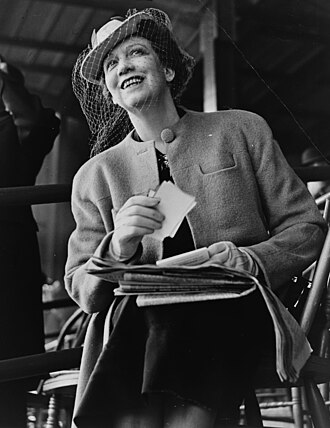
Her other consuming passion was horses. From 1931 she built a thoroughbred racing operation, the Maine Chance Farm stable, that became a genuine power on American tracks; in 1946 it was the nation's leading money-winner with nearly $600,000 in earnings, and in 1947 her colt Jet Pilot won the Kentucky Derby [4][7]. The horse racing, as much as the cosmetics, put her on the cover of Time in May 1946, the magazine declared that she had "made femininity a science" [4][5]. She lavished her face creams on the horses' legs and famously remarked that one should "treat a horse like a woman, and a woman like a horse" [4][7].
When she died in 1966 her company had sales of roughly $60 million and an estate valued in the tens of millions, yet she had no heirs and had built no succession; the empire she had refused to share with anyone in life was sold off after her death, going to the pharmaceutical maker Eli Lilly in 1971 for about $38 million [4][8]. The Red Door, the regimen, and the very respectability of cosmetics outlived her completely [1][4].
Early Life & Path
Florence Nightingale Graham was born on the family's market-garden farm in Woodbridge, Ontario, north of Toronto, most biographers settle on December 31, 1878, though census records and a brother's later sworn statement point to 1881, and Arden herself encouraged the confusion all her life [1][6]. Her father, William Graham, was a Scottish-born tenant farmer; her mother, Susan Tadd, was Cornish and died when Florence was a small child, leaving the family poor and the children scattered among relatives and odd jobs [1][6]. There was money for little, and certainly not for the finishing-school polish Florence would later affect so convincingly that strangers took her for old New York gentry [1].
She tried and abandoned a string of starts, a brief, aborted attempt at nurse's training, then work as a stenographer, a cashier, and a dental assistant, the last of which sharpened an instinct for selling intangibles and for making a small shop seem prosperous [6]. Around 1907 she followed her brother to New York City. After a ten-day stint as a bookkeeper at the pharmaceutical house E. R. Squibb & Sons, where she haunted the laboratory to learn what went into skin creams, she took a job at Eleanor Adair's beauty salon, learning the trade of facial "treatments" hands-on [3][6].
In 1910, with very little capital of her own, accounts of a loan from her brother William range improbably from $1,000 to $6,000, she went into partnership with the experienced beautician Elizabeth Hubbard on Fifth Avenue [1][3][6]. The partnership soured almost immediately, but Florence Graham had found her life's work and, in the leftover lettering on the salon door, the beginnings of the only name the world would ever know her by [3][6].
Career Timeline
- 1878Born Florence Nightingale Graham on a market-garden farm in Woodbridge, Ontario (some records suggest 1881) [1][6].
- 1907Moves to New York City; briefly works at E. R. Squibb & Sons, then trains under beautician Eleanor Adair [3][6].
- 1910Opens a Fifth Avenue salon in partnership with Elizabeth Hubbard; paints the door red [3][6].
- 1912Travels to Paris, studies French use of cosmetics, and brings eye makeup and tinted color back to a reluctant U.S. market [3][6].
- 1914Now solo as "Elizabeth Arden," partners with a chemist to develop Cream Amoretta and the Ardena tonic [3].
- 1915Marries banker Thomas Jenkins Lewis, who builds her wholesale business; begins selling cosmetics internationally [3][6].
- 1920Arden products are carried in more than 5,000 drug and department stores [4][6].
- 1929Reportedly refuses a $15 million buyout offer rather than relinquish control [4][6].
- 1930Introduces Eight Hour Cream, the apricot-tinted balm that becomes her most enduring product [3][4].
- 1934Divorces Thomas Lewis (who joins rival Helena Rubinstein); opens the Maine Chance destination spa in Maine [3][6].
- 1946Maine Chance Farm is the nation's leading racing stable by earnings; Arden appears on the cover of Time, May 6 [4][5][7].
- 1947Her colt Jet Pilot wins the Kentucky Derby [4][7].
- 1962Awarded the French Légion d'Honneur [2].
- 1966Dies October 18 at Lenox Hill Hospital, New York; the company is sold to Eli Lilly in 1971 for about $38 million [4][8].
Key Ventures & Innovations
The Red Door salon (1910)
A three-room beauty salon on Fifth Avenue, behind a door painted a bold red. Arden made the salon itself the product, a luxurious, intimidatingly elegant space where respectable women could buy "treatments" without shame. The Red Door became her logo and spread to dozens of cities worldwide [1][4][6].
Making cosmetics respectable
Her central act of invention was rhetorical and social: reframing rouge, lipstick, and eye color, previously the marks of actresses and "low women", as scientific "treatment" and ladylike self-care. After her 1912 Paris trip she introduced tinted makeup and the coordinated, fully made-up look to mainstream America [1][3][4].
Eight Hour Cream and the Arden product line (1930)
The apricot-hued Eight Hour Cream, alongside Cream Amoretta, the Ardena line, and later the Blue Grass fragrance, anchored a catalog of luxury products sold in thousands of stores and dozens of countries. Arden obsessed over packaging and her signature "Arden pink," reportedly refusing to ship product whose color was off [3][4][6].
Maine Chance destination spa (1934)
Opened near Mount Vernon/Rome, Maine, Maine Chance is regarded as the first American destination beauty spa, an exclusive resort where wealthy women came for diet, exercise, massage, and pampering. Arden later opened a second Maine Chance in Arizona [4].
Maine Chance Farm racing stable (1931 onward)
Arden's thoroughbred operation became a major force in American racing, running under cerise, blue and white colors. In 1946 it led the nation in earnings (nearly $600,000); in 1947 Jet Pilot won the Kentucky Derby. The stable, as much as the cosmetics, made her a national celebrity [4][7].
“Repetition makes reputation and reputation makes customers.”
From the Record
“Dear, never forget one little point: It's my business. You just work here.”
“Repetition makes reputation and reputation makes customers.”
“Elizabeth Arden has made femininity a science, and probably earned more money doing it than any businesswoman in history.”
What Operators Can Learn
- 01
Sell the idea, not the jar
Arden's product was never really the cream; it was respectability, refinement, and a vision of the customer's better self. She understood that women would pay for what a product let them believe about themselves, and she built the salons, packaging, and language to deliver that belief.
- 02
Reframe the taboo and you own the category
By relabeling makeup as scientific 'treatment' and ladylike self-care, she made cosmetics acceptable to a mass middle-class market that had shunned them, and in doing so created the modern beauty industry on her own terms.
- 03
Control has a cost as well as a value
Her absolute, sole ownership let her run the company entirely by instinct and protected the brand's perfectionism, but it also meant she built no partners, no successor, and no institution that could outlast her. The empire was sold off within five years of her death.
- 04
The brand can be the founder, and that is dangerous
Arden fused herself so completely with the company, even taking its invented name, that the business had no identity apart from her. That made the brand magnetic in her lifetime and orphaned at her death.
Legacy
Elizabeth Arden's deepest legacy is invisible because it is now universal: the assumption that a respectable woman wears makeup, follows a skincare routine, and is entitled to spend time and money on her own beauty. She did not invent lipstick or face cream, but she did more than anyone to drag cosmetics out of the theatrical demimonde and into the bathroom cabinet of ordinary America, dressing the whole enterprise in the language of science and self-respect [1][4][9]. The multi-step regimen, the makeup demonstration at the counter, the coordinated lip-and-nail look, the destination spa, the celebrity beauty founder, all bear her fingerprints [1][4].
Her rivalry with Helena Rubinstein, the two of them building competing global empires across fifty years while reportedly never speaking, became a defining business legend of the twentieth century, later dramatized on Broadway as War Paint [1][6]. Yet for all her wealth and fame, the Time cover, the Légion d'Honneur, the Kentucky Derby winner, she left no heirs and no succession plan, and the company she had guarded so jealously passed to Eli Lilly in 1971 and onward through a chain of corporate owners [4][8].
Historians render her as a near-perfect study in the founder who is the brand: brilliant, autocratic, self-mythologizing, and ultimately irreplaceable in a way that hollowed out her own institution. The Red Door still opens onto salons that carry her invented name, a name worn by a woman who began life as Florence Graham on an Ontario farm and willed herself into Elizabeth Arden [1][6].
Further Reading
War Paint: Madame Helena Rubinstein and Miss Elizabeth Arden, Their Lives, Their Times, Their Rivalry, Lindy Woodhead (2003)
The definitive dual biography, and the best single account of Arden's life, business, and lifelong feud with Helena Rubinstein.
Miss Elizabeth Arden: An Unretouched Portrait, Alfred Allan Lewis and Constance Woodworth (1972)
An early, readable biography drawing on former employees and relatives, published a few years after Arden's death.
Hope in a Jar: The Making of America's Beauty Culture, Kathy Peiss (1998)
The leading scholarly history of the American cosmetics industry, essential context for what Arden and her rivals built.
Beauty Imagined: A History of the Global Beauty Industry, Geoffrey Jones (2010)
A business-history overview by a Harvard Business School historian, placing Arden within the rise of the global beauty business.
Sources
- 1.Lindy Woodhead, War Paint: Madame Helena Rubinstein and Miss Elizabeth Arden, Their Lives, Their Times, Their Rivalry, John Wiley & Sons, 2003, book
- 2.“Elizabeth Arden”, Wikipedia, 2026
- 3.Cosmetics and Skin, “Elizabeth Arden (company history)”, cosmeticsandskin.com, 2020
- 4.Women in World History: A Biographical Encyclopedia, Arden, Elizabeth (1878–1966), Encyclopedia.com (Gale), 2002, journal
- 5.“Cover story: Elizabeth Arden, "made femininity a science"”, Time, May 6, 1946, newspaper
- 6.Alfred Allan Lewis and Constance Woodworth, Miss Elizabeth Arden: An Unretouched Portrait, Coward, McCann & Geoghegan, 1972, book
- 7.“Remembering Jet Pilot, who got the full beauty treatment from a cosmetics queen (Arden's Maine Chance Farm and the 1947 Kentucky Derby)”, Thoroughbred Racing Commentary, April 2024, newspaper
- 8.U.S. District Court, Southern District of New York, “American Cyanamid Co. v. Elizabeth Arden Sales Corp., 331 F. Supp. 597 (S.D.N.Y. 1971)”, Justia, U.S. District Court Decisions, 1971, archive
- 9.Kathy Peiss, Hope in a Jar: The Making of America's Beauty Culture, Metropolitan Books / Henry Holt, 1998, book
Researched and written with Claude + live web search.