Overview
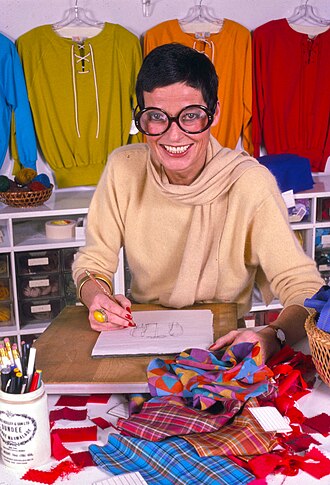
For twenty years before her name was on a building, Anne Elisabeth Jane Claiborne worked in the back rooms of Seventh Avenue, sketching dresses for other people's labels and watching the bosses ignore the customer she knew best, herself [1][2]. She was a working mother who hated to shop, who could not find clothes that were professional without being severe, and who grew certain that millions of American women, pouring into offices in the 1970s, felt the same way [2][4]. When the junior-dress house she ran design for would not let her build a line of coordinated, mix-and-match separates, she did something almost no woman her age did in 1976: at forty-six, she quit and bet her savings on the idea [1][2].
Liz Claiborne Inc. was incorporated in January 1976 with roughly $250,000, about $50,000 of the couple's own savings and some $200,000 borrowed from friends and family, and a four-person partnership: Claiborne as designer, her husband Arthur Ortenberg running operations, Leonard Boxer handling production, and Jerome Chazen, who joined within the year, running sales [1][3][5]. The premise was deceptively simple. She did not design for the runway or the fashion editor; she designed for a specific woman she could picture closing her eyes, the lawyer, the teacher, the bank officer, and she made clothes that woman could buy as separates, mix into many outfits, and wear straight from store to office [4][6]. "Businesslike, but not too pinstripe," was how the look was described, "more casual, more imaginative, less uptight" [2].
The market answered immediately. First-year sales topped $2 million; by 1978 they had jumped to roughly $23 million [1][5]. The company went public in 1981 at $19 a share on net income of about $10 million against $117 million in sales [1][5][7]. Then came the milestone that made her a business-history figure: in 1986 Liz Claiborne Inc. became the first company founded by a woman to crack the Fortune 500, and Claiborne, chairman and CEO, became the first woman to run a Fortune 500 company she had built [3][5][7]. By the time she stepped back, the firm was the largest women's apparel maker in America with sales above $1.2 billion [5][7].
The genius was not only in the clothes. Claiborne and her partners refused to chase discounters or mark merchandise down, only about five percent of goods were ever discounted, against an industry norm near fifteen, and they sold through department stores in dedicated, color-coordinated "concept" displays that taught the customer to buy the whole wardrobe at once [5][6]. They eschewed splashy consumer advertising for more than a decade, letting the product and the retail relationships do the work [5]. And they built early information systems to read the selling floor in near-real time, so the company manufactured what was actually moving rather than what a designer guessed would [6].
Claiborne was, in the words that followed her everywhere, the "reluctant revolutionary", a private, exacting woman who disliked celebrity, did not hold runway shows in the conventional way, and insisted she was a merchant serving a customer rather than an artist serving herself [2][6]. In 1989 she and Ortenberg walked away from active management at the top, leaving a billion-dollar company to professional managers, and turned to a second life funding wildlife conservation through their foundation [1][2]. She had not invented sportswear or separates; she had understood, earlier and more completely than anyone, that the American workplace had just acquired tens of millions of new women, and that nobody was dressing them [2][7].
Early Life & Path
She was born Anne Elisabeth Jane Claiborne in Brussels on March 31, 1929, the youngest of three children of Omer Villere Claiborne, an American banker posted to Belgium, and his wife Louise [2][6]. The family was old New Orleans Creole stock, descended from the line that gave Louisiana its first American governor, William C. C. Claiborne, and Elisabeth grew up bilingual, learning French before English and absorbing a sense, as her husband later put it, that privilege carried responsibilities [2][6]. Her father disapproved of formal schooling for girls and steered her toward art; she never finished high school, studying painting instead in Brussels in 1947 and in Nice the following year [6].
In 1949, still a teenager in ambition if not in years, she entered and won a national design contest sponsored by Harper's Bazaar, the Jacques Heim award, and used it as her ticket to New York's garment district [1][6]. There she spent the 1950s and 1960s in apprenticeship to the trade: a sketch artist and sometime fit model at the sportswear house of Tina Leser, then, from 1960, the chief designer for the junior-dress division of Jonathan Logan, one of the giants of Seventh Avenue [1][6]. For fifteen years she designed there, and for fifteen years she chafed, convinced that the company was missing the woman she saw all around her, the one who needed practical, coordinated separates, not frilly-bowed blouses or stiff little suits [6].
Her personal life ran alongside the work. A first marriage in 1950 to Ben Schultz ended in divorce and produced her only child, a son, Alexander [6]. In 1957 she married Arthur Ortenberg, a textiles executive who would become her life and business partner; for years they saved toward the company they meant to build together, and in 1976, with their children grown enough and the savings sufficient, they finally jumped [1][6].
Career Timeline
- 1929Born Anne Elisabeth Jane Claiborne on March 31 in Brussels, Belgium, to American parents of old New Orleans stock [2][6].
- 1949Wins the Jacques Heim national design contest sponsored by Harper's Bazaar and moves to New York's garment district [1][6].
- 1950sWorks as a sketch artist (and occasional fit model) at the sportswear house Tina Leser [6].
- 1960Becomes chief designer of the junior-dress division at Jonathan Logan, a post she holds about fifteen years [1][6].
- 1976Co-founds Liz Claiborne Inc. in January with Arthur Ortenberg, Leonard Boxer, and Jerome Chazen on about $250,000; first-year sales top $2 million [1][3][5].
- 1978Sales reach roughly $23 million as the coordinated-separates concept catches on in department stores [1][5].
- 1981Liz Claiborne Inc. goes public at $19 a share, raising about $6.1 million, on roughly $117 million in sales [1][5][7].
- 1982Adds a dress division, broadening beyond the original sportswear and 'better' separates lines [5][7].
- 1985Named Designer of the Year by the Council of Fashion Designers of America [3][5].
- 1986Becomes the first company founded by a woman to make the Fortune 500; Claiborne is chairman and CEO; sales near $1.2 billion [3][5][7].
- 1989Claiborne and Ortenberg announce they will resign from active management, leaving the firm to professional managers [1][5].
- 1990Inducted into the business hall of fame; turns to full-time wildlife conservation through the Liz Claiborne and Art Ortenberg Foundation [1][2].
- 2007Dies June 26 in Manhattan at age 78 of complications of cancer, a decade after a rare abdominal-lining diagnosis [2].
Key Ventures & Innovations
Liz Claiborne Inc. (1976)
A four-founder partnership built on about $250,000, roughly $50,000 of the couple's savings and $200,000 borrowed from friends and family, aimed squarely at the working woman the rest of Seventh Avenue ignored [1][3][5]. First-year sales topped $2 million; it became one of the fastest climbs in apparel history [1][5].
The 'Liz Look', coordinated separates
Instead of dresses or stiff suits, Claiborne built color-coordinated, mix-and-match pieces a woman could combine into many outfits and wear from store to office: 'businesslike, but not too pinstripe, more casual, more imaginative, less uptight' [2][6]. She designed by picturing a real customer's closet, not the runway [4][6].
The department-store 'concept' shop and no-markdown discipline
The company sold through dedicated, coordinated displays inside department stores rather than discounters, and held the line on price: only about five percent of merchandise was ever marked down, versus an industry norm near fifteen percent [5][6]. It avoided big consumer advertising for over a decade [5].
Reading the selling floor
Liz Claiborne built early retail-feedback information systems to track what was actually selling across the country, manufacturing to real demand rather than a designer's guess, a discipline studied later in business-school cases [6].
The IPO and the Fortune 500 (1981–1986)
Public in 1981 at $19 a share on about $117 million in sales and $10 million net income; by 1986 the first woman-founded company on the Fortune 500, with Claiborne as chairman and CEO and sales near $1.2 billion [1][5][7].
“When I was designing, I would close my eyes and picture my customer's closet. I would think, 'What does she have in there and what does she need?'”
From the Record
“When I was designing, I would close my eyes and picture my customer's closet. I would think, 'What does she have in there and what does she need?' That's the beginning.”
“Born in Brussels in 1929, the third and last child of a highborn American banker and his delicate, beautiful wife, she was born privileged and taught that privilege incurs responsibilities.”
“Liz Claiborne, the designer of indefatigable career clothes for professional women entering the work force en masse beginning in the 1970s, died Tuesday in Manhattan.”
What Operators Can Learn
- 01
Design for the customer you can name, not the editor you want to impress
Claiborne's edge was that she pictured a specific working woman's closet and made what that woman actually needed. She treated herself as a merchant in service of a customer, not an artist in service of a vision, and the customer rewarded her.
- 02
A demographic shift is a business waiting to be built
Tens of millions of women entered the American workforce in the 1970s, and the industry kept selling them either frills or imitation menswear. Seeing the new customer clearly, and earlier than rivals, was worth more than any single garment.
- 03
Pricing discipline protects a brand
By refusing discounters and marking down only a sliver of merchandise, Liz Claiborne kept the brand's value intact and trained customers to buy at full price, the opposite of the markdown spiral that hollowed out competitors.
- 04
Listen to the selling floor, not the design room
Early information systems let the company manufacture what was truly moving rather than what a designer guessed would sell, turning fashion's chronic inventory gambling into something closer to a managed supply chain.
- 05
Know when to leave at the top
Claiborne and Ortenberg walked away from a billion-dollar company in 1989, at its peak, handing it to professional managers and turning to conservation. Founding genius and operating it forever are different jobs.
Legacy
Liz Claiborne's monument is partly statistical and partly cultural. The statistic is unambiguous: in 1986 hers became the first company founded by a woman to reach the Fortune 500, and she became the first woman to chair and run such a company that she had built from nothing, a ceiling broken by a back-room designer who never finished high school [3][5][7]. The cultural legacy is larger. She gave a name and a wardrobe to the American working woman at the precise moment that woman was arriving in offices by the millions, and in doing so helped define what 'career dressing' would mean for a generation [2][7].
Her business methods proved as influential as her clothes. The coordinated-separates concept, the disciplined refusal to discount, the dedicated in-store shops, and the early use of point-of-sale feedback to drive manufacturing became standard teaching in the apparel trade and the subject of Harvard Business School cases [6]. Competitors copied the formula; few matched the consistency [5][6].
In retirement she and Ortenberg redirected their fortune toward wildlife and wild-lands conservation through their foundation, funding fieldwork from the American West to Africa, before her death from cancer in 2007 [1][2]. The brand outlived her ownership, passing through corporate hands and licenses, but the figure who matters to business history is the one who, at forty-six, looked at an industry that would not dress her and decided to do it herself [2][7].
Further Reading
Liz Claiborne: The Legend, The Woman, Arthur Ortenberg (2010)
An intimate memoir by her husband and co-founder, less about the business than the private character behind it, the essential primary portrait.
The Fashion Cycle, Irene Daria (1990)
A reporter's fly-on-the-wall year inside top design houses, including Liz Claiborne, that shows how the company actually decided and produced.
My Life at Liz Claiborne (and "Two Decades at Liz Claiborne," Columbia Journal of World Business), Jerome A. Chazen (1996)
The marketing co-founder's firsthand account of the strategy, the partnership, and the retail relationships that built the brand.
Liz Claiborne, Inc. and Ruentex Industries, Ltd. (Harvard Business School case), Jill S. Dalby and M. Therese Flaherty (1990)
The classic teaching case on the company's sourcing, retail strategy, and operations at its peak.
Sources
- 1.Arthur Ortenberg, Liz Claiborne: The Legend, The Woman, Rowman & Littlefield, 2010, book
- 2.Eric Wilson, “"Liz Claiborne, Designer, Dies at 78"”, The New York Times, June 27, 2007, newspaper
- 3.Fashion Institute of Technology, Special Collections and FIT Archives, “Oral History of Liz Claiborne (interview by Estelle Ellis), Oral History Project of the Fashion Industries”, FIT Archive on Demand, 1986, archive
- 4.“"Liz Claiborne Redefined 'Career Clothes' for Women Everywhere" (Women's Wear Daily archive retrospective, quoting her 1986 WWD interview)”, Women's Wear Daily (WWD), 2025, newspaper
- 5.“"Liz Claiborne, Inc." company history”, Encyclopedia.com (Business Leader Profiles / company histories), 2002
- 6.Jerome A. Chazen, "Notes from the apparel industry: Two decades at Liz Claiborne", Columbia Journal of World Business, 31(2): 40–43, 1996, journal
- 7.Jill S. Dalby and M. Therese Flaherty, "Liz Claiborne, Inc. and Ruentex Industries, Ltd." (HBS Case 9-690-748), Harvard Business School, 1990, journal
- 8.Irene Daria, The Fashion Cycle: A Behind-the-Scenes Look at a Year with Bill Blass, Liz Claiborne, Donna Karan, Arnold Scaasi, and Adrienne Vittadini, Simon and Schuster, 1990, book
- 9.Sheila Dow (ed.), Business Leader Profiles for Students, Vol. 1 ("Liz Claiborne," pp. 150–153), Gale, 2002, book
Researched and written with Claude + live web search.