Overview
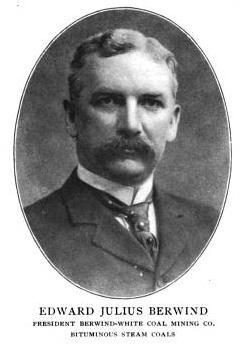
Edward Julius Berwind was, by the testimony of his own obituaries, "said to have been the country's largest individual owner of bituminous mines", and for a generation around 1900 he was very likely the largest in the world [1][3]. He did not invent the coal trade or the company town; what he did was assemble, through ruthless consolidation and a close working partnership with J. P. Morgan, a vertically lashed empire that dug the coal in Pennsylvania, carried it on its own colliers, and sold it to the customers who could not run without it: the United States Navy, foreign navies, the Pennsylvania Railroad, the great transatlantic steamship lines, and the New York subway he himself helped finance [2][3][4].
The firm was founded in January 1886 in Philadelphia by Edward, his older brother Charles Frederick Berwind, and Judge Allison White, and it took the prosaic name Berwind-White Coal Mining Company [1][3]. Charles, the elder businessman, was president until his death in 1890; thereafter Edward ran the company for forty years, until 1930 [1][2]. He had come to it by an unusual road. Appointed to the U.S. Naval Academy in 1865 by Abraham Lincoln and commissioned in 1869, he served as a naval aide in the Grant White House before retiring from the service in 1875, and the connections and the customer he acquired in uniform, the Navy that burned smokeless steam coal, would make his fortune [1][3].
Berwind's method was integration and control. He opened his first mine at Houtzdale, then drove into the rich Somerset County field, where in 1897 the company laid out a brand-new town and, in a piece of corporate vanity, named it Windber, the syllables of "Berwind" reversed [5][6]. Coached by Morgan, he bought, merged, and chaired: president of six coal companies, director of dozens of banks, railways and steamship lines, chairman of the board of the Colorado Fuel and Iron Company, and a founding figure in the International Mercantile Marine, the Morgan shipping trust that owned the White Star Line [2][3][14]. He was also a director and the largest individual stockholder of the Interborough Rapid Transit Company, which ran New York's first subway, and which bought its coal from Berwind-White, an act of self-dealing that critics attacked for years [3][7].
The coal made him fabulously rich and, in the coalfields, fabulously hated. Berwind refused on principle to recognize a union or bargain with his men; Harvard Business School's own profile records that his mines were "the last bastions of the open shop in the coal fields" [2]. That intransigence produced two of the ugliest episodes in Pennsylvania labor history, the kind of company-town violence that recurs throughout the history of American bituminous coal [13]. In the 1906 strike at Windber, company guards and state police broke the walkout; on Easter Monday, April 16, hired detectives opened fire on a crowd, killing three immigrant miners and a ten-year-old boy [8]. In 1922–23, after wage cuts of 32 to 54 percent, some 25,000 Somerset County miners struck for seventeen months; Berwind-White answered by evicting more than two thousand families from company houses, who passed the winter in tents, barns, and hen houses while armed Coal and Iron Police patrolled the patch towns [9][8].
While his miners froze, Berwind built. In 1901 he completed The Elms, a $1.4-million Newport "cottage" modeled by Horace Trumbauer on an eighteenth-century French château, where he reportedly spent $300,000 a season entertaining and where, in an irony almost too neat to be true, the coal that heated the house was delivered through a hidden underground tunnel and burned in concealed boilers, so that no soot, no wagon, and no laboring servant would ever mar the gilded illusion [10][11]. He died in New York on August 18, 1936, at eighty-eight, leaving an estate valued at more than $34 million [1][3].
Early Life & Path
Edward Julius Berwind was born on June 17, 1848, in Philadelphia, the third of six children of John and Augusta (Guldenfennig) Berwind, German-speaking immigrants of modest, middle-class means [1][3]. He was emphatically "new money," and the family's first foothold in coal came not through him but through his elder brother Charles Frederick, who started as an office boy in a Philadelphia coal counting-house in 1861 and rose to be a vice-president of the Powelton Coal and Iron Company before he was of age [12][3]. The pattern of the Berwinds, disciplined, upwardly clawing, comfortable with the machinery of railroads and credit, was set before Edward came of business age.
Edward's own apprenticeship was in the Navy. Appointed to the U.S. Naval Academy at Annapolis in July 1865 by President Lincoln, he graduated in 1869, was promoted to ensign and then master, and served as a naval aide in Washington during the Grant administration before a service-related disability ended his career and he retired in 1875 [1][3]. The decade in uniform was not a detour. It taught him the strategic importance of coal, the fuel that moved the entire fleet, and it gave him entrée to the officers and contracts of a Navy converting to steam. When he turned to business, his decisive early advantage was an inside understanding of, and access to, the government's hunger for high-grade smokeless steam coal [3].
In 1886 Berwind married Sarah Vesta Herminie Torrey in Leghorn (Livorno), Italy, where her American father served as a consular agent [1]. The couple had no children, and after Sarah's death in 1922 his unmarried sister Julia became the formidable hostess of his houses [1][10]. That same year, 1886, Edward joined Charles and Judge Allison White to incorporate the Berwind-White Coal Mining Company, the vehicle that would carry the boy from immigrant Philadelphia into the front rank of America's industrial aristocracy [1][3].
Career Timeline
- 1848Born June 17 in Philadelphia, son of German immigrants John and Augusta Berwind [1][3].
- 1865Appointed to the U.S. Naval Academy by President Abraham Lincoln [1][3].
- 1869Graduates from Annapolis; later serves as a naval aide in the Grant administration [1][3].
- 1875Retires from the Navy because of a service-related disability and turns to the coal business [1][3].
- 1886Co-founds the Berwind-White Coal Mining Company in January with brother Charles F. Berwind and Judge Allison White; marries Sarah Torrey in Italy [1][3].
- 1890Becomes president of Berwind-White on the death of his brother Charles, a post he holds until 1930 [1][2].
- 1897Opens the Somerset County coalfield and lays out the company town of Windber, its name his own surname reversed [5][6].
- 1906On Easter Monday, April 16, company detectives fire on strikers at Windber, killing three immigrant miners and a ten-year-old boy [8].
- 1904Helps finance and joins the board of New York's Interborough Rapid Transit, becoming its largest individual stockholder while selling it Berwind-White coal [3][7].
- 1901Completes The Elms in Newport, a $1.4-million château by Horace Trumbauer [10][11].
- 1922After wage cuts of 32–54 percent, some 25,000 Somerset miners strike; Berwind-White evicts more than 2,000 families from company housing [9][8].
- 1923The Windber strike collapses after seventeen months without union recognition; Berwind's mines remain open shops [9][2].
- 1930Steps down as president of Berwind-White after four decades at the helm [2].
- 1936Dies August 18 in New York City at age 88, leaving an estate of more than $34 million [1][3].
Key Ventures & Innovations
Berwind-White Coal Mining Company (1886)
The Philadelphia-based firm Berwind built into the largest individual coal holding in America, mining the Houtzdale and Somerset fields across roughly 105,000 acres. By the early 1900s it was selling millions of tons a year of premium bituminous and smokeless steam coal [1][3].
The Navy and steamship coal trade
Drawing on his naval background, Berwind locked up contracts to fuel the U.S. Navy, foreign navies, and the great transatlantic lines, operating his own coaling stations and colliers. Contemporaries called the resulting grip on premium steam coal a monopoly [3][1].
The Windber company town (1897)
A purpose-built patch town in Somerset County, named by reversing the syllables of Berwind, where the company owned the houses, the stores, and the police. It became the laboratory of his open-shop labor regime, and the flashpoint for the 1906 and 1922–23 strikes [5][6][9].
Partnership with J. P. Morgan
Berwind allied with Morgan to consolidate, reorganize, and expand his coal interests, joining the orbit of Morgan enterprises, the Colorado Fuel and Iron board he chaired, and the International Mercantile Marine shipping trust that controlled the White Star Line [2][3][14].
The Interborough Rapid Transit (IRT)
Berwind helped finance New York's first subway and became its largest individual stockholder and a director, then steered the IRT's coal purchases to his own Berwind-White, a conflict of interest that drew shareholder litigation and lasting criticism [3][7].
The Elms (1901)
His Newport monument: a $1.4-million Trumbauer château filled with French and Venetian paintings and Oriental jades, heated by coal hauled in through a concealed tunnel so the trade that paid for it stayed invisible [10][11].
From the Record
“we are fighting to be respected as free people and not slaves.”
“His mines were the last bastions of the open shop in the coal fields.”
“Edward J. Berwind, Coal Operator, 88; Said to Have Been Country's Largest Individual Owner of Bituminous Mines.”
What Operators Can Learn
- 01
Own the chain, capture the customer
Berwind's edge was not a better lump of coal but control of everything around it, mines, colliers, coaling stations, and a seat on the board of the railroads, navies, and the subway that had to buy from him. He turned essential infrastructure into a captive market.
- 02
A relationship can be worth more than a product
His decade in the Navy was the real seed capital: it gave him the knowledge and contacts to lock up government steam-coal contracts. The lesson and the warning are the same, privileged access builds fortunes and breeds the charge of monopoly.
- 03
Refusing to bargain has a price you don't put on the books
Berwind kept the open shop longer than almost anyone, and it bought him low costs and total control. It also bought two massacres' worth of bloodshed, decades of litigation, and a name still synonymous in Somerset County with company-town tyranny.
- 04
Splendor built on hidden labor invites a reckoning
The tunnel that fed coal invisibly into The Elms is the perfect emblem of his career: a gilded surface engineered to hide the grimy, human work that produced it. History eventually lifts the floorboards.
Legacy
Berwind's hard legacy is written on the map. Towns still carry his name, Windber, Pennsylvania; Berwind, West Virginia; Berwind, Colorado, and the privately held Berwind Corporation his family founded survives to this day, managing mineral rights, real estate, and investments long after the mines closed [5][3]. The Elms, sold to the Preservation Society of Newport County in 1962 and made a National Historic Landmark in 1996, is now a museum whose immensely popular "servant life" tour turns his vanished downstairs army of servants, and that hidden coal tunnel, into the main attraction, an unintended monument to the labor he tried to keep out of sight [10][11].
His softer legacy is contested and, increasingly, critical. To business historians he is a case study in vertical integration and Morgan-era consolidation; to labor historians, above all Mildred Allen Beik, whose The Miners of Windber draws on immigrant newspapers, church records, and oral histories, he is the autocrat whose open-shop regime the new immigrants of Somerset County finally broke in the New Deal era [9][8]. The two readings are not really in conflict. Edward Berwind built one of the most efficient and profitable extractive enterprises in America by controlling everything he could, the coal, the carriers, the customers, and the men, and the same monomaniacal control that made the fortune is what makes him, a century on, a byword for the costs of the Gilded Age model he so completely embodied [2][9].
Further Reading
The Miners of Windber: The Struggles of New Immigrants for Unionization, 1890s–1930s, Mildred Allen Beik (1996)
The definitive scholarly history of Berwind-White's flagship company town, told from the miners' side using immigrant newspapers, church records, and oral histories.
Where the Sun Never Shines: A History of America's Bloody Coal Industry, Priscilla Long (1989)
A sweeping, vivid history of American coal and its labor wars that sets the Berwind operations in national context.
The House of Morgan: An American Banking Dynasty and the Rise of Modern Finance, Ron Chernow (1990)
Essential background on the J. P. Morgan consolidation machine and trusts (CF&I, IMM) into which Berwind tied his fortune.
The Elms: Newport, Rhode Island, Clift Anderson and Stuart Leuthner (et al.) (2009)
An illustrated guide from the Preservation Society of Newport County to Berwind's château and its place in the Gilded Age.
Killing for Coal: America's Deadliest Labor War, Thomas G. Andrews (2008)
A Bancroft Prize–winning study of Colorado coal, the world Colorado Fuel and Iron and the company town of Berwind, Colorado belonged to.
Sources
- 1.“"Edward J. Berwind, Coal Operator, 88; Said to Have Been Country's Largest Individual Owner of Bituminous Mines" (obituary)”, The New York Times, August 19, 1936, newspaper
- 2.“Edward J. Berwind, 20th Century Great American Business Leaders Database”, Harvard Business School, n.d., archive
- 3.“Edward Julius Berwind”, Wikipedia, 2025
- 4.Interchange: Berwind-White Coal Company (Pennsylvania Railroad coal traffic), PennsyRR.com / The Pennsylvania Railroad Technical & Historical Society, n.d., journal
- 5.“Windber [Bituminous Coal] Historical Marker”, ExplorePAHistory.com (Pennsylvania Historical & Museum Commission), n.d., archive
- 6.Mildred Allen Beik, The Miners of Windber: The Struggles of New Immigrants for Unionization, 1890s–1930s, The Pennsylvania State University Press, 1996, ch. on the founding of Windber as a company town, book
- 7.“Continental Securities Co. v. Interborough Rapid Transit Co., 207 F. 467”, U.S. District Court, S.D. New York (federal reporter), 1913, archive
- 8.“Remembering the 1906 Strike for Union in Windber, Pennsylvania”, Indiana University of Pennsylvania Libraries, Coal Mining & Labor collections, n.d., archive
- 9.“The Windber Miners' Strike for Union in 1922–1923 / "That Magnificent Fight for Unionism"”, Indiana University of Pennsylvania Libraries, Coal Mining & Labor collections, n.d., archive
- 10.“The Elms, History”, The Preservation Society of Newport County (Newport Mansions), n.d., archive
- 11.“The Elms (Newport, Rhode Island)”, Wikipedia, 2025
- 12.“Charles Frederick Berwind”, Wikipedia, 2025
- 13.Priscilla Long, Where the Sun Never Shines: A History of America's Bloody Coal Industry, Paragon House, 1989, book
- 14.Ron Chernow, The House of Morgan: An American Banking Dynasty and the Rise of Modern Finance, Atlantic Monthly Press, 1990, book
Researched and written with Claude + live web search.