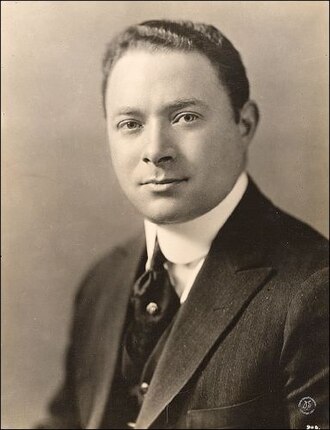
Overview
David Sarnoff did not invent radio, did not invent television, and, contrary to the legend he spent decades polishing, was neither the founder nor the owner of the Radio Corporation of America [3][6]. What he possessed was rarer: an almost violent certainty, decades ahead of the consensus, that wireless was not a tool for sending private messages between two points but a medium for broadcasting one signal to a continent at once. Where his employers saw a glorified telegraph, Sarnoff saw a "household utility in the same sense as the piano or the phonograph" [4]. He bet his career, and eventually the resources of the largest electronics company on earth, on that single reframing, and he was right [1][2].
Sarnoff rose from the floor up. He arrived in New York in 1900 a nine-year-old Russian Jewish immigrant, sold Yiddish newspapers to support a dying father, and in September 1906 walked into the American Marconi company as a fifteen-year-old office boy [1][7]. He mastered the telegraph key, made himself indispensable, and by the time the U.S. Navy pressured General Electric to assemble an all-American wireless monopoly out of Marconi's assets in 1919, Sarnoff was American Marconi's commercial manager and slid into the new RCA as its commercial manager [6]. RCA was a patent pool jointly controlled by GE, Westinghouse, AT&T and United Fruit, a corporate creature Sarnoff did not create but learned, with patience and ferocity, to command [3][6].
His instrument was a now-famous 1916 memorandum proposing a "Radio Music Box," and the demonstration that vindicated it: the July 2, 1921 heavyweight title fight between Jack Dempsey and Georges Carpentier, which RCA helped broadcast to an audience estimated in the hundreds of thousands and which set off a national craze for receiving sets [2][5]. Sarnoff understood before almost anyone that the money was not in the broadcast but in the boxes people bought to hear it. To feed programming to those boxes he engineered the National Broadcasting Company in 1926, RCA's, and America's, first true national network, launched with a four-and-a-half-hour gala from New York on November 15, 1926 [3][8]. When he became RCA's president in 1930, he set about prying the company loose from its GE-Westinghouse parents and turning it into an independent industrial empire [1][3].
Sarnoff then did it a second time, with television. In 1929 he backed the émigré engineer Vladimir Zworykin's electronic system, pouring millions into research through the Depression, and on April 20, 1939 he stood before the cameras at the New York World's Fair to announce television to the public: "Now we add radio sight to sound" [2][6]. After the war he fought, and won, the defining standards battle of the medium, beating back CBS's FCC-approved mechanical color system through the courts and the laboratory, until in December 1953 the FCC reversed itself and adopted RCA's all-electronic, black-and-white-compatible color standard, the basis of American color television for the next half-century [2][3].
The same will that built the empire could be merciless. Sarnoff's RCA ground the FM inventor Edwin Howard Armstrong, once Sarnoff's friend, through years of patent litigation; in January 1954, financially ruined and exhausted by the fight, Armstrong jumped to his death from his Manhattan apartment [2][3]. Sarnoff cultivated a heroic personal myth, beginning with a wholly embroidered account of the Titanic, that historians have spent decades disentangling from the documented record [3][6]. Yet the core verdict holds: more than any single figure, Sarnoff turned American broadcasting from a hobbyists' novelty into the central nervous system of twentieth-century mass culture [1][2][3].
Early Life & Path
He was born February 27, 1891, in Uzlian, a Jewish shtetl in the Pale of Settlement near Minsk in the Russian Empire, the eldest son of Abraham and Leah Sarnoff [1][6]. His father emigrated first; in 1900 the rest of the family crossed in steerage to join him on Manhattan's Lower East Side, into the poverty and crowding of immigrant New York [1][6]. The boy spoke no English when he landed. He learned it fast, and by his early teens, with his father ill and unable to work, he was effectively the family's breadwinner, selling Yiddish-language newspapers and running his own small newsstand to keep the household fed [1][7].
Intending to become a newspaperman, the fifteen-year-old instead walked, in September 1906, into the New York office of the Commercial Cable Company and then the American Marconi Wireless Telegraph Company, where he was hired as an office boy [1][7]. It was the hinge of his life. He bought a telegraph key, taught himself Morse, and made himself useful to everyone, including Guglielmo Marconi himself, whose confidence the teenager won with what one biographer called astonishing rapidity [7]. He worked as a wireless operator at shore stations and at sea, and by 1912 had become a radio inspector and instructor for the company's New York district [7].
It was in this period that Sarnoff attached himself to the Titanic disaster of April 1912, a connection he would later inflate into a legend of a lone operator at his key for seventy-two hours, taking down the names of the saved. The documented reality is far more modest: he was one of several operators relaying survivor information, and no contemporary account singles him out; the heroic version did not appear in print until Sarnoff supplied it to a writer around 1923 [3][6]. The myth-making is itself revealing, Sarnoff grasped, earlier than most, that a great industry would need a great founding story, and he was prepared to be it [3][6].
Career Timeline
- 1891Born February 27 in Uzlian, near Minsk, in the Russian Empire [1][6].
- 1900Immigrates with his family to Manhattan's Lower East Side; sells Yiddish newspapers to support an ailing father [1][6].
- 1906Joins the American Marconi Wireless Telegraph Company as a fifteen-year-old office boy in September [1][7].
- 1912Becomes a radio inspector and instructor; later builds a personal legend around the Titanic disaster [3][7].
- 1916Writes the "Radio Music Box" memo proposing radio as a mass-market home entertainment device [4][5].
- 1919American Marconi is absorbed into the new Radio Corporation of America; Sarnoff becomes commercial manager [6].
- 1921RCA helps broadcast the July 2 Dempsey–Carpentier title fight to a vast audience, igniting a receiver-set boom [2][5].
- 1926Engineers the founding of the National Broadcasting Company, launched with a gala broadcast on November 15 [3][8].
- 1929Backs Vladimir Zworykin's all-electronic television research, funding it through the Depression [2][6].
- 1930Becomes president of RCA; soon afterward maneuvers it free of GE–Westinghouse control [1][3].
- 1939Announces television to the public at the New York World's Fair on April 20: "Now we add radio sight to sound" [2][6].
- 1944Promoted to brigadier general for Signal Corps service at SHAEF; thereafter known as "the General" [3][6].
- 1953Wins the color-TV war as the FCC adopts RCA's compatible all-electronic color standard in December [2][3].
- 1954After years of RCA patent litigation, FM inventor Edwin Armstrong takes his own life in January [2][3].
- 1971Dies December 12 in New York, having led RCA for half a century [3][6].
Key Ventures & Innovations
The "Radio Music Box" (1916)
Sarnoff's memo to Marconi management reframed wireless from point-to-point messaging into a consumer appliance, projecting that if even one million families bought sets, the business would be worth about $75 million. Management shelved it; within a few years it became the blueprint for the entire broadcasting industry [4][5].
RCA's consumer-receiver business
Sarnoff's central insight was that the profit lay not in the broadcast but in the hardware. The 1921 Dempsey–Carpentier broadcast and the radio mania that followed validated the bet, and RCA's Radiola receivers turned the company into a consumer powerhouse [2][5].
The National Broadcasting Company (1926)
To give set-buyers something worth hearing, Sarnoff assembled America's first national network from RCA's and AT&T's stations, debuting with a star-studded coast-leaning broadcast across some 25 stations on November 15, 1926 [3][8].
Electronic television and the 1939 launch
Sarnoff bankrolled Zworykin's iconoscope and kinescope through the lean 1930s, then unveiled television to the public at the 1939 World's Fair, a calculated debut that staked RCA's claim to the medium it would dominate [2][6].
Compatible color television (to 1953)
After the FCC approved CBS's incompatible mechanical color system in 1950, Sarnoff fought it in court and pushed his engineers to perfect an all-electronic, monochrome-compatible system. The FCC reversed itself in December 1953, and RCA's standard became the U.S. norm for decades [2][3].
“I have in mind a plan of development which would make radio a 'household utility' in the same sense as the piano or phonograph. The idea is to bring music into the house by wireless.”
From the Record
“I have in mind a plan of development which would make radio a 'household utility' in the same sense as the piano or phonograph. The idea is to bring music into the house by wireless.”
“Now we add radio sight to sound. It is with a feeling of humbleness that I come to this moment of announcing the birth in this country of a new art so important in its implications that it is bound to affect all society.”
“Competition brings out the best in products and the worst in people.”
What Operators Can Learn
- 01
Reframe the medium, not just the product
Everyone around Sarnoff saw wireless as a better telegraph, a way to send one message between two points. His durable advantage was redefining it as a one-to-many broadcast medium and a consumer appliance, which opened a market orders of magnitude larger.
- 02
Sell the razor, give away the blade
Sarnoff grasped that the money was in the receiving sets, not the broadcasts. He was willing to fund programming (NBC) as a loss-leader to drive demand for the RCA hardware that actually carried the profit.
- 03
Standards wars are won with patience and lawyers, not just labs
In the color-TV fight he lost the first FCC ruling outright, then used litigation to stall, engineering to leapfrog, and the installed base of black-and-white sets as his trump card. Controlling the standard mattered as much as inventing the technology.
- 04
A founding myth is a strategic asset, and a moral hazard
Sarnoff understood the value of a heroic story and manufactured one (the Titanic vigil). It built the brand, but the same will-to-win that fabricated a legend also crushed Edwin Armstrong, a reminder that the instinct to dominate the narrative can curdle into ruthlessness.
Legacy
Sarnoff is remembered, accurately, as the chief architect of American broadcasting, the executive who twice took a laboratory curiosity (radio, then television) and willed it into a mass-market industry, and who built RCA and NBC into the institutions through which a nation learned to listen and watch together [1][2][3]. The structure he pioneered, networks delivering free programming to draw audiences whose attention was monetized, while the manufacturer profited from the sets, became the template for twentieth-century mass media [2][3]. Princeton's Sarnoff Research Center and the surviving David Sarnoff Library kept his name attached to the science he funded but did not himself perform [6].
Historians render a split verdict, and the honest biographies hold both halves at once. Sarnoff was a genuine visionary with an unmatched feel for where technology and the public were heading, and he was an empire-builder who cultivated a self-serving mythology and could be ruthless with rivals, most damningly Edwin Armstrong, whose FM patents RCA fought until the inventor's suicide [2][3][6]. The Bilby biography, written by a former RCA executive, was notable precisely for measuring the man against the documented record rather than the legend his own publicity department had spun [3]. What survives all the qualification is the scale of what he saw first: that the future of communication was not a private wire but a public broadcast, beamed into every living room in America [1][2][3].
Further Reading
The General: David Sarnoff and the Rise of the Communications Industry, Kenneth Bilby (1986)
The most balanced full biography, by a former RCA executive who tested Sarnoff's own legends against the documentary record.
Empire of the Air: The Men Who Made Radio, Tom Lewis (1991)
A gripping group portrait of Sarnoff, Lee de Forest, and Edwin Armstrong; indispensable on the FM tragedy. Basis for the Ken Burns film.
David Sarnoff: A Biography, Eugene Lyons (1966)
The authorized, admiring life written with Sarnoff's cooperation, invaluable as primary material and as a window into the myth he wished to project.
Sarnoff: An American Success, Carl Dreher (1977)
A more tempered portrait by an RCA sound engineer who knew Sarnoff personally in the 1920s.
RCA, Robert Sobel (1986)
A business-historian's account of the corporation Sarnoff built and ran, from patent pool to electronics giant.
Looking Ahead: The Papers of David Sarnoff, David Sarnoff (1968)
Collected speeches and documents in Sarnoff's own voice, essential primary source on how he framed his vision.
Sources
- 1.Eugene Lyons, David Sarnoff: A Biography, Harper & Row, 1966, book
- 2.Tom Lewis, Empire of the Air: The Men Who Made Radio, Edward Burlingame Books / HarperCollins, 1991, book
- 3.Kenneth Bilby, The General: David Sarnoff and the Rise of the Communications Industry, Harper & Row, 1986, book
- 4.David Sarnoff, “The "Radio Music Box" memo (text as printed in History of Radio to 1926)”, EarlyRadioHistory.us (reproducing Gleason L. Archer), 1916, archive
- 5.Louise Benjamin, In Search of the Sarnoff "Radio Music Box" Memo, Journal of Broadcasting & Electronic Media, vol. 37, no. 3, 1993, pp. 325–335, journal
- 6.“Who Was David Sarnoff? (Parts I–II)”, Hagley Museum and Library, 2019, archive
- 7.“David Sarnoff biographical profile”, Engineering and Technology History Wiki (ETHW), IEEE, 2016, archive
- 8.“Father of Broadcasting: David Sarnoff (cover profile)”, Time, July 23, 1951, newspaper
- 9.Robert Sobel, RCA, Stein and Day, 1986, book
Researched and written with Claude + live web search.