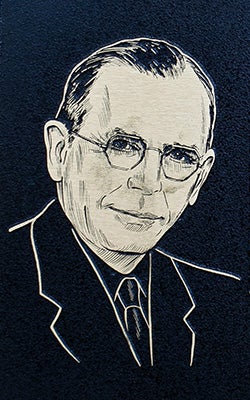
Overview
Charles Lyons Coughlin is not a household name, and that is precisely the point: for thirty-five years he ran one of the most quietly profitable industrial companies in America by selling something nobody noticed, the small, cheap gasoline engine bolted under a lawn mower, a washing machine, a generator, a garden tractor [2][3]. When he took the presidency of Briggs & Stratton in 1935, in the trough of the Depression, the Milwaukee firm was a maker of automotive ignition parts and door locks that had nearly gone bankrupt twice in its first decade [3][6]. When he relinquished the title in the early 1970s, Briggs & Stratton was on its way to becoming the largest manufacturer of air-cooled gasoline engines in the world, and the engine that powered postwar suburbia's most ubiquitous machine, the rotary lawn mower, was very largely his [2][6].
Coughlin was an electrical engineer, not a tinkerer-folk-hero in the Ford mold, and his genius was managerial and strategic rather than inventive [1][4]. He had known the founder, Stephen F. Briggs, as a fellow engineering student in the upper Midwest; he joined Briggs & Stratton in 1910, left in 1918 for the Ladish Drop Forge Company, and returned in 1923 as vice-president and general manager, the operating brain behind Briggs's restless inventiveness [3][6]. The partnership of inventor and manager is the spine of the company's story, and Coughlin was the half that turned ideas into volume, margin, and market share [3][6].
His first triumph came not in engines but in locks. In 1924 the company found that a die-cast automobile lock cylinder it had developed outsold the brass cylinders the industry used, and within five years Briggs & Stratton had become the largest producer of automotive locks in the country, controlling more than three-quarters of the market [3][6]. The die-casting expertise built on that business, and Coughlin's own patents, including a 1934 key with a break-off identification tab assigned to the company, would later prove decisive when the firm bet its future on cheap, mass-produced aluminum engines [5][6].
The defining move came in 1953. Briggs & Stratton developed the first lightweight aluminum die-cast engine, a radical departure from the heavy cast-iron motors of the day, and it arrived at the exact moment that returning GIs were buying tract houses with lawns that had to be cut [2][6]. The aluminum engine was lighter, cheaper, and perfectly matched to the newly popular rotary mower; by 1957 it accounted for nearly eighty percent of all Briggs & Stratton orders [2][6]. Coughlin had positioned a sleepy parts-maker squarely in front of one of the great consumer waves of the century, and the numbers followed: net sales more than doubled from roughly $40 million to $90 million between 1953 and 1959, reaching a record $105 million by 1965 [3][6].
What makes Coughlin worth studying is the discipline beneath the growth. He refused to diversify, sticking stubbornly to two lines, small engines and automotive components, in a market he judged too small to attract giant competitors and too specialized to lose [3][6]. From 1950 to 1970 that focus produced a return on assets that ranked Briggs & Stratton among the top fifty corporations in the United States, an extraordinary result for a company most Americans had never heard of [1][9]. He was, in the most literal sense, a hidden champion: invisible to consumers, indispensable to the machines they bought.
Early Life & Path
Charles Lyons Coughlin was born on November 10, 1885, in the small farming town of Carthage, in the Dakota Territory that would soon become eastern South Dakota [4][7]. He came up through the land-grant engineering tradition of the Great Plains, taking a degree in electrical engineering from South Dakota State College in 1909 [4]. There he overlapped with the men who would shape the rest of his life, most importantly Stephen F. Briggs, the inventive engineering student (Class of 1907) who would soon partner with the Milwaukee grain merchant Harold M. Stratton to start a company [3][7].
Coughlin's first job was not in industry but in the classroom: he began as an instructor in mechanical engineering, an early sign of the methodical, teaching-minded temperament that would mark his management [4]. In 1910 he followed Briggs to Milwaukee and joined the young firm, which was then struggling to find a product that paid, Briggs had burned through a costly six-cylinder engine and a doomed attempt to build automobiles before the company found its footing in ignition systems and automotive switches [3][6]. Coughlin left in 1918 to work for the Ladish Drop Forge Company, a detour into heavy metalworking that sharpened his grasp of forging and die-casting, before returning to Briggs & Stratton in 1923 as vice-president and general manager [3][6].
From that point his identity and the company's were inseparable. He kept his ties to South Dakota with a benefactor's loyalty: in 1929, on the twentieth anniversary of his graduation, he gave his alma mater the Coughlin Campanile, a 165-foot chimes tower that cost roughly $75,000 and remains a landmark of the campus, and he laid its cornerstone himself during the college's first outdoor commencement [4][7]. It was an unusually grand gesture for a man not yet at the head of his company, a glimpse of the wealth the small engine would soon generate, and of the institution-builder's instinct that later made him a trustee and donor at Marquette University and a fixture of Milwaukee's civic establishment [4].
Career Timeline
- 1885Born November 10 in Carthage, in present-day South Dakota [4][7].
- 1909Graduates from South Dakota State College with a degree in electrical engineering [4].
- 1910Joins Briggs & Stratton in Milwaukee, following classmate and founder Stephen F. Briggs [3][6].
- 1918Leaves to work for the Ladish Drop Forge Company, deepening his metalworking expertise [3][6].
- 1923Returns to Briggs & Stratton as vice-president and general manager, the company's chief operating mind [3][6].
- 1924Company's die-cast automobile lock cylinder outsells brass rivals, launching a dominant locks business [3][6].
- 1929Donates the Coughlin Campanile to South Dakota State College at a cost of about $75,000 [4][7].
- 1934Patents a vehicle key with a break-off identification tab, assigned to Briggs & Stratton [5].
- 1935Becomes president of Briggs & Stratton, succeeding the founders in operating control [1][3].
- 1953Briggs & Stratton introduces the first lightweight aluminum die-cast engine, transforming the rotary lawn mower [2][6].
- 1955Opens a Wauwatosa plant to meet surging demand for small aluminum engines [3].
- 1965Net sales reach a record of roughly $105 million; by 1957 the aluminum engine had already accounted for nearly 80 percent of orders [2][6].
- 1970Steps up to chairman of the board and chief executive officer, capping 35 years atop the company [1][4].
- 1972Coughlin dies; he had led Briggs & Stratton through its transformation into a global small-engine power [1][4].
Key Ventures & Innovations
The automotive lock business (1924)
A die-cast lock cylinder that undercut the industry's brass parts gave Briggs & Stratton a stranglehold on the automotive-lock market, more than 75 percent of it within five years, and seeded the die-casting know-how the company would later turn on engines [3][6].
The aluminum die-cast engine (1953)
Under Coughlin, Briggs & Stratton built the first lightweight aluminum engine, slashing weight and cost. It was the right product at the right moment for the suburban rotary mower, and by 1957 it made up nearly four-fifths of the company's orders [2][6].
The small-engine franchise
Coughlin built Briggs & Stratton into the dominant supplier of small air-cooled engines to mower, generator, and equipment makers, the unseen power plant inside other companies' brands like Toro and Lawn-Boy, a classic component-monopoly position [2][6].
Strategic refusal to diversify
He deliberately kept the company to two lines, engines and auto components, judging the small-engine market too modest to lure giant rivals yet too specialized to surrender. The focus drove a top-fifty return on assets from 1950 to 1970 [1][3][9].
From the Record
“During Coughlin's tenure, Briggs & Stratton revolutionized the lawn and garden industry by producing the first lightweight aluminum engine.”
“A new die cast automobile lock cylinder outsold competing brass models, and within five years Briggs & Stratton had become the largest producer of automotive locks with more than 75 percent of the total market.”
“From 1950 to 1970, Coughlin generated a return on assets performance that ranked Briggs as one of the top 50 U.S. businesses.”
What Operators Can Learn
- 01
Own the part nobody sees
Coughlin built an empire on a commodity buried inside other companies' products. By dominating the small engine rather than the mower, he captured durable margins while ceding the brand glory, and the marketing costs, to his own customers.
- 02
Stay where the giants won't bother to come
He judged the small-engine market too modest to attract the likes of General Motors and too specialized to lose to a newcomer, and he refused to diversify out of it. Discipline about which markets to ignore was as important as which to enter.
- 03
Yesterday's tooling is tomorrow's edge
The die-casting expertise built making humble auto locks in the 1920s became the foundation for the breakthrough aluminum engine of the 1950s. Capabilities compound; a skill mastered for one product can decide the next.
- 04
Be early to the wave you didn't create
Coughlin didn't invent the suburb or the rotary mower, but he had the cheap, light engine ready exactly when postwar America needed millions of them. Timing a known capability to a coming demand can beat pure invention.
Legacy
Charles Coughlin's monument is not a brand but an ambient sound, the small gasoline engine that, for the second half of the twentieth century, was the heartbeat of the American Saturday morning [2][6]. By marrying die-casting discipline to a single cheap, light, mass-produced engine, he made Briggs & Stratton the default power plant of the suburban yard and a fixture of the country's lawn mowers, generators, pumps, and tillers, eventually the largest air-cooled-engine maker on earth [2][6]. He proved that a company could grow rich and consequential while remaining almost entirely invisible to the consumers who depended on it.
His record is also a study in the virtues and limits of focus. The same conservatism that produced a top-fifty return on assets, sticking to two product lines, avoiding glamour, banking on volume and cost, left a company superbly built for one era of American manufacturing [1][3]. In later decades, after Coughlin was gone, Briggs & Stratton's narrow concentration and Rust Belt cost structure would expose it to global competition and bitter labor conflict, ending in a 2020 bankruptcy that his careful stewardship could scarcely have imagined [6]. But the institutions he seeded with his small-engine fortune endure: the Coughlin Campanile still chimes over South Dakota State, and Coughlin Hall stands at Marquette, quiet markers of a Milwaukee engineer who understood that the most profitable place in an industry is often the one no one is looking at [4][7].
Further Reading
The Legend of Briggs & Stratton, Jeffrey L. Rodengen (1995)
The canonical illustrated corporate history of the company Coughlin built, the single best narrative of the engine business he ran for 35 years.
In Their Time: The Greatest Business Leaders of the Twentieth Century, Anthony J. Mayo and Nitin Nohria (2005)
The Harvard Business School study whose database ranks Coughlin among the century's top American executives by return on assets.
Hidden Champions of the Twenty-First Century, Hermann Simon (2009)
The definitive framework for understanding companies like Coughlin's Briggs & Stratton, dominant, profitable, and unknown to consumers.
The American Automobile Industry, John B. Rae (1984)
Context on the auto-parts and ignition-supplier world from which Coughlin's company emerged before pivoting to small engines.
Sources
- 1.Anthony J. Mayo, Nitin Nohria, et al., “Great American Business Leaders of the 20th Century, profile of Charles L. Coughlin”, Harvard Business School, archive
- 2.“History of the Lawn Mower / aluminum engine of 1953”, Briggs & Stratton Corporation (company history), 2020
- 3.St. James Press (ed.), International Directory of Company Histories, "Briggs & Stratton Corporation", St. James Press / Gale, 1991, book
- 4.“Charles L. Coughlin, Distinguished Engineer Honoree”, South Dakota State University (Jerome J. Lohr College of Engineering), 1977, archive
- 5.Charles L. Coughlin (assignor to Briggs & Stratton Corporation), “U.S. Patent No. 1,979,960, "Key"”, United States Patent Office, 1934, archive
- 6.Matthew Costello, Encyclopedia of Milwaukee, "Briggs & Stratton Corporation", University of Wisconsin–Milwaukee, 2016, journal
- 7.“Coughlin Campanile (building history and Charles L. Coughlin biography)”, South Dakota State University, 1929, archive
- 8.Jeffrey L. Rodengen, The Legend of Briggs & Stratton, Write Stuff Syndicate (Fort Lauderdale, Fla.), 1995, book
- 9.Anthony J. Mayo and Nitin Nohria, In Their Time: The Greatest Business Leaders of the Twentieth Century, Harvard Business School Press, 2005, book
- 10.“Briggs & Stratton: How Engine Production Began”, Gas Engine Magazine
Researched and written with Claude + live web search.