Overview
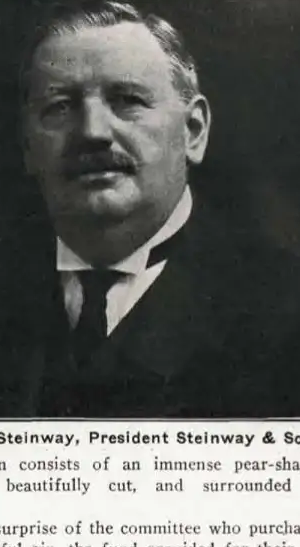
Charles H. Steinway is the least mythologized of the Steinways, and that is partly the point: he was the steward, not the founder, the man who took the wheel of an already-great American institution at the exact moment its towering creator died, and who held it on course for twenty-three years through prosperity, panic, and the most anti-German moment in American history [1][2]. When his uncle William Steinway died on November 30, 1896, William had been the public face, the salesman, the diarist, the rail and real-estate speculator who built a company town in Queens; the board met four days later, on December 4, 1896, and unanimously elected Charles H., then vice president and the firm's commercial brain, president of Steinway & Sons [2][4].
Charles had not arrived through charisma. He started at the firm on January 2, 1874, served nearly four years as an apprentice on the factory floor, and then moved into William's office, where his head for finance and detail made him indispensable; he was elected a vice president by 1880 [2][4]. By the time he succeeded William he had been doing the company's commercial work for two decades and knew the business, costs, dealers, artists, and accounts, better than anyone alive [2]. He was also, unusually for a piano executive, a genuine musician: a competent pianist and composer who had more than forty of his own compositions published [2].
His defining instinct was the marriage of the concert stage and the sales floor. It was Charles who, traveling in London in 1891, heard a young Polish virtuoso and cabled William that he had "played immense", and who pressed for the American tour that turned Ignacy Jan Paderewski into a sensation playing Steinways, the cornerstone of the artist-endorsement strategy the firm rode for a century [2]. The relationship was not always smooth: in 1906, when Paderewski complained that the instruments shipped to him were unsatisfactory, Charles took offense, called the complaint "offensive," and withdrew Steinways from the pianist, who decamped to Weber for a few seasons before returning, chastened, in 1909 [2].
Under Charles the firm reached its symbolic summit. In January 1903, in the company's fiftieth-anniversary year, Steinway presented its 100,000th piano, a gold-leaf, art-case grand decorated with the coats of arms of the thirteen original states, to the White House, where it would serve seven presidents from Theodore Roosevelt to Franklin Roosevelt before going to the Smithsonian [7]. But the market was turning underneath him. As cheaper rivals and the player-piano boom crowded the field, Charles cut prices on top-line instruments and pushed lower-priced models; sales nearly doubled by 1906 and reached roughly 3,700 units in 1909, when American piano output peaked at over 365,000 instruments a year [6].
Then came the war that targeted his very name. Steinway was an American firm with deep German roots, a Hamburg factory, and a German-speaking family; during World War I, with anti-German hysteria at its peak, the company bought Liberty Bonds, paid hundreds of thousands in wartime excess-profits taxes, and demonstrated its Americanism while losing contact with Hamburg [3]. The firm survived, it still turned a net profit reported around $520,000 in the war years, but its share of a shrinking, consolidating market collapsed from about 3.7 percent in 1909 to under 1.5 percent by 1919 [6]. Charles H. Steinway died suddenly on October 30, 1919, at his apartment in the Sherman Square Hotel, having been stricken the day before [2][5]. The torch passed to his brother Frederick T. Steinway, who had spent three decades running manufacturing [6].
Early Life & Path
Charles Herman Steinway was born June 3, 1857, in New York City, a grandson of the founder Heinrich Engelhard Steinweg, who had anglicized the name to Steinway on reaching America, and a son of the founder's son Charles G. Steinway, who died young in 1865 [2]. He grew up inside the orbit of the family enterprise during the years it was vaulting from immigrant workshop to the dominant American piano house, and the dominant figure of his youth was his uncle William, the dynamic younger son who ran the company's public and commercial life and kept the famous diary now held at the Smithsonian [2][8].
Rather than enter through privilege, Charles went in through the shop. He joined Steinway & Sons on January 2, 1874, at sixteen, and put in close to four years of apprenticeship learning how a piano was actually made, the forty-thousand-odd pieces, the year-long seasoning of wood, before William, recognizing his nephew's gift for numbers and order, brought him into the office [2][4]. There he became William's right hand on the commercial side, mastering the firm's costs, dealer network, and artist relations, and he was elected a vice president of the board by 1880 [2][4].
He was, in temperament, the opposite of the flamboyant William: methodical, financially exacting, and at home with the firm's books and its musicians alike. His genuine musicianship, he played and composed, and published more than forty pieces, gave him an ear for the artists whose endorsements were the company's most valuable advertising, and it was in that role, scouting talent abroad, that he made his first lasting mark on the firm's fortunes [2].
Career Timeline
- 1857Born June 3 in New York City, grandson of founder Heinrich (Henry) E. Steinway [2].
- 1874Joins Steinway & Sons on January 2, beginning nearly four years as a factory apprentice [2][4].
- 1880Elected a vice president of Steinway & Sons after moving into William Steinway's office on the commercial side [2][4].
- 1891In London, hears the young Ignacy Jan Paderewski and cables William that he "played immense," urging an American tour [2].
- 1896William Steinway dies November 30; the board unanimously elects Charles H. president on December 4 [2][4].
- 1903In its 50th-anniversary year, Steinway presents the gold art-case 100,000th piano to the White House [7].
- 1906Cuts prices on top-line pianos and introduces lower-priced models, nearly doubling sales [6].
- 1906Withdraws Steinways from Paderewski after calling the pianist's complaint "offensive"; Paderewski plays Weber until 1909 [2].
- 1909Steinway output reaches about 3,700 pianos as U.S. piano production peaks above 365,000 units [6].
- 1914Marks his 40th anniversary with the firm at a celebratory dinner at Lüchow's, showered with gifts from employees in New York, London, and Hamburg [2].
- 1917–1918Through World War I and anti-German hysteria, the firm buys Liberty Bonds and pays heavy excess-profits taxes while cut off from Hamburg [3].
- 1919Market share has fallen from ~3.7% (1909) to under 1.5% as the player-piano boom and consolidation reshape the trade [6].
- 1919Dies suddenly October 30 at the Sherman Square Hotel, New York; succeeded by his brother Frederick T. Steinway [2][5][6].
Key Ventures & Innovations
Succession to the presidency (1896)
Elected president four days after William's death, Charles inherited a firm at its zenith and a market about to turn. Having run the commercial side since the 1880s, he provided continuity at the dangerous moment when a founder-led company loses its founder [2][4].
The Steinway Artist strategy and Paderewski
Charles's 1891 cable that Paderewski "played immense" launched the tours that made the Pole a phenomenon on Steinways and entrenched the concert-endorsement model. His 1906 rupture with Paderewski, and the pianist's chastened return in 1909, showed both the power and the friction of tying a brand to temperamental stars [2].
The 100,000th piano and the White House (1903)
In the golden-jubilee year, the firm presented a gold-leaf art-case grand decorated with the arms of the thirteen original states to the Roosevelt White House. It served seven presidencies before entering the Smithsonian, the ultimate placement of Steinway as America's piano [7][10].
Price cuts and a broader line (1900s)
Facing cheaper competitors and the player-piano craze, Charles slashed prices on the top instruments and added lower-priced models, nearly doubling sales by 1906 and reaching about 3,700 units by 1909 [6].
Surviving World War I
With a German name, a Hamburg factory, and a German-American family, Steinway weathered wartime hysteria by buying Liberty Bonds and paying large excess-profits taxes, keeping the firm in good civic standing even as it lost touch with Hamburg and saw its market share fall sharply [3][6].
“played immense”
From the Record
“played immense”
“Charles Steinway, Head of Piano Firm, Dies at Home Here”
What Operators Can Learn
- 01
Stewardship is its own kind of founding
Charles never invented anything as memorable as William's company town or the founder's patents, yet keeping a great institution intact and profitable through a founder's death, a market inversion, and a world war is a rarer skill than starting one.
- 02
Tie your brand to stars, and accept the volatility
The artist-endorsement model Charles championed gave Steinway unmatched prestige, and also gave it the Paderewski feud. Borrowed glamour comes with borrowed temperament; the relationship has to be managed, not just won.
- 03
Defend the franchise when the market moves
Confronted by cheap rivals and player pianos, Charles cut prices and widened the line rather than stand on dignity. It bought time and volume, even as the whole category eventually shrank around him.
- 04
Identity can become a liability overnight
A proudly German-rooted name was an asset for decades and a hazard in 1917. Charles's wartime patriotism, bonds, taxes, visible Americanism, was a reminder that a company sometimes has to actively defend the very identity that built it.
Legacy
Charles H. Steinway's legacy is the continuity itself. He took a family firm at the instant it could have fractured, its founder dead, its finances strained, its market on the cusp of a long decline, and he kept it whole, prestigious, and solvent for more than two decades, handing his brother Frederick a going concern rather than a wreckage [2][6]. The institutions he reinforced outlasted him: the Steinway Artist program he helped invent with the Paderewski tours still anchors the company's marketing, and the gold White House grand he presented in 1903 made Steinway, in the public mind, simply the American piano [2][7].
He also embodies the limits of stewardship in a turning market. The numbers tell the harder story, a market share that fell from roughly 3.7 percent in 1909 to under 1.5 percent by 1919 as player pianos, consolidation, and war reshaped the trade [6]. Charles managed the decline with skill but could not reverse a structural tide, and the firm that emerged from World War I was smaller and more vulnerable than the one he inherited [3][6].
That his name is now the faintest of the famous Steinways is itself instructive. The records that document him sit in the Smithsonian's Steinway & Sons collection and the LaGuardia and Wagner Archives at LaGuardia Community College, where Henry Z. Steinway deposited the family and business papers in 1985, the raw material from which Richard Lieberman and D. W. Fostle reconstructed a dynasty in which the quiet, capable middle manager who held it all together in the worst possible decade has only lately begun to get his due [1][3][4][9].
Further Reading
Steinway and Sons, Richard K. Lieberman (1995)
The definitive scholarly history, the first built on the Steinway business and family papers at the LaGuardia and Wagner Archives, essential on the leadership era after William.
The Steinway Saga: An American Dynasty, D. W. Fostle (1995)
A sweeping, document-rich narrative of the family's rivalries, technology, advertising, and labor wars across generations.
Steinway, Ronald V. Ratcliffe (1989)
An accessible, richly illustrated history of the company and its instruments, good as a first overview.
Giraffes, Black Dragons, and Other Pianos: A Technological History from Cristofori to the Modern Concert Grand, Edwin M. Good (1982)
Places Steinway's technical achievements in the long arc of piano-building that the firm came to dominate.
Piano 300: Celebrating Three Centuries of People and Pianos, Cynthia Adams Hoover, Patrick Rucker, and Edwin M. Good (2001)
Smithsonian exhibition companion that situates the Steinway artist-and-concert strategy within American musical culture.
Sources
- 1.Richard K. Lieberman, Steinway and Sons, Yale University Press, 1995, book
- 2.The William Steinway Diary: 1861–1896, “Charles Herman Steinway (annotation)”, Smithsonian Institution, National Museum of American History, archive
- 3.“1917, Steinway & Sons in World War I (Liberty Bonds, excess-profits taxes, Hamburg cut off)”, Steinway History, 2017
- 4.“Steinway & Sons Collection (papers donated by Henry Z. Steinway, 1985; scope 1848–1990s)”, LaGuardia and Wagner Archives, LaGuardia Community College, CUNY, archive
- 5.“"Charles Steinway, Head of Piano Firm, Dies at Home Here" (obituary)”, New-York Tribune, October 31, 1919, p. 8, newspaper
- 6.“Steinway Musical Properties, Inc., company history (sales, prices, market share 1896–1919)”, International Directory of Company Histories, via Encyclopedia.com
- 7.“Treasures of the White House: Steinway Grand Piano (the gold 100,000th piano, presented January 1903)”, White House Historical Association, archive
- 8.The William Steinway Diary: 1861–1896, “Charles H. Steinway and Paderewski ("played immense" cable, 1891)”, Smithsonian Institution, National Museum of American History, archive
- 9.D. W. Fostle, The Steinway Saga: An American Dynasty, Charles Scribner's Sons, 1995, book
- 10.Ronald V. Ratcliffe, Steinway, Chronicle Books, 1989, book
Researched and written with Claude + live web search.