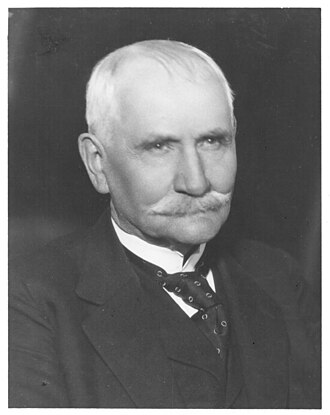
Overview
Charles Albert Coffin built nothing you could patent. He drew no circuits, filed no claims, and by his own cheerful admission could not explain what electricity actually was [4]. What he understood better than almost anyone of his age was that the great problem of the new electrical industry was not invention, there were geniuses enough, but organization: how to finance it, sell it, defend its patents, and assemble the men who could do the rest [2][3]. Out of a shoe factory in Lynn, Massachusetts, he built that machine, and in 1892 he ran it straight over Thomas Edison's company and absorbed it [1][7].
The instrument was the Thomson-Houston Electric Company, which Coffin and a syndicate of Lynn shoe men bought, financed, and moved to Massachusetts in the early 1880s, hiring the inventor Elihu Thomson to supply the science while Coffin supplied everything else [2][6]. Coffin's signature innovation was financial and commercial rather than technical: to sell central-station equipment to cash-poor utilities, Thomson-Houston took payment partly in the stock and bonds of the very companies it was electrifying, turning the manufacturer into the banker of its own customers [2][3]. By 1892 the firm had grown to roughly $10 million in annual sales and some 4,000 employees, and, crucially, it earned more money and a higher return on capital than Edison's larger, more famous operation [1][6].
That asymmetry decided the most consequential merger in American industrial history. When J. P. Morgan moved in 1892 to combine the warring electrical giants and end the ruinous patent litigation between them, due diligence found Edison General Electric the bigger name but the weaker business [1][7]. The new company that emerged on April 15, 1892, was capitalized in the tens of millions, incorporated in New York, and named simply General Electric, Edison's name struck from the title, with Charles A. Coffin, the shoe man, installed as its first president [1][7][8]. Edison attended a single board meeting and sold out his shares by 1894 [7].
Coffin's nerve was tested almost at once. The Panic of 1893 nearly destroyed the infant company: GE was choking on the unsalable utility securities it had taken in payment, and a cash shortage threatened its survival [1][3]. Coffin negotiated a rescue under which New York banks advanced cash against the pledged utility stocks, and GE survived the depression that killed many of its rivals [1][3]. Having learned the lesson, he and Westinghouse later ended their mutually destructive patent war by pooling their key patents into a cross-licensing duopoly that stabilized the whole industry [1].
His most enduring bet was on knowledge itself. In 1900, urged by the brilliant mathematician Charles Proteus Steinmetz and his manufacturing chief Edwin W. Rice, Coffin authorized a permanent research laboratory at Schenectady under the chemist Willis R. Whitney, the first true industrial research laboratory in the United States, and the model every American corporation would eventually copy [4][5]. He governed not by command but by cultivation, insisting on calling the men around him "my associates," not subordinates, and treating the building of an organization as a creative act in its own right [3].
When Coffin stepped down as president in 1912 and as chairman in 1922, he handed Owen D. Young and Gerard Swope a company that had grown many times over and would dominate the American electrical century [8]. Thomas Edison, friend of Ford and Firestone, no easy judge of businessmen, called him "the most remarkable business man I have ever known" [4].
Early Life & Path
He was born December 31, 1844, in Fairfield, Maine, the son of Albert Coffin, a farmer, and Anstrus Hobby Varney [1]. There was nothing electrical, or even mechanical, in his upbringing; the Coffins were old New England stock, and the boy's path led not to a laboratory but to a tannery's end product. At about eighteen he went to Lynn, Massachusetts, then the shoe-making capital of America, to work for his uncle Charles E. Coffin in the shoe trade, where he spent some two decades learning to buy, sell, finance, and manage [1][2].
By his thirties he had his own firm, the shoe house of Coffin & Clough in Lynn, and a reputation as one of the shrewdest commercial minds in a town full of them [1]. It was this reputation, not any technical gift, that drew electricity to him. Around 1883 a fellow Lynn businessman, Silas A. Barton, brought him a struggling electric-equipment maker out of New Britain, Connecticut, and asked Coffin to finance it, lead it, and bring it to Lynn [1][2]. Coffin organized a syndicate of his shoe-manufacturing friends, bought the company, renamed it Thomson-Houston after its inventors Elihu Thomson and Edwin J. Houston, and installed it in a new works on Lynn's Western Avenue [1][2][6].
The division of labor that would define his career was set from the start: Elihu Thomson ran the model room and the science, Edwin Rice built and ran the factory, and Coffin built the business, selling the equipment, financing the customers, and recruiting the talent [2][6]. He was nearly forty, a career shoe merchant, when he made the unlikely leap that would put his name on the first great electrical corporation in the world [1][2].
Career Timeline
- 1844Born December 31 in Fairfield, Maine, son of a farmer [1].
- 1862Moves at about age eighteen to Lynn, Massachusetts, to enter his uncle's shoe business [1][2].
- 1872Marries Caroline Louise Russell on September 23; later a partner in the shoe firm Coffin & Clough [1].
- 1883Leads a syndicate of Lynn shoe men to buy and finance a struggling electric company, renamed Thomson-Houston and moved to Lynn [1][2].
- 1880sBuilds Thomson-Houston into a national power by selling central-station gear and taking utility stock and bonds as part payment [2][3].
- 1889Thomson-Houston equips Joel Hurt's electric streetcar line and power plants in Atlanta, Georgia [1].
- 1892On April 15, J. P. Morgan merges Thomson-Houston with Edison General Electric to form General Electric; Coffin becomes first president [1][7][8].
- 1893Steers GE through the Panic of 1893, pledging utility securities to New York banks for cash to survive [1][3].
- 1896GE and Westinghouse end their patent war by pooling key patents into a cross-licensing arrangement [1].
- 1900Authorizes the GE Research Laboratory at Schenectady under Willis R. Whitney, the first U.S. industrial research lab [4][5].
- 1912Steps down as president of General Electric after twenty years, becoming chairman of the board [1][8].
- 1922Retires as chairman, handing leadership to Owen D. Young; the Charles A. Coffin Foundation is endowed in his honor [3][8].
- 1926Dies July 14 at Locust Valley, New York, aged 81, among the wealthiest men of his era [1][4].
Key Ventures & Innovations
Thomson-Houston Electric Company (1883)
Coffin and his Lynn shoe-trade syndicate bought a failing electric maker, hired Elihu Thomson for the science, and built a $10-million-a-year enterprise, more profitable than Edison's, by mastering sales, finance, and organization rather than invention [1][2][6].
Financing the customer
To sell expensive central-station equipment to cash-strapped utilities, Thomson-Houston took payment partly in the stocks and bonds of those utilities. The strategy fueled explosive growth, and nearly sank GE when those securities froze in the 1893 panic [2][3].
The 1892 merger into General Electric
When Morgan combined the feuding electrical giants, Coffin's smaller-named but stronger Thomson-Houston effectively absorbed Edison General Electric. Edison's name was dropped, and the shoe man became president of the new General Electric Company [1][7][8].
The GE Research Laboratory (1900)
Persuaded by Steinmetz and Rice, Coffin funded a permanent corporate science lab under Willis R. Whitney at Schenectady, the first of its kind in America and the template for industrial R&D worldwide [4][5].
The Westinghouse patent pool
Rather than bleed in endless litigation, Coffin engineered a cross-licensing arrangement with arch-rival Westinghouse that ended the patent wars and gave the two firms a stabilizing duopoly over the industry's core technology [1].
“He was the most remarkable business man I have ever known.”
From the Record
“He was the most remarkable business man I have ever known. . . .”
“Thomas Alva Edison, intimate friend of Henry Ford and Harvey Samuel Firestone, spoke last week of another friend: "He was the most remarkable business man I have ever known. . . ."”
“[Awarded annually to] a railway company which during the year has made a distinguished contribution to the development of electric railway transportation for the convenience of the public and the benefit of the electrical industry.”
What Operators Can Learn
- 01
Organization can beat invention
Coffin never built a dynamo, yet his company swallowed Edison's. He proved that the decisive scarce resource in a young technical industry is not genius but the system that finances, sells, and assembles the genius.
- 02
Your growth engine can become your near-death machine
Taking utility securities as payment built Thomson-Houston fast, and nearly killed GE when those securities froze in 1893. The cleverest financing strategy carried a hidden balance-sheet risk that a panic exposed instantly.
- 03
Institutionalize discovery
By funding a permanent research lab instead of buying inventions one at a time, Coffin turned innovation from a lucky event into a repeatable corporate function, the single most copied idea he ever backed.
- 04
Lead by cultivation, not command
Calling his people "associates" and giving scientists room to fail, Coffin built loyalty and judgment into the organization itself, so the company could outlast any one leader, including him.
Legacy
Coffin's monument is not a device but a form of enterprise. General Electric under his hand became the prototype of the modern science-based corporation: professionally managed, financially sophisticated, defended by pooled patents, and fed by an in-house research laboratory that the rest of American industry spent the next half-century imitating [4][5]. The Schenectady lab he authorized in 1900 would in time produce Nobel laureates and a stream of products that justified his original bet that a company should own its own scientists [5]. He also seeded the company's leadership: the lawyer Owen D. Young, whom Coffin had spotted and recruited, succeeded him and carried GE to global stature [8].
His name outlasted him in metal and money. On his retirement in 1922 his associates endowed the Charles A. Coffin Foundation, later the seed of the GE Foundation, and established the Charles A. Coffin Award, which became the company's highest internal honor, alongside a Coffin Medal recognizing achievement in electric transportation [3][6]. When he died in 1926 he was one of the richest men in the world, his fortune built almost entirely from a company he had organized rather than invented [1][4].
History has been quieter about Coffin than about the inventors he employed, and that is itself the point. He belongs to a less glamorous lineage, the builders of institutions rather than machines, and stands as the answer to a question Edison never had to ask: who turns a workshop of brilliant ideas into a corporation that can carry them for a century? [2][4]
Further Reading
The Electrical Manufacturers, 1875–1900, Harold C. Passer (1953)
The definitive scholarly study of the early electrical industry; the best account of Coffin's Thomson-Houston as a business.
Men and Volts: The Story of General Electric, John Winthrop Hammond (1941)
The classic narrative company history, rich on the Lynn years, the 1892 merger, and the Schenectady lab.
Willis R. Whitney, General Electric, and the Origins of U.S. Industrial Research, George Wise (1985)
Authoritative history of the research lab Coffin authorized, the institution that became his most copied legacy.
Owen D. Young and American Enterprise: A Biography, Josephine Young Case and Everett Needham Case (1982)
Biography of Coffin's hand-picked successor, illuminating the management culture Coffin built at GE.
Networks of Power: Electrification in Western Society, 1880–1930, Thomas P. Hughes (1983)
Sweeping analysis of how the electrical systems Coffin's GE supplied reshaped the modern world.
Sources
- 1.Harold C. Passer, The Electrical Manufacturers, 1875–1900: A Study in Competition, Entrepreneurship, Technical Change, and Economic Growth, Harvard University Press, 1953, book
- 2.John Winthrop Hammond, Men and Volts: The Story of General Electric, J. B. Lippincott Company, 1941, book
- 3.Charles E. Wilson, Charles A. Coffin, 1844–1926: Pioneer Genius of the General Electric Company, Newcomen Society / General Electric Company, 1946, book
- 4.“"Business: Coffin" (obituary notice quoting Thomas A. Edison)”, TIME, July 26, 1926, newspaper
- 5.“General Electric Opens Research Laboratory (Schenectady, 1900), research starter”, EBSCO Research Starters / GE Research Laboratory history, 1900, archive
- 6.“"Science: Coffin Medal" (terms of the Charles A. Coffin Medal)”, TIME, 1929, newspaper
- 7.“Schenectady Electrical Handbook, The General Electric Company (formation and 1892 merger)”, Schenectady County Historical Society / schenectadyhistory.org, 1904, archive
- 8.Josephine Young Case and Everett Needham Case, Owen D. Young and American Enterprise: A Biography, David R. Godine, 1982, book
Researched and written with Claude + live web search.