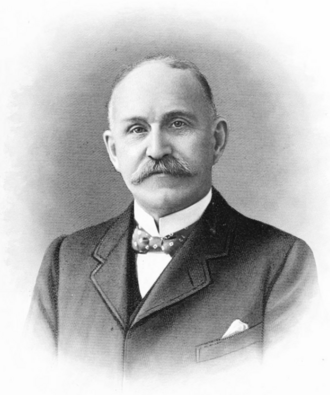
Overview
Andrew Woodbury Preston did not discover the banana, sail it north, or plant a single tree of it. What he did was rarer and more lasting: he saw, before almost anyone, that a perishable curiosity from the tropics could be made into a staple cheaper than the apple, and he bent shipping, refrigeration, advertising, and a sprawling Central American land empire around that single conviction [3][6]. When a Cape Cod schooner captain named Lorenzo Dow Baker began landing Jamaican bananas in New England in the 1870s, it was Preston, a clerk in a Boston produce house, who sold them on commission and grasped what Baker had not: the money was not in the cargo but in the system [1][6].
In 1885 Baker and Preston, with eight other backers, organized the Boston Fruit Company, Baker running the Jamaican plantations and steamers while Preston ran the selling end out of Boston [1][3]. Preston's instinct ran exactly opposite to the prevailing trade. Bananas had been a luxury sold dear in small lots; Preston meant to flood the market, high volume, low price, a fruit sold "up and down the economic scale" until it sat in every grocer's window [6]. To do that he had to conquer the banana's two great enemies, time and rot, by chartering faster ships, building ripening rooms, and eventually pioneering refrigerated ocean transport [3]. By the time Boston Fruit was incorporated in 1890 its investment had grown to roughly $531,000, and it was the most successful banana house in the country [1][3].
The decisive act of Preston's life came in 1899. Minor C. Keith, the Brooklyn-born railroad builder who had laid track across Costa Rica and planted bananas along it to fill his freight cars, was overextended and short of cash; he came to the Bostonians to merge [2][3]. On March 30, 1899, under New Jersey law, the United Fruit Company was incorporated with an authorized capital of $20 million [3]. Preston became president, Keith vice-president, and the marriage of Boston's ships and selling muscle to Keith's land and railroads produced, almost at a stroke, a colossus [2][3]. From 1900 to 1910 United Fruit handled well over three-quarters of all banana stems imported into the North American and European markets combined [3].
As president from 1899 until his death in 1924, Preston built what came to be called the Great White Fleet, white-hulled steamers, refrigerated and reflective against the tropical sun, that carried bananas north and passengers, mail, and Caribbean cargo south [3]. In 1903 the chartered steamer Venus was rigged for refrigeration and opened, in the words of the company's authorized historians, "a new era in ocean transportation" [3]. On the selling side Preston was a marketing pioneer: recipe pamphlets, grocer education, coupons, and respectable advertising aimed at turning a faintly disreputable novelty into a wholesome household food, with the avowed ambition of making the banana more popular than the apple [6].
The same drive that built the empire seeded its darkest legacy. United Fruit's hunger for land, railroads, and political leverage in Honduras, Guatemala, Costa Rica, and Colombia made it the original "banana republic" power, a private government in green, later notorious for the 1928 Colombian banana massacre and the 1954 Guatemalan coup, both after Preston's time but rooted in the system he assembled [2][4][5]. Careful to dodge the antitrust hammer that had broken Standard Oil, Preston reputedly kept United Fruit below a controlling share of any one market and quietly fostered rivals, even ceding ground to the young Sam Zemurray, the immigrant "ripe" peddler who would one day swallow United Fruit itself [5][6].
Preston died on September 26, 1924, at his summer home in Swampscott, Massachusetts, still president of United Fruit and of a clutch of allied sugar, railroad, and radio companies [7][8]. He left behind the most powerful agricultural enterprise in the hemisphere and a fruit so cheap and ubiquitous it had stopped seeming exotic at all, which had been precisely the point [3][6].
Early Life & Path
He was born June 29, 1846, in Beverly Farms, Massachusetts, a North Shore village of fishermen and tradesmen [7]. The future of the tropical fruit trade began, improbably, in the New England shoe industry: in 1864, at eighteen, Preston entered a partnership with Augustus Williams to manufacture shoes in Beverly [1]. Illness ended that venture, and Preston turned to the produce trade, clerking for Boston commission houses, including, by various accounts, the respected firm of Seaverns & Co., where the perishable business of fruits and vegetables became his school [1][3].
It was there, in the 1870s, that he first handled the strange green bunches that Captain Lorenzo Dow Baker was bringing back from Jamaica. Baker's legend was already fixed: in 1870 he had loaded 160 bunches of bananas, bought for a shilling a bunch at Port Antonio, aboard his schooner and sold them eleven days later in Jersey City for two dollars a bunch, a profit that convinced him, as he supposedly put it, that "the first man who has ten acres of bananas will be rich" [1][2]. Baker had the supply and the daring; Preston, selling the fruit on commission in Boston, had the head for distribution, finance, and the patient logistics a perishable crop demanded [3][6].
In 1869 Preston had married Frances E. Gutterson; he would remain a Boston-area man his whole life, eventually keeping a summer place in Swampscott [7]. He was not an inventor or an explorer but an organizer, the rarer commercial gift, and when he and Baker formalized their partnership as the Boston Fruit Company in 1885, the modern banana business, and Preston's life's work, can fairly be said to have begun [1][3].
Career Timeline
- 1846Born June 29 in Beverly Farms, Massachusetts [7].
- 1864Enters a shoe-manufacturing partnership in Beverly with Augustus Williams; leaves the trade after falling ill, and turns to the Boston produce business [1].
- 1870Captain Lorenzo Dow Baker lands a cargo of Jamaican bananas, bought at a shilling a bunch, that sells in Jersey City at two dollars a bunch, the seed of the trade Preston will industrialize [1][3].
- 1885Preston and Baker, with eight other backers, organize the Boston Fruit Company; Baker runs Jamaica, Preston runs sales and shipping from Boston [1][3].
- 1890Boston Fruit Company is incorporated in Massachusetts, its investment grown to about $531,000, the leading banana house in the United States [1][3].
- 1899On March 30, the United Fruit Company is incorporated in New Jersey with $20 million authorized capital, merging Boston Fruit with Minor C. Keith's Central American railroads and plantations; Preston becomes president [2][3].
- 1900–1910United Fruit handles well over three-quarters of all banana stems imported into the North American and European markets combined [3].
- 1903The chartered steamer Venus is rigged for refrigeration, the first successful refrigerated banana ship, and United Fruit lists on the New York Stock Exchange [3].
- 1904United Fruit builds the El Central Preston sugar mill in Cuba, named for the president himself [9].
- 1905United Fruit's domination of the banana trade is essentially complete, it owns the most ships, the most land, and controls both supply and demand [6].
- 1910sPreston expands the white-hulled, refrigerated Great White Fleet to scores of steamers carrying fruit north and passengers, mail, and cargo south [3].
- 1924Dies September 26 at his summer home in Swampscott, Massachusetts, still president of United Fruit and of allied sugar, railroad, and radio companies [7][8].
Key Ventures & Innovations
Boston Fruit Company (1885)
The partnership of Preston (selling, finance, shipping from Boston) and Captain Lorenzo Dow Baker (Jamaican plantations and steamers) that turned the banana from a dockside novelty into a volume business. Incorporated in 1890 with an investment of roughly $531,000, it was the most successful banana company in America [1][3].
The United Fruit Company (1899)
Incorporated March 30, 1899, in New Jersey with $20 million authorized capital, joining Boston Fruit's ships and markets to Minor Keith's railroads and Central American land. Within a decade it controlled over three-quarters of the world banana trade, with Preston as president for life [2][3].
The Great White Fleet
Preston's refrigerated, white-painted steamer fleet, built to beat the banana's enemies of time and rot, that ruled Caribbean shipping. The 1903 refrigerated Venus, in the company history's words, opened "a new era in ocean transportation"; the ships also carried passengers, mail, and freight, becoming one of the largest private fleets afloat [3].
Manufacturing banana demand
Preston ran one of the first modern consumer-marketing campaigns in food: recipe booklets, grocer education, coupons, and respectable advertising to make a faintly disreputable fruit wholesome and ubiquitous, with the stated aim of overtaking the apple as America's favorite fruit [6].
Antitrust evasion and managed competition
Watching Standard Oil broken by the trustbusters, Preston reputedly kept United Fruit from openly controlling any single market outright and tolerated rivals, including the young Sam Zemurray's Cuyamel Fruit, a strategy that preserved the empire even as it nurtured the man who would eventually take it over [5][6].
“The first man who has ten acres of bananas will be rich.”
From the Record
“In 1870, Captain Lorenzo Dow Baker, commander of the fishing schooner Telegraph out of Wellfleet, Massachusetts, loaded as extra cargo 160 bunches of bananas purchased for a shilling a bunch at Port Antonio, Jamaica. Eleven days after the date of purchase the Telegraph docked in Jersey City, where the bananas sold at two dollars a bunch.”
“In 1903, the Venus, owned by the Weinbergers of New Orleans and chartered by United, was rigged up for refrigeration, and as the first successful refrigerated ship started a new era in ocean transportation.”
“After many efforts Mr. Preston finally induced nine men to join him in an association to promote the banana business with Boston as the port of entry. This association was formed in 1885. Mr. Preston and each of his nine associates advanced $2,000, giving this enterprise an original capital of $20,000.”
What Operators Can Learn
- 01
Own the system, not the cargo
Baker had the bananas and the nerve; Preston saw that the real prize was the chain that moved a perishable fruit from a Jamaican beach to a Boston grocer before it rotted. The fortune was in distribution, refrigeration, and finance, not in any single shipment.
- 02
Cut the price to enlarge the world
Preston inverted the luxury-fruit trade, from low volume and high price to high volume and cheap bananas sold to everyone. By manufacturing demand and slashing cost, he turned a curiosity into a staple, the same flywheel that built other mass-market empires.
- 03
Demand can be built, not just met
Recipe books, coupons, grocer education, and wholesome advertising created appetite where none had existed. Preston understood that a new product needs a story before it needs a market.
- 04
Stay just under the line that draws the trustbusters
Having watched Standard Oil dismembered, Preston preferred dominance that did not look like monopoly, tolerating rivals and avoiding open control of any one market. The discipline preserved the empire, even as it let a future conqueror grow.
Legacy
Preston's commercial legacy is the banana itself, so cheap, so constant, and so unremarkable that Americans long ago stopped thinking of it as a tropical import at all. He proved that a perishable crop could be engineered into a year-round staple through refrigeration, scheduled shipping, and aggressive demand-building, and in doing so he wrote an early playbook for the global agribusiness corporation: integrate the land, the transport, and the market under one roof and price for volume [3][6]. The Great White Fleet and the company's marketing machinery were studied and imitated for decades [3].
But the empire he assembled became a byword for something darker. United Fruit's grip on the land, railroads, ports, and politics of Honduras, Guatemala, Costa Rica, and Colombia gave the world the phrase "banana republic," and its later record, the 1928 massacre of striking workers in Colombia and its hand in the 1954 CIA-backed coup in Guatemala, turned the company into a symbol of Yankee imperialism, even though both episodes came after Preston's death [2][4][5]. The structures that made those abuses possible were nonetheless the ones he built.
His own name lingers quietly on the map and in the archive: the El Central Preston sugar town in Cuba, the letterpress copybooks and ledgers of the Boston Fruit Company preserved at Harvard's Baker Library, and the institutional DNA that passed from United Fruit to United Brands to today's Chiquita [3][9]. Preston is far less remembered than the fruit he sold, which, for a man who wanted bananas everywhere and himself nowhere in particular, may be the truest measure of his success.
Further Reading
The United Fruit Company in Latin America, Stacy May and Galo Plaza (1958)
The data-rich, company-access study by a War Production Board statistician and a former president of Ecuador, the best single source on early structure, capitalization, and the Great White Fleet.
The Fish That Ate the Whale: The Life and Times of America's Banana King, Rich Cohen (2012)
A vivid narrative of the banana business through Sam Zemurray, with the clearest popular account of how Preston, Baker, and Keith built United Fruit.
Bananas: How the United Fruit Company Shaped the World, Peter Chapman (2007)
A sweeping critical history of the company from its founding to the banana-republic interventions and beyond.
An American Company: The Tragedy of United Fruit, Thomas P. McCann (1976)
An insider's bitter memoir-history by a former United Fruit executive, invaluable on the corporate culture Preston founded.
Empire in Green and Gold: The Story of the American Banana Trade, Charles Morrow Wilson (1947)
The authorized, largely uncritical company history (Henry Holt), useful for early detail on Preston and Baker if read against the grain.
Banana: The Fate of the Fruit That Changed the World, Dan Koeppel (2008)
A biography of the fruit itself, strong on the biology and marketing that made the Gros Michel banana a mass commodity.
Sources
- 1.Frederick Upham Adams, Conquest of the Tropics: The Story of the Creative Enterprises Conducted by the United Fruit Company, Doubleday, Page & Company, 1914, book
- 2.Rich Cohen, The Fish That Ate the Whale: The Life and Times of America's Banana King, Farrar, Straus and Giroux, 2012, book
- 3.Stacy May and Galo Plaza, The United Fruit Company in Latin America, National Planning Association, 1958, pp. 4–6, 13, 18, book
- 4.Peter Chapman, Bananas: How the United Fruit Company Shaped the World, Canongate, 2007, book
- 5.Thomas P. McCann, An American Company: The Tragedy of United Fruit, Crown Publishers, 1976, book
- 6.Be Fruitful and Multiply (on the founding of the Boston Fruit Company and the banana trade), Caribbean Beat Magazine, Issue 162, 2020, journal
- 7.“Andrew Woodbury Preston (1846–1924), vital records, marriage, and death certification”, WikiTree, citing Vital Records of Beverly, Massachusetts and Massachusetts Death Records 1921–1924, 1924, archive
- 8.“"United Fruit Head Dies. Andrew W. Preston Veteran in Business World."”, Evening Star (Washington, D.C.), September 27, 1924, newspaper
- 9.“Boston Fruit Company records, 1891–1901 (incl. A. W. Preston letterpress copybook and private ledger)”, Baker Library Special Collections, Harvard Business School, archive
Researched and written with Claude + live web search.