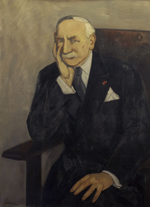
Overview
André Meyer did not run a household name, build a factory, or sign his work. He worked the way the most powerful financiers have always preferred to work, out of a hotel suite, by telephone, behind a curtain, and from that obscurity he reshaped how American companies were bought, sold, and put back together [1][6]. For roughly three decades from the mid-1940s, Meyer was the senior partner and animating force of Lazard Frères & Co. in New York, and he turned a small, capital-light private bank into what one historian called the most venturesome investment house in America [1][6].
His instrument was the deal itself. Where the great houses of the era underwrote securities and waited for fees, Meyer treated finance as a creative act, buying undervalued or tangled enterprises, restructuring their capital, and reselling them at a profit Lazard kept for itself [1][6]. The textbook case became legend: Lazard bought the Avis rent-a-car company for about $7 million and a few years later sold it to Harold Geneen's ITT for some $52 million in stock, helping ignite the conglomerate boom of the 1960s [2][6]. David Rockefeller called him "the most creative financial genius of our time in the investment banking field" [1][3].
Meyer's power, though, ran on something less quantifiable: access. He was a financial adviser and trustee to the Kennedys, helped manage Jacqueline Onassis's affairs, counseled William S. Paley of CBS and Katharine Graham of The Washington Post, and was used by Lyndon Johnson as an unofficial economic consultant [1][2][3]. He collected men of consequence the way he collected Cézannes and Monets, deliberately, and for what they could yield [1][2].
The portrait that survives, drawn most fully in Cary Reich's biography, is not a flattering one. Meyer could be, in Reich's own catalogue, duplicitous, a schemer, vindictive, cynical, opportunistic, greedy, and a bully [1][5]. He treated his partners as clerks, berated them in public, and summoned them to early-morning and midnight meetings [1][5]. He amassed a personal fortune that Reich estimated at more than $500 million, and he trusted almost no one [1][5].
Yet the methods outlasted the man. The leveraged purchase, the friendly merger engineered for a fee, the banker as confidential adviser to titans rather than mere underwriter, these are the everyday furniture of modern Wall Street, and Meyer did as much as anyone to put them there [1][6]. His protégé Felix Rohatyn, who would later rescue New York City from bankruptcy, learned the trade at Meyer's elbow and called him his mentor [1][6][7]. The age of the deal-maker that followed, the M&A boom, the rise of the adviser, is in large part André Meyer's inheritance [1][6].
They called him the Picasso of banking, and like Picasso he reshaped his medium so completely that those who came after could not imagine it any other way [3].
Early Life & Path
He was born André Benoît Mathieu Meyer on September 3, 1898, in Paris, into a poor Jewish family [1][3]. His father, by Cary Reich's account, was an inveterate gambler who left a vacuum at the head of the household, and the burden of providing fell early onto André [1]. He left school at sixteen and went to work as a runner on the Paris Bourse, learning the markets from the floor up rather than from any university [1][3]. The trading floor was his education, and the lesson he absorbed there, that information, nerve, and timing beat pedigree, never left him [1].
He rose quickly. After the First World War he worked at a small Paris house, Baur & Fils, and his evident talent drew the attention of Raymond Philippe, a partner at the old and aristocratic firm of Lazard Frères, who arranged an offer [1][3]. Meyer joined Lazard in 1925 and was made a partner within about a year, an extraordinary ascent for an outsider with no family money and no schooling [1][3]. In the late 1920s he organized SOVAC, a consumer-credit company that pioneered installment financing for automobiles in France, and from 1927 he helped lead the rescue and reorganization of the foundering carmaker Citroën, work for which France made him a chevalier of the Legion of Honor [3].
Then history nearly erased him. As a Jew in a France about to fall to Germany, Meyer fled ahead of the Nazi occupation, reaching the United States in 1940 with his wife, Bella Lehman, and their children and taking over Lazard's small New York operation alongside the senior partner Pierre David-Weill [1][2][3]. He arrived a refugee in a country where he was barely known; he became an American citizen in 1948 [3]. The man who had begun as a messenger on the Bourse would, within a few years of landing in Manhattan, take command of Lazard's New York house and never relinquish it [1][6].
Career Timeline
- 1898Born André Benoît Mathieu Meyer on September 3 in Paris, into a poor Jewish family [1][3].
- 1914Leaves school around age sixteen to work as a runner on the floor of the Paris Bourse [1][3].
- 1925Recruited to Lazard Frères in Paris by partner Raymond Philippe; made a partner within about a year [1][3].
- late 1920sOrganizes the consumer-credit firm SOVAC and helps reorganize the failing carmaker Citroën; later made a chevalier of the Legion of Honor [3].
- 1940Flees Nazi-occupied France with his family and takes charge of Lazard Frères & Co. in New York [1][2][3].
- 1943–1944Consolidates leadership of Lazard's American house, the post he will hold for more than three decades [1][6].
- 1948Becomes a naturalized United States citizen [3].
- 1951Lazard buys the 800,000-acre Matador Land and Cattle Company for about $18.9 million and breaks it up, an early, audacious asset-restructuring play [1][6].
- 1962Lazard takes control of the Avis rent-a-car company for roughly $7 million [2][6].
- 1965–1966Sells Avis to ITT for about $52 million in stock, helping touch off the conglomerate era; protégé Felix Rohatyn joins ITT's board [2][6].
- 1960sBuilds Lazard into a leading U.S. mergers firm and advises the Kennedys, Jacqueline Onassis, William Paley, Katharine Graham, and President Johnson [1][2][3].
- 1968Profiled in Time as Lazard recruits three senior federal officials as partners, a showcase of Meyer's web of contacts [4].
- 1979Dies September 9 at a hospital in Lausanne, Switzerland, at 81; buried in Paris [2][3].
- 1980The Metropolitan Museum of Art opens galleries named for him, drawn from his collection of 19th-century European art [8].
Key Ventures & Innovations
Rebuilding Lazard Frères in New York
Taking over the New York house in the early 1940s, Meyer transformed a genteel old private bank into the most venturesome investment firm in America, financing everything from Texas ranchland to New York real estate and, above all, the corporate mergers of the postwar boom [1][6].
The Avis–ITT play (1962–1966)
Lazard took control of Avis for about $7 million, professionalized it, and sold it to Harold Geneen's ITT for roughly $52 million in stock, a defining demonstration of buy-fix-sell finance that helped launch the 1960s conglomerate boom [2][6].
The Matador Ranch breakup (1951)
Lazard paid about $18.9 million for the Scottish-owned, 800,000-acre Matador Land and Cattle Company, then put it into liquidation and parceled the land and cattle among newly formed corporations, pure asset restructuring [1][6].
Confidential adviser to the powerful
Meyer made himself indispensable to the people who ran America: trustee and adviser to the Kennedys, counsel to Jacqueline Onassis, banker to CBS's William Paley and The Washington Post's Katharine Graham, and an economic consultant to Lyndon Johnson [1][2][3].
Training the next generation of deal-makers
Meyer's demanding shop produced Felix Rohatyn, who brokered ITT's acquisitions, later saved New York City from bankruptcy, and credited Meyer as the mentor who made his career possible [1][6][7].
“Life is a discipline.”
From the Record
“I have to see men for business reasons. But I don't like men. They have no courage. All my friends are now women. They have more courage.”
“the most creative financial genius of our time in the investment banking field.”
“Andre Meyer, the French-born senior partner of Lazard Freres & Co., was a former economic consultant to President Johnson and an adviser to Jacqueline Onassis and a trustee of the late Joseph P. Kennedy's estate.”
What Operators Can Learn
- 01
The deal is the product
Meyer proved a small partnership with little capital could dominate Wall Street if its real inventory was ideas and relationships. He sold restructuring and judgment, not money, and built an empire on advice.
- 02
Buy the overlooked, fix it, then sell the story
Avis was a tired rental company until Lazard professionalized it and reframed it for a buyer hungry to grow. Meyer's genius was seeing the value an asset would have in someone else's hands.
- 03
Access is the asset
His real franchise was not money but proximity: to presidents, publishers, and heiresses who trusted him with their fortunes. The confidential adviser to the powerful can shape events no balance sheet captures.
- 04
Brilliance and cruelty are not opposites
He was a financial genius who treated partners as clerks and trusted almost no one. The same ferocity that built the firm also made it a place people feared, a reminder that fear is an expensive way to lead.
Legacy
André Meyer's deepest legacy is the modern advisory investment bank itself. By making Lazard, small, private, lightly capitalized, into the most influential deal house in America, he showed that the future of Wall Street lay in intellect, relationships, and the fee-earning art of the merger, not in the size of a firm's balance sheet [1][6]. The mergers-and-acquisitions business that exploded in the decades after him, and the celebrity deal-maker as a type, descend directly from his example. His protégé Felix Rohatyn carried the method into public life, using it to pull New York City back from the edge of bankruptcy in the 1970s [1][6].
The human ledger is harder to balance. He amassed a fortune Reich put at more than $500 million and assembled a museum-grade collection of Cézanne, Monet, and other masters that endowed galleries at the Metropolitan Museum of Art after his death [1][8]. He was a philanthropist to Mount Sinai Medical Center and to Israel's Technion [3]. Yet the same biographer judged that, for all his genius, greatness eluded him, that a certain narrowness of spirit, in which the bottom line always carried a dollar sign, kept him from inspiring the people around him [5].
He died in September 1979 in a Swiss hospital and was buried in Paris, near his old partner Pierre David-Weill, a refugee who had arrived in New York almost unknown and left as the most powerful private banker of his age [2][3].
Further Reading
Financier: The Biography of André Meyer, Cary Reich (1983)
The definitive, deeply reported biography, unflinching on Meyer's genius and his cruelty alike, and the foundation for everything written since.
The Last Tycoons: The Secret History of Lazard Frères & Co., William D. Cohan (2007)
A National Book Award–winning inside history of Lazard that places Meyer at the center of the firm's culture of deal-making and intrigue.
Dealings: A Political and Financial Life, Felix Rohatyn (2010)
Memoir by Meyer's most famous protégé, with firsthand portraits of life under his demanding mentor at Lazard.
Memoirs, David Rockefeller (2002)
Includes Rockefeller's appraisal of Meyer as the most creative financial genius of his time in investment banking.
Sources
- 1.Cary Reich, Financier: The Biography of André Meyer, A Story of Money, Power, and the Reshaping of American Business, William Morrow & Co., 1983, book
- 2.“Andre Meyer, N.Y. Investment Banker, Philanthropist, Dies”, The Washington Post, September 11, 1979, newspaper
- 3.“Andre Meyer Dead at 81 (former senior partner of Lazard Frères)”, Jewish Telegraphic Agency, September 12, 1979, newspaper
- 4.Business: Meyer's Triple Play, Time, 1968, journal
- 5.“Yes, Mr. Meyer (review of Cary Reich's Financier)”, The Christian Science Monitor, December 2, 1983, newspaper
- 6.William D. Cohan, The Last Tycoons: The Secret History of Lazard Frères & Co., Doubleday, 2007, book
- 7.Felix Rohatyn, Dealings: A Political and Financial Life, Simon & Schuster, 2010, book
- 8.“The André Meyer Galleries (19th-century European paintings), The Metropolitan Museum of Art”, The Metropolitan Museum of Art, 1980, archive
Researched and written with Claude + live web search.