Overview
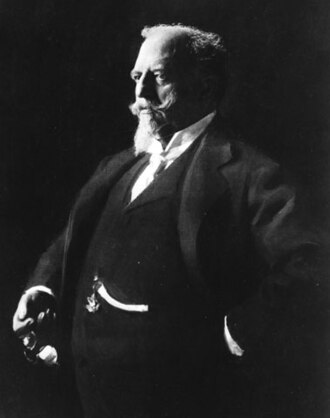
Adolphus Busch did not invent lager, pasteurization, or the railroad refrigerator car, and he did not even found the brewery that bears half his name [1][4]. What he did was rarer: he saw that a perishable, intensely local product could be made into a national one if you controlled the entire chain that carried it, the science that kept it from spoiling, the cars that moved it cold, the salesmen and saloons that sold it, and the advertising that made a German immigrant's lager into an American household word [1][4]. He arrived in St. Louis in 1857 as the well-schooled son of a Rhineland merchant, married into a struggling brewery, and over four decades turned roughly 4,000 barrels a year into the largest brewing operation on earth [4].
The brewery was his father-in-law's. Eberhard Anheuser, a soap manufacturer, had taken over the insolvent Bavarian Brewery; Adolphus, who married Anheuser's daughter Lilly in 1861 and had been supplying the trade with hops and malt, bought into it in the mid-1860s and supplied the ambition his father-in-law lacked [4]. He grasped, earlier than most American brewers, what Louis Pasteur's work meant for a business built on a living, spoiling product. By the early 1870s he was pasteurizing bottled beer so it could survive heat and time; in 1876 he put the first fleet of refrigerated railcars to work hauling beer out of St. Louis, and built ice houses along the lines to keep it cold [1][4]. Unpasteurized beer had been a tavern's local prisoner; Busch turned it into freight.
The brand was, fittingly, a collaboration and then a conquest. In 1876 a St. Louis liquor importer named Carl Conrad contracted with the brewery to make a light, Bohemian-style lager he called Budweiser; when Conrad went bankrupt in 1882 owing the brewery some $94,000, Busch took the trademark for himself [4][7]. He drove its sales with a marketing apparatus that was decades ahead of the trade: an army of salaried, territory-managed salesmen; lavish saloon point-of-sale displays; and giveaways stamped with his own likeness, most famously a pocketknife-corkscrew and lithographed copies of the gory battle painting Custer's Last Fight, which he distributed by the million and which Time would later call one of the most famous pictures in America [4][7][8]. The credo, later borrowed as a company-history title, was "making friends is our business" [3].
By 1901 Anheuser-Busch was the largest brewer in the United States, having passed a million barrels a year; the company's name had been formalized as the Anheuser-Busch Brewing Association in 1879, the year before Eberhard Anheuser died and Busch took full command [4]. Busch himself lived like the German-American "Prince" his friends called him, a private railcar named the Adolphus, mansions in St. Louis, Pasadena, Cooperstown and the Rhineland, and a friendship that ran to Presidents Roosevelt and Taft and to Kaiser Wilhelm II [4]. He drank wine, not his own beer, which he reportedly dismissed in his accent as "dot schlop" [1].
He was also, ahead of his time, a labor pragmatist: in 1891, facing an American Federation of Labor boycott, Anheuser-Busch became among the first major brewers to sign with a union, and in 1910 Busch set up a "happiness fund" for worker entertainment, pensions and relief [4][5]. The shadow over all of it was the gathering prohibition movement, which Busch fought as an existential and, given the anti-German tenor of the temperance crusade, a personal threat [4]. He died in 1913, before national Prohibition arrived in 1920 to nearly destroy the industry he had nationalized, leaving an estate of roughly $60 million, then the largest ever probated in Missouri, and a template for the modern consumer brand [4][6].
Early Life & Path
He was born July 10, 1839, in Kastel, near Mainz, in the grand duchy of Hesse-Darmstadt, the twenty-first of the twenty-two children of Ulrich Busch, a wealthy Rhine River merchant with timber, vineyard and hospitality interests, and Barbara Pfeifer Busch [4]. It was a prosperous, crowded household that gave Adolphus an education far above that of the average emigrant: gymnasium in Mainz, an academy in Darmstadt, French in Brussels, and a stint clerking in a Cologne shipping house, where he learned the river trade [4]. His father died in 1852, when Adolphus was a boy of thirteen; by 1857, at eighteen, he had used a share of the inheritance to follow several brothers to America [4].
He landed at New Orleans and made his way up the Mississippi to St. Louis, already one of the great German immigrant cities of the republic, its population multiplying as the breweries multiplied with it [4]. He worked first as a clerk and a "mud clerk" on the river steamers, assessing cargo, then in 1859 went into business with Ernst Wattenberg supplying brewers, the hops, malt and barley trade, which taught him both the chemistry and the customers of the industry he would come to dominate [4]. He was naturalized in 1867 [4].
The turn came through marriage. On March 7, 1861, Adolphus married Lilly Anheuser, daughter of Eberhard Anheuser, in a double ceremony in which his brother Ulrich married Lilly's sister Anna; the groom, characteristically, arrived twenty minutes late because he was closing a deal [4]. Eberhard Anheuser had recently taken control of the foundering Bavarian Brewery, a small concern producing only a few thousand barrels a year. Adolphus, the supplier-turned-son-in-law, bought a half interest in the mid-1860s, securing, the histories record, a $50,000 loan from the St. Louis banker Robert A. Barnes after more cautious lenders had judged him too extravagant a risk, and went to work transforming it [4]. He was in his twenties, and the brewery that would carry his name to every corner of America was making 4,000 barrels a year [4].
Career Timeline
- 1839Born July 10 in Kastel, near Mainz, Hesse-Darmstadt, the twenty-first of twenty-two children of a wealthy Rhineland merchant [4].
- 1857Emigrates to America at eighteen, landing at New Orleans and settling in St. Louis [4].
- 1861Marries Lilly Anheuser on March 7, tying himself to her father Eberhard Anheuser's struggling Bavarian Brewery [4].
- 1865Buys a half interest in the brewery, then producing about 4,000 barrels a year, with a $50,000 loan from banker Robert A. Barnes [4].
- 1872–1873Adopts Pasteur's science to pasteurize bottled beer for stability and long-distance shipping [1][4].
- 1876Launches the first fleet of refrigerated railcars for beer; Carl Conrad contracts the brewery to make Budweiser [1][4].
- 1879Company is formally named the Anheuser-Busch Brewing Association [4].
- 1880Eberhard Anheuser dies; Busch takes full control of the company [4].
- 1882Carl Conrad goes bankrupt owing the brewery about $94,000; Busch acquires the Budweiser trademark [4][7].
- 1891Anheuser-Busch is among the first major brewers to sign an agreement with a labor union after an AFL boycott [4][5].
- 1896Introduces Michelob as a premium draught brand [4].
- 1901Output passes one million barrels a year, making Anheuser-Busch the largest brewer in the United States [4].
- 1910Establishes a worker 'happiness fund' for entertainment, pensions and relief, while fighting the rising prohibition movement [4][5].
- 1913Dies October 10 at Villa Lilly in Germany; his St. Louis funeral draws a city-wide five-minute silence and an estate of roughly $60 million [4][6].
Key Ventures & Innovations
Pasteurized, bottled beer (early 1870s)
Reading Louis Pasteur's work on fermentation as a business problem, Busch applied heat treatment to bottled beer so it would survive temperature swings and time, converting a perishable tavern product into something that could be shipped, stored, and sold under a brand name far from the brewery [1][4].
The refrigerated railcar network (from 1876)
Busch fielded the first fleet of refrigerated railcars for beer and built ice houses along the routes; the fleet grew from five cars to forty by 1882 and into the hundreds, creating the physical infrastructure of a national, rather than local, brewery [1][4].
Budweiser (1876, acquired 1882)
First brewed under contract for the importer Carl Conrad as a light Bohemian-style lager; when Conrad failed in 1882 owing some $94,000, Busch took the trademark outright and built it into the first truly national American beer brand [4][7].
The national sales-and-advertising machine
Salaried, territory-managed salesmen; saloon point-of-sale displays; and promotional giveaways stamped with Busch's likeness, the pocketknife-corkscrew and over a million lithographs of the painting Custer's Last Fight, under the credo 'making friends is our business' [3][4][8].
Vertical integration
Busch controlled the chain around the beer: the Adolphus Busch Glass Manufacturing Company, the Manufacturers Railway Company (1887), refrigerator-car operations, cooperage and an on-site malt house, owning the inputs and the logistics, not just the brew [4].
“Only by fair, sociable and liberal treatment can you create a lasting attachment between brewery and its trade.”
From the Record
“Only by fair, sociable and liberal treatment can you create a lasting attachment between brewery and its trade... A large plant with only trade to consume one half to three quarters of its capacity in output is bound to run into bankruptcy; therefore the most valuable assets we possess in our brewery are our trade and the loyalty of all those with whom we are in business connection.”
“I wish we might have the pleasure of seeing you here in St. Louis again, so we could have the opportunity of showing you the greatest and largest brewery in America, in which you were once half owner.”
What Operators Can Learn
- 01
Sell the system, not the product
Beer was a commodity; what Busch built was everything around it, pasteurization to preserve it, refrigerated cars to move it, salesmen and ads to pull it through. The defensible business was the chain, not the recipe.
- 02
Treat science as a competitive weapon
Pasteur's lab work was, to most brewers, academic news. Busch read it as a way to break the geographic prison of a perishable good, and got years of advantage by acting on research his rivals merely admired.
- 03
A brand is a relationship you maintain
'Making friends is our business' was not sentiment. The loyalty of saloon-keepers and distributors was, in Busch's own words, the brewery's most valuable asset, cultivated with fair dealing, constant contact, and relentless promotion.
- 04
Buy the inputs before someone else controls them
Glass, railcars, ice, malt, cooperage, Busch integrated backward so that no supplier could throttle his growth or his margins. Owning the bottleneck is cheaper than fighting it.
Legacy
Adolphus Busch's real invention was not a beer but a method: take a local, perishable good, wrap it in preservation science, refrigerated logistics, professional selling and saturation advertising, and you can make it a national brand owned by a single company [1][4]. That template, built in St. Louis in the 1870s and 1880s, became the blueprint for the modern consumer-goods business, and Budweiser remains one of its most enduring monuments [4][7]. By the time he died in 1913, the brewery was the largest on earth and his estate, near $60 million, was the biggest ever probated in Missouri [4][6].
The verdict is shadowed by what came after. National Prohibition, which Busch had fought as both a business and an anti-German threat, arrived in 1920 and nearly destroyed the industry he had unified; the company survived on yeast, malt syrup and soft drinks until repeal [4][7]. The dynasty he founded ran the company for nearly a century and a half, through his son August A., who killed himself in 1934, and his grandson Gussie, who made it the undisputed national leader, until the Belgian-Brazilian InBev bought Anheuser-Busch in 2008 for roughly $52 billion, ending Busch family control [7].
His philanthropy outlived the dynasty: the Busch-Reisinger Museum at Harvard, the Busch laboratories and large gifts to Washington University's medical school, and earthquake relief for San Francisco in 1906 all trace to him [4]. So does the figure of the immigrant industrialist as civic prince, the man his friends called 'the Prince,' who built an American empire on German science and salesmanship and then handed it the future of national branding [4][6].
Further Reading
Bitter Brew: The Rise and Fall of Anheuser-Busch and America's Kings of Beer, William Knoedelseder (2012)
The most readable modern narrative of the dynasty, from Adolphus through the 2008 InBev sale, strong on family and business drama.
Under the Influence: The Unauthorized Story of the Anheuser-Busch Dynasty, Peter Hernon and Terry Ganey (1991)
A detailed, well-sourced investigative history of the family and company; quotes primary correspondence including Busch's own letters.
Making Friends Is Our Business: One Hundred Years of Anheuser-Busch, Roland Krebs with Percy J. Orthwein (1953)
The company's authorized centennial history, celebratory, but rich with internal detail on Adolphus Busch's innovations and methods.
Ambitious Brew: The Story of American Beer, Maureen Ogle (2006)
A scholarly, lively history of American lager that sets Busch and Anheuser-Busch in the wider rise (and fall) of the brewing industry.
Breweries of St. Louis: Two Centuries of the Brewing Industry, Carl Miller (1995)
Local history grounding the Busch story in the German-American brewing capital that made it possible.
Sources
- 1.Peter Hernon and Terry Ganey, Under the Influence: The Unauthorized Story of the Anheuser-Busch Dynasty, Simon & Schuster, 1991, p. 28, book
- 3.Roland Krebs with Percy J. Orthwein, Making Friends Is Our Business: One Hundred Years of Anheuser-Busch, Anheuser-Busch / Cuneo Press, 1953, book
- 4.Timothy J. Holian, "Adolphus Busch" (scholarly biographical entry), Immigrant Entrepreneurship, German Historical Institute, 2013, journal
- 5.“Adolphus Busch (Historic Missourians)”, The State Historical Society of Missouri, 2016, archive
- 6.“"Adolphus Busch Dies in Prussia"”, The New York Times, October 11, 1913, newspaper
- 7.William Knoedelseder, Bitter Brew: The Rise and Fall of Anheuser-Busch and America's Kings of Beer, HarperBusiness, 2012, book
- 8.“"Corporations: The Baron of Beer"”, Time, 1955, newspaper
- 9.“Adolphus Busch | German Immigrant, Beer Innovator”, Britannica Money, 2024
Researched and written with Claude + live web search.