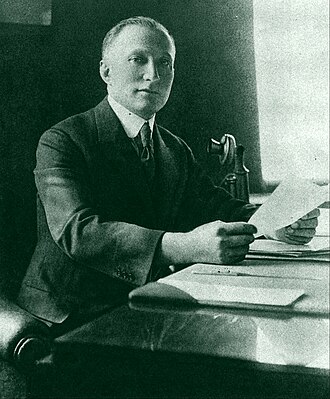
Overview
Adolph Zukor did not invent the motion picture, the feature film, or the movie star. What he did, with a furrier's eye for value and an immigrant's appetite for risk, was see before almost anyone else that all three could be welded into a single, vertically integrated business, and then he built that business, brick by brick and theater by theater, into Paramount [1][2]. When he bought the American rights to the French film of Sarah Bernhardt as Queen Elizabeth in 1912, advancing forty thousand dollars to a Paris producer who had run out of money, the established trade thought he was mad; one-reel shorts were the standard, and conventional wisdom held that audiences would not endure forty minutes of story [5][2]. Zukor's contention, as he put it, was simply that "audiences would sit through feature-length films starring the great theater figures", and they did [5].
On that gamble he founded the Famous Players Film Company in 1912, under the slogan "Famous Players in Famous Plays," partnering with the Broadway impresario Daniel Frohman and the pioneering director Edwin S. Porter to drape the disreputable nickelodeon in the prestige of the legitimate stage [3][1]. The strategy was to make pictures an event, screened in real theaters at real prices, and to attach to them names the public already worshipped. Chief among those names was a girl with golden curls, Mary Pickford, whom Zukor signed away from cheaper work and rode to the top of the new star system, paying her ever-escalating salaries until, by his own account, they parted only when her price reached "a million-odd-dollars-a-year" [5][1].
In 1916 Zukor engineered the merger that made him a titan. He folded Famous Players into Jesse L. Lasky's Feature Play Company to create Famous Players–Lasky, swept aside W. W. Hodkinson at the Paramount distribution exchange in a boardroom coup, and combined production, distribution, and exhibition under one roof [4][2]. He grasped earlier than his rivals that the three branches of the film business were financially interlocking, and that whoever controlled all three controlled the trade. To finance the ambition he turned to Wall Street, raising some ten million dollars through Kuhn, Loeb & Co. and making his company one of the first in the industry to tap the public capital markets [6][2].
The money fueled a buying spree. From 1919 Zukor directed the purchase of theater chains across the country, Alfred Black's houses in New England, S. A. Lynch's roughly two hundred Southern Enterprises theaters in the South, until Paramount controlled hundreds of first-run screens and could guarantee a market for its own films [7][2]. To bind exhibitors further he perfected block booking: to get the Pickford and the prestige pictures, a theater owner had to lease the whole season's output, sight unseen [7][2]. It was ruthlessly effective and, ultimately, legally fatal. In 1921 the Federal Trade Commission filed a complaint charging Famous Players–Lasky with conspiracy and restraint of trade, opening a struggle with the government that would outlast Zukor's own reign [7][8].
That fight reached its end in 1948, when the Supreme Court in United States v. Paramount Pictures ordered the studios to abandon block booking and divest their theater chains, dismantling the very integration Zukor had spent three decades assembling [8]. By then he had long since become an institution rather than an operator, chairman of the board, the grand old man of an industry he had done as much as anyone to create [2]. He kept an office and a daily routine at Paramount almost to the end, dying in Los Angeles in 1976 at the age of 103, the last living link to the movies' first generation [1][2].
Early Life & Path
He was born January 7, 1873, in Ricse, a rural village in northeastern Hungary, into a Jewish family soon shattered by death: his father died when he was an infant and his mother before he was eight, leaving him an orphan raised by an uncle, a Talmudic scholar who hoped the boy might become a rabbi [1][9]. Adolph had other ideas. Apprenticed to a dry-goods merchant named Blau in a town near Ricse, he learned shopkeeping rather than scripture, and at sixteen he set out for America, "an orphan boy of sixteen with a few dollars sewn" into his clothing, as the autobiography describes the figure who landed in New York in 1889 [5][9].
He swept floors in a fur shop for a couple of dollars a week, learned the trade and the language, and revealed an instinct for risk and trend. With a partner he built a fur business, clearing a few hundred dollars the first season, several thousand the next, and made a small fortune around 1903 by betting correctly on a fashion for red fox [9][1]. The same money-nose drew him into the new amusement business: he sank capital into a penny arcade, the Automatic Vaudeville, on Fourteenth Street, where peep-show machines took in coins by the bucketful [1][9].
The arcade led to the nickelodeon, and the nickelodeon to film. Zukor briefly chased the fad of Hale's Tours, simulated railway rides, and ran up heavy debt when the novelty faded, but converting the storefronts to movie theaters dug him out [1]. By the time he allied with the exhibitor Marcus Loew and then broke off to found Famous Players in 1912, he had absorbed the lesson that would define him: in show business the customer, not the showman, decides. He would title his memoir for it, The Public Is Never Wrong [5].
Career Timeline
- 1873Born January 7 in Ricse, Hungary; orphaned young and raised by an uncle [1][9].
- 1889Emigrates to the United States at sixteen, beginning as a floor-sweeper in a New York fur shop [5][9].
- 1903Invests in the Automatic Vaudeville penny arcade on Fourteenth Street, entering the amusement trade [1][9].
- 1912Buys the American rights to the Bernhardt film Queen Elizabeth for $40,000 and founds the Famous Players Film Company under the slogan "Famous Players in Famous Plays" [5][3].
- 1913Brings Mary Pickford into feature pictures, building the modern star system around her rising salary [5][1].
- 1916Merges Famous Players with Jesse L. Lasky's company to form Famous Players–Lasky and ousts W. W. Hodkinson to seize the Paramount distribution exchange [4][2].
- 1919Launches a national theater-buying campaign, acquiring chains such as S. A. Lynch's ~200 Southern Enterprises houses [7][2].
- 1919Raises roughly $10 million through Kuhn, Loeb & Co. to fund expansion, tapping Wall Street capital [6][2].
- 1921The Federal Trade Commission charges Famous Players–Lasky with conspiracy and restraint of trade over block booking and theater acquisitions [7][8].
- 1926Opens the Paramount Building and 3,600-seat Paramount Theatre on Times Square, over board objections [10].
- 1935Becomes chairman of the board of Paramount after the company's Depression-era reorganization [1][2].
- 1948The Supreme Court's United States v. Paramount Pictures ruling forces studios to end block booking and divest their theaters [8].
- 1949Receives an honorary Academy Award (voted for 1948) for his contributions to the industry [1][2].
- 1976Dies June 10 in Los Angeles at age 103, having held the title of chairman emeritus to the end [1][2].
Key Ventures & Innovations
Famous Players Film Company (1912)
Built on the Queen Elizabeth gamble and the slogan "Famous Players in Famous Plays," Zukor's first company partnered with Broadway's Daniel Frohman and director Edwin S. Porter to make feature-length films starring legitimate-stage names, dragging cinema upmarket from the nickelodeon [3][5].
The star system and Mary Pickford
Zukor put the player's name on the marquee when rivals feared it would raise wages, and bid Pickford's salary ever higher, by his own telling, parting with her only at a million-dollar-a-year price. "We built the modern movie industry on the star system," he wrote, "but the public made the stars" [5][1].
Famous Players–Lasky and the Paramount coup (1916)
By merging with Jesse Lasky and outmaneuvering W. W. Hodkinson for control of the Paramount exchange, Zukor united production, distribution, and exhibition, the integrated studio model that would dominate Hollywood for thirty years [4][2].
Theater empire and Wall Street financing
With roughly $10 million raised via Kuhn, Loeb & Co., Zukor bought theater chains nationwide from 1919, controlling hundreds of first-run screens and guaranteeing his own films a market [6][7].
Block booking
To obtain Paramount's stars and prestige titles, exhibitors had to lease the entire season's slate sight unseen, a powerful lever that made the studio dominant and drew the antitrust fire that ended in the 1948 Paramount decision [7][8].
“We built the modern movie industry on the star system, but the public made the stars.”
From the Record
“It had been my contention that audiences would sit through feature-length films starring the great theater figures. Makers and exhibitors of the one-reelers and occasional two-reelers, all there were at the time, had not been able to make up their minds whether the lunatic asylum or the poorhouse would get me first. But audiences did sit through them.”
“Mary Pickford was the first of the great stars. We built the modern movie industry on the star system, but the public made the stars. All the skill of directors and all the booming of press-agent drums will not make a star. Only the audiences can do it.”
“In the end I agreed to pay forty thousand dollars for them, advancing the money to enable Mercanton to go ahead. It was a long gamble.”
What Operators Can Learn
- 01
Sell what the customer already loves
Zukor did not try to educate audiences into liking features; he borrowed prestige they already revered, Bernhardt, Broadway plays, famous faces, and let that demand pull the new product. His whole creed, distilled in a book title, was that the public is never wrong.
- 02
Control the whole chain, not just one link
He saw that production, distribution, and exhibition were financially inseparable, and assembled all three. Vertical integration gave Paramount pricing power and a guaranteed market, the model that defined the studio era.
- 03
A star is an asset worth overpaying for
Putting names on marquees and bidding salaries to unheard-of heights looked reckless, but Zukor understood that a proven draw de-risked an expensive feature. The star system was a financing strategy as much as a creative one.
- 04
Market power invites the state
Block booking and theater buy-ups made Paramount supreme, and made it a target. The FTC complaint of 1921 and the 1948 Supreme Court decree show that the very integration that built the empire became the thing the law was built to break.
Legacy
Zukor's true invention was the shape of the movie business itself. The integrated major studio, making films, distributing them through its own exchanges, and screening them in its own theaters, with stars under contract as the central asset, was largely his design, and for three decades it was simply how Hollywood worked [2][8]. Paramount, the company he assembled out of Famous Players, Lasky's outfit, and Hodkinson's exchange, remains one of the oldest continuously operating studios in the world, a direct inheritance of the 1916 merger he forced through [4][2].
His legacy is double-edged, as the historians who chronicle Hollywood's immigrant founders insist [2]. The same vertical control that let Zukor finance ambitious features and pay stars like Pickford also let him squeeze exhibitors through block booking and theater intimidation, practices the government pursued from the 1921 FTC complaint to the landmark 1948 Supreme Court ruling that bears his company's name and dismantled the system he had built [7][8]. The Paramount decree reshaped the entire industry's structure for half a century.
That he lived to 103, presiding from a Paramount office long after the studio system he created had been ordered apart, made Zukor a living monument, the orphan from Ricse who arrived with a few dollars sewn into his coat and ended as the patriarch of an American art form and a global business [1][2]. His memoir's title doubled as his epitaph: he had wagered everything on the judgment of the audience, and the audience had made him right [5].
Further Reading
The Public Is Never Wrong: The Autobiography of Adolph Zukor, Adolph Zukor with Dale Kramer (1953)
Zukor in his own (ghost-assisted) words, the indispensable primary source on the Queen Elizabeth gamble, Pickford, and his market creed.
An Empire of Their Own: How the Jews Invented Hollywood, Neal Gabler (1988)
The definitive group portrait of the immigrant founders; its Zukor and Paramount chapters set the standard for the modern understanding of him.
The Genius of the System: Hollywood Filmmaking in the Studio Era, Thomas Schatz (1988)
The clearest analytic account of the integrated studio model Zukor pioneered and how Paramount actually ran.
The American Film Industry, Will Hays / Tino Balio (ed.) (1985)
A standard scholarly anthology with strong material on Famous Players–Lasky, block booking, and the road to the Paramount decree.
Engulfed: The Death of Paramount Pictures and the Birth of Corporate Hollywood, Bernard F. Dick (2001)
Traces the long arc of the company Zukor built, from his studio system through the antitrust decree and beyond.
Sources
- 1.“Adolph Zukor (1873–1976)”, PBS, American Experience, 2005
- 2.Neal Gabler, An Empire of Their Own: How the Jews Invented Hollywood, Crown / Anchor Books, 1988, book
- 3.Thomas Schatz, The Genius of the System: Hollywood Filmmaking in the Studio Era, Pantheon Books, 1988, book
- 4.James Robert Parish, The Paramount Pretties, Arlington House, 1972, book
- 5.Adolph Zukor with Dale Kramer, The Public Is Never Wrong: The Autobiography of Adolph Zukor, G. P. Putnam's Sons, 1953, book
- 6.Andrea Nolen, “World War I and the Paramount Takeover”, andreanolen.com, 2014
- 7.“The Hollywood Antitrust Case, 1921 (FTC complaint against Famous Players–Lasky)”, SIMPP Archive, cobbles.com, 1921, archive
- 8.U.S. Supreme Court (Douglas, J.), “United States v. Paramount Pictures, Inc., 334 U.S. 131 (1948)”, Justia U.S. Supreme Court Center, 1948, archive
- 9.“Adolph Zukor: The Outsider Whose Vision Changed the Way We See”, Archbridge Institute, 2023
- 10.“Paramount Theatre (Manhattan)”, Wikipedia, 2024
Researched and written with Claude + live web search.